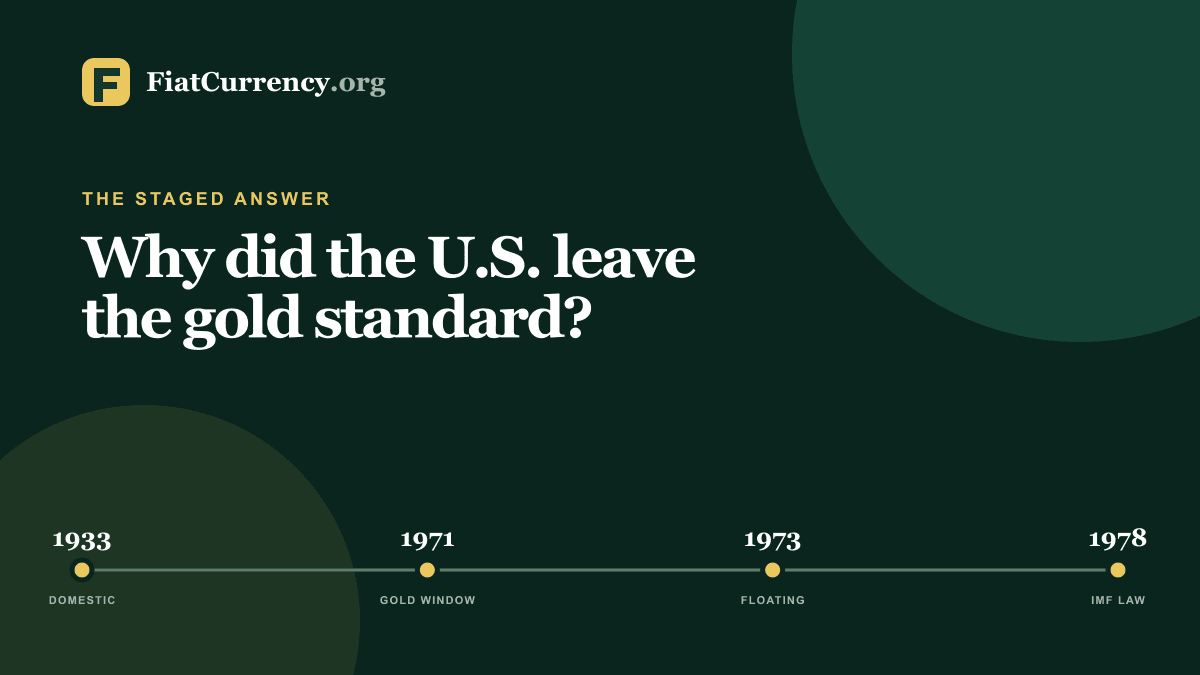
The dates that answer different questions
One transition, four institutional breaks
- 1933–34Ordinary domestic dollar-to-gold redemption ended.
- 1971Official foreign dollar-to-gold conversion was suspended.
- 1973The major currencies moved toward generalized floating.
- 1976–78IMF reforms legally consolidated the post-Bretton Woods order.
The short answer: 1933, 1971, or 1973?
All three dates matter because “the gold standard” can mean different institutional arrangements.
| Date | What changed | What did not change |
|---|---|---|
| March–April 1933 | Domestic gold payments, exports, and private monetary gold use were sharply restricted; ordinary redemption was suspended | The dollar retained an official gold definition and gold remained central to international monetary policy |
| January 30, 1934 | Gold Reserve Act transferred Federal Reserve monetary gold to the Treasury and entrenched nonredemption domestically | The United States still valued the dollar in gold and later used gold convertibility internationally |
| January 31, 1934 | Roosevelt fixed the official gold price at $35 per ounce, devaluing the dollar relative to gold | International gold relationships continued |
| March 1968 | London Gold Pool collapsed and a two-tier gold market emerged | Official monetary gold transactions continued at the official price |
| August 15, 1971 | Nixon suspended official convertibility of dollars into gold | Governments initially tried to preserve fixed exchange rates |
| December 1971 | Smithsonian Agreement realigned parities | Gold convertibility was not restored |
| March 1973 | Major currencies shifted toward generalized floating | Gold remained a reserve asset held by central banks |
| January 1976–April 1978 | Jamaica reforms and IMF Second Amendment formalized the new exchange-rate framework and reduced gold’s official IMF role | Gold remained a major reserve asset and market commodity |
This staged answer is not semantic hair-splitting. It is necessary to understand what rights different holders possessed, what governments were trying to defend, and why the crises of 1933 and 1971 were fundamentally different.
What was the U.S. gold standard?
A gold standard is not simply a monetary system in which a government owns gold. A meaningful gold standard normally includes a legally or institutionally defined relationship between the monetary unit and a specified quantity of gold. Depending on the period, that relationship may involve gold coin, bullion redemption, reserve requirements, or official international conversion.
Several concepts must be separated.
Gold coin standard
Under a full gold coin standard, gold coins circulate and the monetary unit is legally defined by a quantity of gold. Private holders may be able to convert eligible monetary claims into gold coin.
Gold bullion standard
A country may keep its currency convertible into bullion rather than freely circulating gold coin. Redemption thresholds can be high, making the arrangement more relevant to banks and large institutions than households.
Gold-exchange standard
A country may hold reserves in another currency that is itself convertible into gold. The interwar gold-exchange standard and later Bretton Woods involved layered reserve structures rather than universal direct redemption by every currency holder.
Gold reserve requirement
A central bank can be legally required to hold a minimum quantity of gold against notes or deposits even when ordinary citizens do not possess an enforceable right to redeem those liabilities for gold. A reserve requirement is therefore not identical to convertibility.
Fixed exchange rate
A government can peg its currency to another currency without promising redemption into gold. After August 1971, governments briefly attempted to preserve fixed exchange rates even though the dollar’s gold window had been closed. This is why the Smithsonian Agreement matters.
Market exchangeability for gold
Modern dollars can be exchanged for gold at market prices. That does not make the dollar gold-backed. A gold standard involves a fixed legal or policy conversion relationship; the ability to buy gold in a market at a changing price is different.
How the United States moved toward a gold standard
The early United States began with bimetallism, not a simple gold-only regime. The Coinage Act of 1792 defined the dollar in relation to both silver and gold. Because market prices of the two metals moved relative to the legal mint ratio, one metal or the other could disappear from circulation. Changes to coinage law in 1834 and later years altered the effective relationship between gold and silver.
The Civil War broke ordinary specie convertibility for federal paper money. United States Notes, or greenbacks, circulated without immediate specie redemption. The Specie Payment Resumption Act of 1875 provided for resumption, which occurred in 1879. The Gold Standard Act of 1900 then formally declared the gold dollar the standard unit of value.
This background matters for two reasons. First, the United States had already experienced nonconvertible paper money before the twentieth century. Second, “gold standard” institutions had repeatedly been adjusted, suspended, or redefined. The system abandoned in 1933 was not a timeless monetary constitution.
The Federal Reserve and gold before the Great Depression
The Federal Reserve Act of 1913 embedded gold constraints into the new central bank. Federal Reserve notes were subject to collateral and gold-reserve requirements. Those rules were intended both to support confidence in convertibility and to limit note issuance.
But the new central bank also developed tools that could conflict with the external discipline of gold. In the 1920s, the Federal Reserve learned to use open-market operations to influence interest rates and credit conditions. Easier U.S. credit could support domestic activity and help foreign countries maintain gold parities, while tighter U.S. policy could attract gold and transmit contraction abroad. (Federal Reserve History: The Fed’s Formative Years)
The gold standard therefore did not eliminate monetary policy. It constrained and internationalized it.
Why gold became a problem during the Great Depression
The Great Depression transformed a monetary constraint into an emergency.
Banking panics and internal gold pressure
As banks failed, depositors withdrew cash. Fear could then spread from banks to the currency itself. If the public expected devaluation or suspension of gold payments, holders had an incentive to convert dollars into gold while they still could.
Britain’s departure from gold in 1931
Britain left gold on September 21, 1931. Federal Reserve History notes that this intensified concern that the United States might also suspend convertibility. Foreigners converted dollar assets into gold, producing an external drain at the same time U.S. depositors were withdrawing currency from banks. (Federal Reserve History: Banking Panics of 1931–33)
Deflation
The monetary contraction of the early 1930s reduced prices and nominal incomes. Deflation increased the real burden of debts, weakened balance sheets, and intensified bankruptcies. Federal Reserve History describes the gold standard as a channel through which deflationary pressure was transmitted internationally. (Federal Reserve History: Banking Panics of 1930–31)
The policy conflict
Defending gold could require higher interest rates or tighter credit to discourage outflows and attract reserves. Supporting banks and reflating a collapsing economy could require the opposite. The Federal Reserve’s Great Depression history explicitly identifies this conflict: some policymakers preferred defending gold even when expansionary measures might have supported banks and countered deflation. (Federal Reserve History: The Great Depression)
The Roosevelt administration’s gold policy emerged from this collision between domestic stabilization and external convertibility.
March 1933: the banking holiday and emergency powers
Franklin Roosevelt took office on March 4, 1933 amid a nationwide banking crisis. On March 6 he proclaimed a bank holiday. Congress enacted the Emergency Banking Act on March 9, expanding executive authority over banking and gold movements.
Federal Reserve History states that the act increased presidential monetary powers and, together with related actions, took Federal Reserve notes off ordinary gold redemption. (Federal Reserve History: Emergency Banking Act of 1933)
The immediate purpose was not abstract monetary theory. Policymakers were trying to stop banking runs, gold exports, currency hoarding, and a feedback loop that threatened both the banking system and the gold reserve.
Executive Order 6102: what it actually did
On April 5, 1933, Roosevelt issued Executive Order 6102, “Forbidding the Hoarding of Gold Coin, Gold Bullion and Gold Certificates.” The order required delivery of covered gold to Federal Reserve banks, branches, agencies, or member banks by a specified date. (American Presidency Project: Executive Order 6102)
The common claim that Roosevelt simply “confiscated all gold” is inaccurate.
The order contained explicit exemptions. FRASER’s contemporary Federal Reserve circular reproduces exemptions for:
- legitimate and customary industrial, professional, and artistic uses;
- gold coin and gold certificates up to an aggregate $100 per person;
- gold coins with recognized special value to collectors of rare and unusual coins;
- gold held in trust for recognized foreign governments, foreign central banks, or the Bank for International Settlements; and
- licensed transactions not involving prohibited hoarding. (FRASER: April 5, 1933 Executive Order circular)
The policy was coercive and legally significant, but its scope must be described precisely. The government regulated monetary gold, compelled delivery in many cases, compensated holders in dollars under the prevailing rules, and retained exemptions and licensing channels.
April 20, 1933: formal suspension of gold exports and redemption
Roosevelt’s gold program was not a single executive order. On April 20, 1933, the administration prohibited exports of gold and prohibited the Treasury and financial institutions from converting currency and deposits into gold coin or ingots. Federal Reserve History treats this as the formal suspension of the gold standard during the first phase of Roosevelt’s program. (Federal Reserve History: Roosevelt’s Gold Program)
This is one reason an article that dates the whole transition only to April 5 is incomplete.
The Gold Reserve Act of 1934
Congress enacted the Gold Reserve Act on January 30, 1934. The statute’s text transferred to the United States all right, title, and interest of the Federal Reserve Board, Federal Reserve Banks, and Federal Reserve agents in gold coin and bullion. It also changed the redemption language for Federal Reserve notes so that they were redeemable in “lawful money” rather than guaranteeing gold redemption. (Gold Reserve Act of 1934, 48 Stat. 337)
Federal Reserve History identifies several major effects:
- Monetary gold was centralized in the U.S. Treasury.
- The domestic redemption system was inverted: financial institutions and the Treasury no longer generally redeemed dollars for gold.
- The revaluation of gold created an accounting gain used in part to capitalize the Exchange Stabilization Fund.
- The official gold price was raised to $35 per ounce, reducing the gold content of the dollar relative to the previous $20.67 parity. (Federal Reserve History: Gold Reserve Act of 1934)
Was the dollar fiat after 1933?
For ordinary domestic holders, the post-1933 dollar had a strong fiat character because holders no longer possessed a general right to exchange ordinary currency for a fixed quantity of gold. But it is misleading to say that “America went completely fiat in 1933” without qualification.
The dollar still had an official gold value. Gold remained central to U.S. international monetary policy. Foreign official institutions retained special relationships with U.S. gold, and after World War II the dollar became the gold-convertible anchor of Bretton Woods.
The correct classification depends on which layer of the monetary system is being discussed:
| Layer | After 1934 |
|---|---|
| Ordinary domestic holder | No general gold redemption right |
| Federal Reserve / Treasury relationship | Gold certificates and statutory reserve structures remained important |
| International official monetary system | Gold remained central |
| Private gold market | Heavily restricted domestically for decades |
Thus, 1933–1934 was the decisive domestic transition, not the final disappearance of gold from every monetary relationship.
Why the $35 gold price mattered
On January 31, 1934, Roosevelt fixed the official price of gold at $35 per troy ounce. Compared with the earlier official parity of approximately $20.67, this represented a substantial devaluation of the dollar against gold.
Revaluation had several effects. It increased the dollar value of the government’s gold stock, supported reflation by raising the domestic dollar price of gold, and changed the international price relationship of the dollar. But it did not restore ordinary domestic convertibility.
The $35 figure later became the central gold price of the Bretton Woods system, which is why it appears both in 1930s U.S. history and in the crisis of 1971.
What happened to gold reserve requirements after 1934?
Another common confusion is to treat statutory gold-reserve requirements as identical to redemption.
Federal Reserve notes originally had to be backed by specified collateral and subject to gold-reserve constraints. Over time, Congress loosened those requirements. Federal Reserve History notes that the limit tying Federal Reserve note issuance to gold holdings was increased in 1945 and eliminated in 1968. (Federal Reserve History: Cash Services)
This matters because the monetary system could become less dependent on statutory gold reserves even before the international gold window closed in 1971.
Bretton Woods: not the classical gold standard
Delegates from 44 countries met at Bretton Woods, New Hampshire, in July 1944 to design a postwar monetary order. They created the International Monetary Fund and the institution that became the World Bank. (Federal Reserve History: Creation of Bretton Woods)
The resulting system was not a return to the nineteenth-century classical gold standard. Instead:
- countries maintained fixed-but-adjustable exchange rates against the U.S. dollar;
- the dollar was defined in relation to gold at the official price;
- official foreign monetary authorities could convert eligible dollar balances into U.S. gold;
- domestic citizens generally could not demand gold for dollars;
- capital controls and exchange restrictions remained common;
- the IMF provided financing and surveillance to support balance-of-payments adjustment.
By 1958, when major European currencies restored current-account convertibility, Bretton Woods became fully operational in the form usually associated with the postwar dollar-gold system. Federal Reserve History describes international balances being settled in dollars, with dollars officially convertible into gold at $35 per ounce. (Federal Reserve History: Creation of Bretton Woods)
Who could actually redeem dollars for gold before 1971?
The phrase “Nixon stopped Americans from redeeming dollars for gold in 1971” is wrong. Ordinary American redemption had been radically curtailed in the 1930s.
Immediately before the gold window closed, redemption was principally an official international privilege.
| Holder | Could normally demand Treasury gold for dollars immediately before August 1971? | Explanation |
|---|---|---|
| Ordinary U.S. citizen | No | Domestic redemption had ended decades earlier |
| U.S. business | No general right | Buying gold in markets was not the same as Treasury conversion |
| U.S. commercial bank | No ordinary public redemption right | Banks settled through the monetary system, not through citizen-style gold redemption |
| Foreign tourist | No | Holding dollars did not create an official conversion privilege |
| Foreign private company | No automatic official right | Private dollar holdings were not equivalent to central-bank claims |
| Foreign central bank | Yes, through official channels | This was the core gold-window relationship |
| Foreign government / monetary authority | Yes, subject to official arrangements | Bretton Woods depended on this official convertibility |
| IMF and certain official institutions | Special status | Governed by international monetary rules |
This is the essential distinction between 1933 and 1971.
The structural problem: the Triffin dilemma
Bretton Woods required the United States to perform two roles that could conflict.
The world needed dollars for reserves, trade, intervention, and international payments. Supplying those dollars meant the United States had to allow dollars to flow abroad through deficits, investment, military spending, aid, and financial transactions. But the more dollar claims accumulated outside the United States, the less credible it became that every official holder could convert those claims into a limited U.S. gold stock at $35 per ounce.
Federal Reserve History describes this as the Triffin dilemma: the reserve-currency issuer must supply international liquidity, but persistent deficits can undermine confidence in the reserve currency’s convertibility. (Federal Reserve History: Gold Convertibility Ends)
The logic can be summarized:
World demands dollar reserves
        ↓
United States supplies dollars abroad
        ↓
Foreign official dollar claims increase
        ↓
Claims grow relative to U.S. monetary gold
        ↓
Confidence in $35 convertibility weakens
        ↓
Conversion and devaluation pressure rises
This structural problem existed before the final crisis of 1971. It is one reason no single spending program can explain Bretton Woods’ collapse.
The London Gold Pool
In 1961, the United States and several European central banks formed the London Gold Pool to help maintain the market price of gold near the official $35 price. Participating authorities coordinated gold sales and purchases in London.
The arrangement bought time but did not eliminate the underlying tension between the official gold price and market demand. Pressure intensified during the 1960s. France withdrew from active cooperation, sterling was devalued in 1967, and speculative demand for gold surged.
In March 1968, the London Gold Pool collapsed. Authorities then adopted a two-tier gold market: official monetary transactions would continue at the official price while private-market gold would trade at market prices. Federal Reserve History treats this as another temporary repair before the closing of the gold window. (Federal Reserve History: Gold Convertibility Ends)
Why 1968 matters
The 1968 two-tier arrangement demonstrated that the official $35 price could no longer govern the entire gold market. The system increasingly depended on separating official monetary gold from private-market gold.
This was a warning that Bretton Woods had become institutionally fragile. The system remained legally and diplomatically alive, but maintaining it required swap lines, official restraint, capital measures, and coordinated interventions.
U.S. balance-of-payments pressure
The United States supplied dollars abroad through multiple channels:
- military expenditure overseas;
- foreign aid;
- private investment;
- purchases of foreign goods and services;
- bank lending and capital flows.
The Office of the Historian notes that by the 1960s a surplus of dollars abroad, generated through foreign aid, military spending, and foreign investment, threatened the system because U.S. gold was insufficient to cover the worldwide dollar stock at the official price. (U.S. Department of State, Office of the Historian)
That statement should not be interpreted to mean that every dollar had ever been literally “100 percent gold backed.” Bretton Woods was a confidence and convertibility system, not a warehouse-receipt system in which every bank deposit had a segregated bar of gold.
The overvalued dollar
As U.S. inflation accelerated relative to some trading partners, the fixed dollar parities became increasingly difficult to sustain. An overvalued dollar made U.S. exports less competitive and encouraged expectations that exchange rates would eventually have to change.
Those expectations could become self-reinforcing. If investors expected a devaluation, they had an incentive to sell dollars before the adjustment. Foreign central banks defending their own exchange rates then accumulated more dollars, increasing official dollar claims on the United States.
Inflation before the Nixon shock
The Great Inflation did not begin on August 15, 1971. Federal Reserve History dates the broader Great Inflation from 1965 to 1982. Inflation had been rising for years before the gold window closed. (Federal Reserve History: Inflation)
The Smithsonian Agreement history notes that U.S. inflation rose from under 2 percent in early 1965 to about 6 percent by the end of 1969. (Federal Reserve History: Smithsonian Agreement)
This chronology is important. Ending gold convertibility may have changed later policy constraints, but it cannot explain inflation that was already underway.
Did the Vietnam War end Bretton Woods?
The Vietnam War contributed to fiscal and external pressure, but “Vietnam ended the gold standard” is too simple.
Military expenditure abroad sent dollars overseas. Wartime spending also contributed to domestic demand alongside Great Society programs and private credit growth. Yet the Bretton Woods system’s structural contradiction predated peak Vietnam spending, and foreign aid, private investment, trade flows, monetary policy, and the reserve-currency role all mattered.
A useful causal ranking is:
| Claimed cause | Role | Assessment |
|---|---|---|
| Vietnam War | Contributing fiscal and external pressure | Important, not sufficient alone |
| Great Society spending | Added domestic demand and budget pressure | Contributing factor, not a complete explanation |
| Foreign aid | Supplied dollars abroad | Relevant but only one channel |
| Private overseas investment | Supplied dollars abroad | Important component of external payments |
| U.S. inflation | Weakened fixed parity credibility | Major factor |
| Dollar overvaluation | Hurt trade position and encouraged realignment expectations | Major factor |
| Speculation | Accelerated the crisis | Trigger/amplifier, not root cause |
| Triffin dilemma | Structural conflict between liquidity provision and convertibility | Fundamental systemic factor |
| “Money printing” | Vague shorthand | Inadequate unless disaggregated into fiscal, monetary, credit, and balance-of-payments mechanisms |
The strongest historical explanation is multicausal.
Kennedy and Johnson tried to preserve Bretton Woods
The United States did not passively wait for the system to fail. The Kennedy and Johnson administrations used capital controls, foreign investment restraints, balance-of-payments programs, diplomatic coordination, gold-pool intervention, and later central-bank swap lines to defend the dollar.
The Office of the Historian summarizes these attempts as efforts to restrain foreign investment and lending, stem official dollar outflows, reform the international monetary system, and coordinate with other countries. It concludes that these measures did not solve the underlying problem. (U.S. Department of State, Office of the Historian)
Federal Reserve swap lines
Beginning in 1962, the Federal Reserve developed reciprocal currency arrangements with foreign central banks. These swap lines allowed central banks to obtain foreign currency and temporarily absorb unwanted dollar balances without immediately converting those dollars into U.S. gold.
Federal Reserve History describes the swaps as a major mechanism for defending the U.S. gold stock during the 1960s. The network expanded over the decade but could only postpone the deeper adjustment problem. (Federal Reserve History: Gold Convertibility Ends)
The crisis of 1971
By 1971, markets increasingly expected a dollar realignment. Dollar selling intensified. Foreign central banks accumulated dollars as they intervened to maintain fixed exchange rates, and official holders had incentives to convert dollars into gold before a devaluation or suspension.
The Office of the Historian describes a run on the dollar and evidence that the overvalued dollar was damaging the U.S. trading position as the immediate pressures that pushed Nixon toward action. (U.S. Department of State, Office of the Historian)
Federal Reserve History likewise emphasizes both a looming gold run and domestic inflation. (Federal Reserve History: Gold Convertibility Ends)
August 13–15, 1971: Camp David
Nixon gathered top economic advisers at Camp David from August 13 to August 15, 1971. Participants included Treasury Secretary John Connally, Federal Reserve Chairman Arthur Burns, and Treasury official Paul Volcker.
The resulting program was broader than gold. Nixon’s administration wanted to address unemployment, inflation, trade pressure, and the balance of payments simultaneously.
What Nixon announced on August 15, 1971
Nixon’s New Economic Policy included:
- suspension of dollar convertibility into gold and other reserve assets;
- a temporary 10 percent import surcharge;
- a 90-day wage and price freeze;
- tax proposals and investment incentives;
- a political commitment to defend the dollar and improve U.S. competitiveness.
The 1972 Economic Report of the President describes the program as suspending dollar convertibility, imposing a temporary import surcharge, freezing wages and prices, and proposing fiscal measures. (Economic Report of the President, 1972)
The gold suspension was presented as temporary. It became permanent.
What exactly was the “gold window”?
The gold window was the official channel through which eligible foreign monetary authorities could convert dollar reserves into U.S. gold at the official price.
Closing it did not mean:
- Americans suddenly lost a redemption right they had exercised until the previous day;
- private holders could no longer buy gold in any market;
- all fixed exchange rates instantly ended;
- gold ceased to be held by central banks;
- the dollar instantly became a freely floating currency.
It meant that the United States would no longer honor the Bretton Woods official conversion commitment.
Was Nixon’s action simply “taking America off the gold standard”?
That phrase is acceptable shorthand only if immediately qualified.
For domestic monetary history, the decisive break had occurred in 1933–1934. For the international Bretton Woods system, August 15, 1971 was decisive because it ended the dollar’s official gold convertibility. For the exchange-rate regime, March 1973 is equally important because fixed parities persisted after the gold window closed.
The Smithsonian Agreement
In December 1971, the Group of Ten negotiated a new set of fixed exchange rates at the Smithsonian Institution in Washington. The dollar was devalued, other currencies were revalued, and exchange-rate bands were widened.
The agreement did not reopen the gold window. Instead, it tried to preserve a fixed-rate system without restoring the old convertibility promise.
Federal Reserve History notes that inflation, balance-of-payments deficits, and speculation had made the old parities unsustainable, and that the Smithsonian arrangement was an attempted rescue. (Federal Reserve History: Smithsonian Agreement)
Why the Smithsonian Agreement failed
The revised parities did not eliminate the underlying disequilibrium. U.S. inflation persisted, capital flows remained large, and markets continued to test official exchange rates.
In February 1973, the dollar was devalued again. A few weeks later, speculative pressure resumed. Governments then abandoned the attempt to preserve the old structure.
Why March 1973 matters as much as August 1971
The Office of the Historian states that in March 1973 the Group of Ten accepted an arrangement in which major European currencies jointly floated against the dollar, effectively signaling the abandonment of the Bretton Woods fixed-exchange-rate system. (U.S. Department of State, Office of the Historian)
This produces a clearer chronology:
- 1971: the gold-conversion promise ended;
- 1971–1973: governments tried to preserve revised fixed exchange rates;
- 1973: generalized floating replaced the failed parities.
That distinction is essential to understanding the modern monetary order.
Jamaica and the IMF Second Amendment
The new system initially existed as practice before international law fully caught up.
At the IMF Interim Committee meeting in Kingston, Jamaica, in January 1976, members reached agreement on reforms that included new rules for exchange arrangements and gold. The IMF’s 1976 annual report records the Jamaica decisions and the plan to sell and restitute portions of IMF gold. (IMF Annual Report 1976)
The IMF’s Second Amendment took effect in April 1978. IMF historical material states that it eliminated gold’s former monetary role within the Fund, allowed members to choose exchange arrangements other than pegging to gold, and strengthened IMF surveillance over exchange-rate policies. (IMF, Silent Revolution, chapter 1)
“Demonetization of gold” in this context did not mean gold became worthless or that central banks stopped owning it. It meant gold ceased to occupy its former legally privileged role in the IMF’s exchange-rate and settlement framework.
What replaced the gold standard?
No single asset replaced gold. The modern system is institutional rather than commodity-redeemable.
Its main components include:
- central-bank notes and reserve balances;
- commercial-bank deposits;
- government securities used as reserve and liquidity assets;
- policy interest rates;
- open-market operations and central-bank lending facilities;
- floating, managed, pegged, and currency-board exchange-rate regimes;
- foreign-exchange intervention;
- IMF reserve assets and emergency financing;
- deep sovereign-debt and money markets;
- deposit insurance and bank regulation;
- explicit or implicit inflation objectives.
The modern dollar is therefore not “backed by nothing” in the sense of having no institutional support. It is simply not contractually redeemable for a fixed quantity of gold. See FiatCurrency.org’s companion research, What Backs the U.S. Dollar Today?, for the modern institutional structure.
Did leaving gold cause the Great Inflation?
The timeline rules out the simplest version of the claim. U.S. inflation was already rising substantially during the 1960s. The Great Inflation is conventionally dated from 1965, six years before Nixon closed the gold window. (Federal Reserve History: Inflation)
After 1971, inflation continued and later intensified. Contributing factors included monetary policy, fiscal policy, wage and price dynamics, oil and food shocks, expectations, and productivity developments. The 1973–1974 oil shock was a major additional disturbance after the transition to floating rates. (U.S. Department of State: Oil Embargo, 1973–1974)
A defensible conclusion is that ending gold convertibility changed the monetary regime and removed a particular external constraint, but it did not single-handedly create the inflation of the 1970s.
Did leaving gold cause modern inequality?
Charts circulating online often place a vertical line at 1971 beside long-run series for wages, productivity, housing, debt, inequality, college costs, or social indicators. Such charts can be useful prompts for questions, but the date line does not establish causation.
A rigorous test requires at least eight questions:
- Does the series actually break in 1971 rather than earlier or later?
- Is the series nominal or inflation-adjusted?
- Did its statistical methodology change?
- Is 1971 selected because it visually fits the graph?
- Is there a plausible mechanism from gold convertibility to the measured outcome?
- Do comparable countries show the same timing?
- Are alternative explanations stronger?
- Does the trend persist when different datasets or endpoints are used?
Many post-1971 changes are real. What is usually unproven is the claim that the closing of the gold window was their dominant cause.
Did oil pricing replace gold backing?
No. The dollar’s role in international oil trade increased global demand for dollar balances and dollar assets, but oil was not a redemption asset. Holders of dollars could not present them to the U.S. government and demand a fixed quantity of petroleum.
The petrodollar system is therefore about invoicing, financial intermediation, reserve recycling, and geopolitical relationships—not commodity backing in the gold-standard sense. The separate petrodollar agreement audit owns that documentary history and the alleged 2024 expiration claim.
Did the U.S. “run out of gold”?
No. The United States retained a large gold stock before and after 1971. The problem was the relationship between official dollar claims and the gold available at the fixed official price.
A country can possess substantial gold and still find a fixed conversion promise unsustainable if outstanding claims grow faster than reserves or if markets expect parity to change.
The phrase “ran out of gold” obscures this balance-sheet and credibility problem.
Was every dollar fully backed by gold before 1971?
No. Under both the classical gold standard and Bretton Woods, money and credit systems were fractional and layered. Bank deposits were private bank liabilities. Central-bank notes and reserves operated under reserve and convertibility rules, but there was not one dollar’s worth of earmarked gold for every dollar-denominated claim in the economy.
Gold standards constrain convertibility and monetary policy; they do not require a one-for-one warehouse reserve against every broad-money unit.
Was a gold standard immune to inflation?
No. Gold discoveries, changes in the monetary demand for gold, banking expansion, changes in reserve practices, and shifts in velocity can all affect prices under metallic systems. Gold standards can experience both inflation and deflation.
The nineteenth century included long periods of price decline as well as inflationary episodes. A gold standard changes the monetary adjustment mechanism; it does not freeze the price level permanently.
Could the United States return to a gold standard?
In a purely legal sense, Congress could attempt to create a new gold-convertibility regime. But “returning to gold” would require many choices that slogans often omit.
Policymakers would need to define:
- the gold parity;
- who has the right to redeem;
- which monetary liabilities are covered;
- whether bank deposits are indirectly or directly convertible;
- reserve requirements;
- how parity would be defended during capital outflows;
- what happens in banking crises;
- whether convertibility can be suspended;
- how fiscal deficits interact with reserve loss;
- whether international coordination is required.
The chosen gold price would matter enormously. A very low legal gold price relative to outstanding monetary liabilities could make convertibility noncredible; a very high price would imply a major one-time change in the dollar value of gold and wealth distribution.
Returning to gold is therefore an institutional redesign, not simply a declaration that the dollar is “backed” by the gold already at Fort Knox.
Which gold standard ended? A classification matrix
| Feature | 1933–1934 | 1968 | 1971 | 1973 | 1976–1978 |
|---|---|---|---|---|---|
| Ordinary domestic gold redemption | Ended | Already absent | Already absent | Absent | Absent |
| Private monetary gold use | Heavily restricted | Restrictions still relevant | Restrictions easing historically, but no redemption | No redemption | No redemption |
| Federal Reserve note gold-reserve requirement | Still evolving | Eliminated | Absent | Absent | Absent |
| Official foreign dollar-gold conversion | Retained / later institutionalized | Retained | Suspended | Absent | Superseded by IMF reform |
| Fixed exchange rates | Not the central 1933 issue | Bretton Woods continued | Temporarily continued | Generalized floating | Multiple regimes formally accepted |
| Official IMF monetary role for gold | Not yet applicable | Central | Weakened | Weakened | Formally reduced by Second Amendment |
| Best description | Domestic break | Gold-market fracture | International convertibility break | Exchange-rate regime break | Legal-institutional consolidation |
1933 versus 1971: two different crises
| Dimension | 1933 | 1971 |
|---|---|---|
| Immediate setting | Great Depression and banking panic | Bretton Woods reserve and exchange-rate crisis |
| Main redemption affected | Domestic | Official international |
| Main threat | Bank runs, gold outflows, deflation, monetary contraction | Foreign dollar claims, overvaluation, inflation, speculation |
| President | Franklin D. Roosevelt | Richard Nixon |
| Key legal/policy action | Banking emergency measures, gold controls, Gold Reserve Act | Suspension of official gold conversion |
| Dollar-gold price | Devalued to $35/oz | $35 parity became untenable |
| Exchange-rate aftermath | Dollar devaluation within a gold-linked world | Smithsonian repair, then generalized floating |
| Long-run result | Domestic fiat-like dollar with continuing official gold role | End of Bretton Woods dollar-gold convertibility |
A forty-milestone timeline
- 1792 — Coinage Act establishes the U.S. mint and a bimetallic monetary framework.
- 1834 — Congress changes the legal gold-silver ratio, increasing gold’s monetary role.
- 1862 — Legal Tender Acts authorize nonconvertible United States Notes during the Civil War.
- 1875 — Specie Payment Resumption Act provides for resumption.
- 1879 — Specie payments resume.
- 1900 — Gold Standard Act formally establishes gold as the standard monetary unit.
- 1913 — Federal Reserve Act creates the Federal Reserve and embeds gold-reserve rules.
- 1914 — Federal Reserve notes begin circulation.
- 1925 — Britain returns to gold at the prewar parity.
- September 21, 1931 — Britain leaves the gold standard.
- March 4, 1933 — Franklin Roosevelt takes office amid banking crisis.
- March 6, 1933 — Roosevelt proclaims a national bank holiday.
- March 9, 1933 — Emergency Banking Act expands executive powers over gold and banking.
- April 5, 1933 — Executive Order 6102 restricts hoarding and requires delivery of covered gold, with exemptions.
- April 20, 1933 — Roosevelt suspends gold exports and ordinary conversion into gold.
- May 1933 — Thomas Amendment expands authority to alter the dollar’s gold content.
- June 5, 1933 — Congress nullifies many gold clauses in public and private obligations.
- August 28, 1933 — Executive Order 6260 replaces earlier gold-hoarding orders with a revised regulatory framework.
- January 30, 1934 — Gold Reserve Act becomes law.
- January 31, 1934 — Official gold price is fixed at $35 per ounce.
- 1934 — Exchange Stabilization Fund is established.
- July 1944 — Bretton Woods conference creates the postwar monetary framework.
- 1945 — Federal Reserve note gold-reserve constraint is loosened.
- 1958 — Major European currencies restore current-account convertibility, making Bretton Woods fully operational.
- 1961 — London Gold Pool begins coordinated intervention.
- 1962 — Federal Reserve establishes modern central-bank swap lines.
- 1965 — Great Inflation period begins in standard Federal Reserve chronology.
- 1967 — Sterling is devalued.
- March 1968 — London Gold Pool collapses.
- March 1968 — Two-tier gold market separates official and private gold transactions.
- 1968 — Remaining statutory gold-reserve requirement for Federal Reserve notes is eliminated.
- 1969 — IMF creates Special Drawing Rights, partly addressing reserve-liquidity concerns.
- May 1971 — Renewed currency pressure exposes the fragility of parities.
- August 13–15, 1971 — Nixon’s advisers meet at Camp David.
- August 15, 1971 — Nixon suspends dollar convertibility into gold and announces the New Economic Policy.
- December 1971 — Smithsonian Agreement realigns fixed exchange rates.
- February 1973 — Dollar is devalued again.
- March 1973 — Major currencies move toward generalized floating.
- January 1976 — Jamaica Agreement establishes the basis for IMF reform of exchange arrangements and gold.
- April 1978 — IMF Second Amendment takes effect, formally consolidating the post-Bretton Woods framework.
Common myths: claim versus evidence
Myth 1: “The United States left the gold standard in 1971.”
Evidence: Only partly correct. Domestic redemption had already been dismantled in 1933–1934. 1971 ended the remaining official international conversion channel.
Myth 2: “The United States left the gold standard in 1933.”
Evidence: Correct for ordinary domestic convertibility, incomplete for the international monetary system. Gold remained central to the dollar’s official international role.
Myth 3: “Nixon made the dollar fiat overnight.”
Evidence: The domestic dollar already operated without ordinary gold redemption. Nixon ended official foreign conversion; fixed exchange rates survived temporarily.
Myth 4: “Roosevelt confiscated every piece of privately owned gold.”
Evidence: Executive Order 6102 contained exemptions for small holdings, recognized rare coins, industrial/professional uses, and specified official foreign holdings.
Myth 5: “Every dollar was backed one-for-one by gold.”
Evidence: False. Gold standards operated with layered bank and central-bank liabilities. Broad money was never simply a warehouse receipt for an equal gold quantity.
Myth 6: “Any American could redeem dollars for Treasury gold until August 1971.”
Evidence: False. Ordinary domestic redemption had ended decades earlier.
Myth 7: “The Vietnam War alone ended Bretton Woods.”
Evidence: Vietnam contributed to external and fiscal pressure, but inflation, private investment, reserve-currency demand, dollar overvaluation, capital flows, and the Triffin dilemma were also important.
Myth 8: “The Great Society alone destroyed the gold standard.”
Evidence: Domestic spending contributed to inflationary and fiscal conditions but cannot explain the international reserve structure by itself.
Myth 9: “Speculators destroyed Bretton Woods.”
Evidence: Speculation accelerated the crisis because market participants anticipated devaluation. It was an amplifier of underlying disequilibrium.
Myth 10: “The United States ran out of gold.”
Evidence: The United States retained substantial gold. The problem was maintaining convertibility at the fixed official price relative to outstanding official dollar claims.
Myth 11: “The Smithsonian Agreement restored Bretton Woods.”
Evidence: It temporarily repaired fixed exchange rates but did not restore gold convertibility, and it failed within fifteen months.
Myth 12: “Floating exchange rates began on August 15, 1971.”
Evidence: Exchange rates moved during the crisis, but governments attempted a new fixed-parity system in December 1971. Generalized floating followed in 1973.
Myth 13: “All 1970s inflation was caused by leaving gold.”
Evidence: Inflation had already risen sharply during the 1960s, before the gold window closed. Later oil and commodity shocks, expectations, and monetary and fiscal policy also mattered.
Myth 14: “Everything economically bad after 1971 was caused by the Nixon shock.”
Evidence: Temporal coincidence is not causal identification. Each series requires its own mechanism, counterfactual, and cross-country evidence.
Myth 15: “The petrodollar replaced gold backing.”
Evidence: Oil invoicing created demand for dollars but no fixed redemption right into oil. See the petrodollar document record for the 1974–75 agreements and recycling system.
Myth 16: “Central-bank gold still secretly backs the dollar.”
Evidence: Gold is a reserve asset, not an enforceable redemption asset for modern dollar holders.
Myth 17: “A gold standard prevents banking crises.”
Evidence: The United States suffered recurrent banking panics while operating under gold-linked systems, including the crises that culminated in 1933.
Myth 18: “Gold-backed money cannot inflate.”
Evidence: Metallic systems can experience inflation when gold supply, bank credit, reserve practices, and monetary demand change.
Myth 19: “Returning to gold just means using the gold already in Fort Knox.”
Evidence: A workable gold standard requires a legal parity, redemption rules, reserve policy, crisis rules, and a relationship to the banking system.
Myth 20: “1971 ended gold’s monetary importance.”
Evidence: Gold remained a major central-bank reserve asset and continued to influence international portfolios even after its formal convertibility role ended.
Quick reference
Frequently asked questions
Concise answers to the main questions about Roosevelt, Nixon, Bretton Woods, gold ownership, inflation, and a possible return to gold.
When did the United States leave the gold standard?
For domestic holders, the decisive break occurred in 1933–1934. Official international dollar-gold convertibility ended on August 15, 1971. Major fixed exchange rates collapsed in 1973.
Why did the United States leave the gold standard?
Because gold convertibility increasingly conflicted with domestic banking stability and recovery in 1933, and later with the sustainability of the Bretton Woods reserve system, U.S. inflation, balance-of-payments deficits, and the fixed $35 parity in 1971.
Did Roosevelt or Nixon end the gold standard?
Both, at different institutional levels. Roosevelt dismantled ordinary domestic convertibility. Nixon suspended official international convertibility.
What happened on April 5, 1933?
Roosevelt issued Executive Order 6102, restricting the hoarding of gold coin, bullion, and certificates and requiring delivery of covered holdings subject to exemptions.
Did Executive Order 6102 confiscate all gold?
No. It compelled delivery of many monetary gold holdings but contained explicit exemptions and licensing provisions.
Were gold owners compensated?
Covered holders generally received dollars at the then-prevailing monetary valuation when they delivered gold through the required channels. The later revaluation to $35 per ounce benefited the government’s gold position rather than prior holders who had already surrendered gold.
What did the Gold Reserve Act of 1934 do?
It centralized monetary gold in the Treasury, altered Federal Reserve note redemption rules, and provided the framework for the dollar’s devaluation and the Exchange Stabilization Fund.
Why was gold revalued to $35 per ounce?
The Roosevelt administration sought to devalue the dollar relative to gold and raise domestic prices as part of its reflation strategy.
Was the dollar fiat in 1934?
For ordinary domestic users, it functioned as nonconvertible fiat money. Internationally, however, the dollar retained a formal gold relationship.
What was Bretton Woods?
A postwar system of fixed-but-adjustable exchange rates in which foreign currencies were pegged to the dollar and the dollar was officially convertible into gold for foreign monetary authorities.
Could Americans redeem dollars for gold under Bretton Woods?
Not as ordinary domestic holders. The key conversion right belonged to foreign official monetary authorities.
What was the gold window?
The official mechanism through which eligible foreign monetary authorities could exchange dollar reserves for U.S. gold at the official price.
Why did Nixon close the gold window?
Because the $35 conversion promise was becoming increasingly difficult to sustain amid foreign dollar accumulation, balance-of-payments deficits, inflation, an overvalued dollar, and speculative pressure.
Was Nixon’s gold suspension temporary?
It was presented as a suspension, but convertibility was never restored.
What was the Nixon shock?
The August 15, 1971 New Economic Policy, especially the suspension of gold convertibility, import surcharge, wage-price freeze, and related economic measures.
Did Nixon act because of Vietnam?
Vietnam was a contributing factor but not the sole cause. The Bretton Woods system had structural vulnerabilities and multiple sources of dollar outflow.
What was the Triffin dilemma?
The conflict in which the reserve-currency issuer must supply global liquidity through external deficits while those deficits eventually weaken confidence in the currency’s convertibility.
What was the London Gold Pool?
A coordinated central-bank intervention arrangement established in 1961 to help keep the market gold price near the official $35 price.
Why did the London Gold Pool fail?
Private demand for gold and pressure on official reserves became too great to sustain intervention at the official price.
What was the two-tier gold market?
After March 1968, official monetary transactions continued at the official price while private gold traded at market prices.
What was the Smithsonian Agreement?
A December 1971 agreement that devalued the dollar and reset fixed exchange rates without restoring gold convertibility.
Why did the Smithsonian Agreement fail?
The revised parities did not eliminate inflation, capital-flow pressure, or underlying exchange-rate imbalances.
When did currencies begin floating?
Major currencies moved toward generalized floating in March 1973 after the Smithsonian arrangement failed.
What were the Jamaica Accords?
The 1976 IMF reform agreement that helped establish the legal basis for varied exchange-rate arrangements and reduced gold’s formal IMF monetary role.
When did the IMF Second Amendment take effect?
In April 1978.
Is the U.S. dollar backed by gold today?
No. Dollars are not redeemable for a fixed quantity of gold.
Why does the United States still own gold?
Gold remains a reserve asset with liquidity, diversification, historical, and geopolitical functions. Ownership is not the same as backing currency through redemption.
Did leaving gold create fiat currency?
No. Fiat-like and fiat currencies existed long before 1971, including U.S. greenbacks and historical Chinese paper-money systems.
Did gold prevent inflation before 1971?
No. Gold-linked systems experienced both inflation and deflation.
Did gold prevent government deficits?
No. Governments could borrow, tax, suspend convertibility, or change parity. Gold constrained monetary settlement but did not eliminate fiscal policy.
Could a fiat currency still be pegged?
Yes. A fiat currency can be pegged to another fiat currency without being redeemable for a commodity.
Could the United States legally return to gold?
Congress could attempt to construct a new system, but its feasibility would depend on the parity, redemption rules, reserve structure, banking system, and crisis-management framework.
Evidence control
Claims checked against primary and official sources
The editorial audit maps 18 central claims to statutes, executive orders, Federal Reserve records, State Department history, IMF material, and contemporary reports. Causal interpretations are labeled separately from documentary facts.
Last reviewed: 26 August 2026.