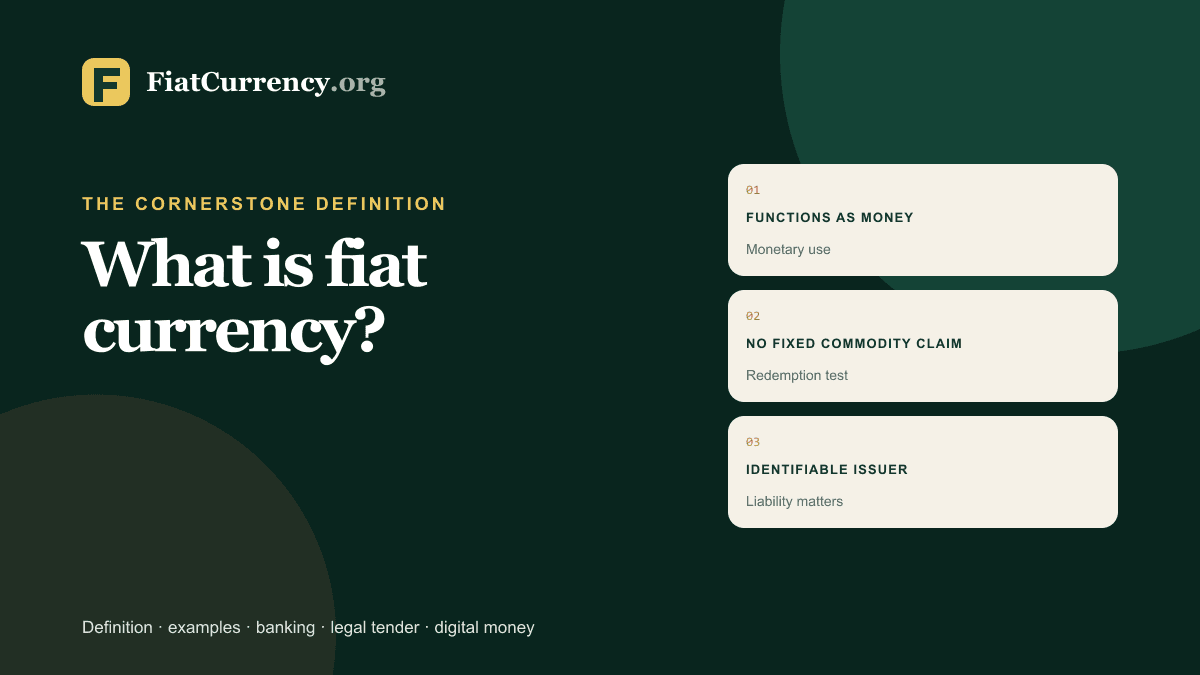
Classification test
What makes a currency fiat?
- 01It functions as money
It acts as a monetary instrument or official settlement asset, not merely something with a market price.
- 02No fixed commodity claim
The holder cannot require the issuer to deliver a fixed quantity of gold, silver, or another external commodity.
- 03The issuer still matters
Direct public money, private bank deposits, stablecoins, and payment interfaces are different legal claims.
Executive summary
“Fiat currency” is often used as though it were a synonym for paper money, government money, legal tender, or every balance shown in a banking application. None of those equivalences is reliable. The decisive historical distinction is commodity convertibility: does the holder have an enforceable right to obtain a fixed quantity of an external commodity from the issuer or monetary authority? When the answer is no, the money may be fiat. The full classification still depends on who issued the claim, what liability it represents, how it settles, and whether it functions as generally accepted money.
Modern economies operate through a monetary hierarchy. Central banks issue physical notes and reserve balances. Treasuries or mints usually issue coins under national law. Commercial banks create deposit liabilities, especially when they lend. Payment cards and applications transmit instructions or provide access to those balances; they are not automatically separate money. Stablecoins are usually private redemption claims against reserve assets. A central bank digital currency, by contrast, would be a direct digital liability of a central bank denominated in the national unit of account.
Fiat currency does not rest on a single source of support. Tax obligations and public payments create recurring uses for the unit. Legal and accounting systems define debts and settlement. Central-bank money allows banks to settle with finality. Regulation, supervision, deposit insurance, and lender-of-last-resort arrangements help different bank deposits remain exchangeable at par. Economic production gives the currency a large field of goods, services, labor, securities, and assets to purchase. Monetary and fiscal credibility shape expectations about future purchasing power.
These institutions can fail. Fiat systems face inflation, fiscal dominance, banking crises, exchange-rate pressure, political interference, and loss of confidence. But hyperinflation is not the mechanical result of removing gold convertibility. Historical collapses generally combine fiscal breakdown, war or political disorder, output loss, foreign-currency obligations, weak taxation, reserve exhaustion, monetary financing, and rapidly changing expectations. Conversely, nonconvertible currencies have remained usable for long periods where institutions, productive capacity, and monetary-fiscal governance were comparatively durable.
The most defensible concise definition is therefore institutional rather than material:
Fiat currency is a generally accepted monetary unit whose value and settlement do not depend on a contractual right to redeem it for a fixed amount of a commodity, and whose use is sustained by a legal, fiscal, banking, payment, and policy framework.
Key findings
- Fiat describes a monetary arrangement, not a material. Paper, polymer, metal, and digital records can all represent fiat money; paper can also represent a gold claim or private credit.
- Nonconvertibility is the central diagnostic. Market ability to buy gold with dollars is not the same as a right to redeem dollars for a fixed quantity of gold.
- Government issuance is not enough. Governments have issued commodity coins, redeemable certificates, tax-backed bills, and nonconvertible notes.
- Legal tender is narrower than ordinary usage suggests. It concerns the legal discharge of certain debts; it does not by itself compel every merchant to accept cash in every transaction.
- Most money used in modern economies is bank-deposit money. Commercial banks create deposits through balance-sheet operations, especially lending; those deposits are bank liabilities.
- Commercial-bank money is not identical to central-bank fiat money. It is private credit denominated in the sovereign unit and kept close to par through settlement, regulation, liquidity support, and public guarantees.
- A payment method is not necessarily money. Cards, checks, banking apps, and many payment applications instruct transfers or provide access to an underlying monetary claim.
- Central-bank reserves are already digital money. They are electronic central-bank liabilities used mainly by eligible financial institutions for settlement.
- A retail CBDC would be a new public interface to fiat money, not the invention of digital money. Its defining feature would be direct central-bank liability.
- Fiat-backed stablecoins are usually representative or credit-like claims. Their stability depends on redemption rights, reserve assets, legal structure, custody, liquidity, and issuer performance.
- A fiat currency can be pegged. Nonconvertibility into a commodity and a fixed exchange rate against another currency are separate questions.
- “Backed by nothing” confuses redemption with institutional support. Fiat lacks fixed commodity redemption but operates through assets, taxation, settlement, law, production, policy, and network acceptance.
- Central banks do not create all money. They issue notes and reserves; commercial banks create much of the deposit money held by the public.
- Banks do not simply lend out pre-existing deposits or reserves. Lending creates a loan asset and a deposit liability, although funding, capital, liquidity, risk, demand, and monetary policy constrain the process.
- Fiat provides capabilities, not guarantees. Flexible liquidity and monetary policy can stabilize an economy, but poor fiscal and monetary governance can produce severe inflation or crisis.
- 1971 did not invent fiat money. It ended official U.S. dollar-gold convertibility under Bretton Woods; modern floating-rate fiat developed through several earlier and later transitions.
A working definition of fiat currency
Definitions vary across textbooks, central-bank publications, legal systems, and economic models. Some theoretical writing uses fiat money for an object with little nonmonetary value that is accepted because others are expected to accept it. Public and institutional explanations usually emphasize government authorization and the absence of commodity convertibility. Historical research requires an even stricter test because many currencies combined convertibility, tax acceptance, legal-tender status, token content, and government support in different proportions.
For this article, fiat currency has four defining elements:
- Monetary function: the unit or instrument is used broadly as a medium of exchange, unit of account, means of payment, or settlement asset.
- No fixed commodity-redemption right: holders cannot require the issuer to deliver a predetermined quantity of gold, silver, or another commodity.
- Nominal denomination: the claim is defined primarily in the monetary unit itself, rather than by the market value of its material.
- Institutional acceptance: circulation is sustained by a legal, fiscal, financial, payment, and policy system, together with expectations of continued acceptance.
The first element prevents every nonredeemable object from being called money. The second distinguishes fiat from representative money. The third distinguishes a dollar coin from a bullion coin whose monetary value follows its metal. The fourth explains why merely printing symbols or declaring a unit does not create a durable monetary system.
The International Monetary Fund summarizes money through three familiar functions: medium of exchange, unit of account, and store of value. These functions are not binary. A currency can remain the dominant unit of account and means of payment while performing poorly as a long-term store of purchasing power. (IMF, “Money: At the Center of Transactions”)
Fiat money and fiat currency
The terms overlap, but usage is not perfectly uniform.
- Fiat money is the broader analytical term. It can refer to a monetary instrument or monetary base whose acceptance does not rest on commodity redemption.
- Fiat currency commonly refers to the circulating state-authorized monetary unit and its official notes and coins.
- In ordinary speech, people may call the entire dollar or euro monetary system “fiat,” even though much of the money held by the public consists of commercial-bank credit rather than direct central-bank liabilities.
This article uses fiat currency for the official noncommodity monetary unit and commercial-bank money for bank deposits denominated in that unit. When discussing the combined system, it uses fiat monetary system.
Why no definition should rely on “intrinsic value” alone
The statement that fiat money has “no intrinsic value” is common but imprecise. A paper note may have negligible commodity use while still embodying a legal claim, payment option, tax capacity, and high liquidity. A gold coin has industrial and ornamental uses, but its market price also depends on scarcity, expectations, and monetary demand. “Intrinsic” can obscure the distinction among material use value, exchange value, legal rights, and monetary liquidity.
The more useful question is: what rights and institutions make this instrument acceptable at its stated denomination?
Why is it called fiat money?
The English noun fiat comes from Latin for “let it be done” and came to mean an authoritative decree or authorization. The Oxford English Dictionary dates known uses of fiat currency to the 1870s and fiat-money to the 1880s; the concept is older than the English label. (Merriam-Webster, “fiat”; Oxford English Dictionary, “fiat currency”)
The etymology encourages a misleading theory: that fiat money has value solely because a ruler commands it. State authority can define the unit, issue notes, accept payments, impose tax obligations, and establish legal-tender rules. But a decree cannot by itself create stable purchasing power. Governments have repeatedly declared currencies legal and nevertheless watched them depreciate when fiscal capacity, output, monetary control, or political legitimacy collapsed.
“Fiat” should therefore be read as describing the absence of a commodity-redemption standard and the role of monetary authority—not as proof that legal command is the only source of demand.
The essential test: redeemable into what, by whom, and at what rate?
The clearest way to distinguish fiat from representative money is to examine redemption.
Can the holder require a specified issuer or monetary authority to exchange the instrument for a fixed quantity of an external commodity under a legally recognized arrangement?
If the answer is yes
The instrument is usually representative or convertible money. A gold certificate promising a fixed weight of gold is paper, but it is not fiat under this definition. The paper represents a commodity claim.
If the answer is no
The instrument may be fiat, but more questions remain:
- Does it function as broadly accepted money?
- Is it a state or central-bank liability, a private-bank liability, or a stored-value claim?
- Is its denomination independent of its material value?
- Is it redeemable into another form of the same monetary unit?
- Is it merely traded on a market rather than redeemable by contract?
Four forms of “convertibility” that should not be confused
| Form | What it means | Does it make the money commodity-backed? |
|---|---|---|
| Commodity redemption | The issuer must deliver a fixed quantity of gold, silver, or another commodity | Usually yes |
| Cash conversion | A bank deposit can be exchanged at par for notes of the same currency | No; this is conversion within the monetary system |
| Foreign-exchange conversion | A currency can be bought or sold for another currency at a market or official rate | No |
| Market purchase of commodities | Currency can buy gold or other goods at changing market prices | No |
The Federal Reserve states that Federal Reserve notes are not redeemable in gold, silver, or any other commodity. A person can buy gold with dollars, but the price changes and no public authority promises a fixed conversion. (Federal Reserve, “Is U.S. currency still backed by gold?”)
A practical classification rule
- Fixed external commodity claim: representative money.
- Material itself carries the monetary value: commodity money.
- No commodity claim; official monetary liability accepted at nominal value: strong fiat classification.
- Private liability convertible at par into official money: commercial-bank or other credit money within a fiat system.
- Privately issued token redeemable into fiat assets: stablecoin or electronic-money claim, not sovereign fiat by default.
Fiat currency is not the same as paper money
The physical medium tells little about the monetary standard.
A paper note can be:
- a warehouse receipt for metal;
- a commercial-bank promise to pay coin;
- a government bill intended to be retired through future taxes;
- a bond-like claim that begins circulating;
- a nonconvertible central-bank note;
- a counterfeit with no valid monetary claim at all.
A metal object can also be fiat or token money. Modern coins generally circulate at denominations far above or otherwise independent of the market value of their metal. Conversely, a bullion coin may be legal tender at a nominal amount while trading mainly for its precious-metal content.
The Bank of England notes that its banknotes could historically be exchanged for gold, while modern notes are not convertible into gold or another asset. The material—paper or polymer—does not determine the classification; the redemption terms do. (Bank of England, “What is money?”; Bank of England, banknote FAQs)
Paper, polymer, metal, and digital records
Modern fiat currency appears in several forms:
- Banknotes: physical central-bank or state-issued currency.
- Coins: usually Treasury- or mint-issued token currency under national law.
- Central-bank reserves: electronic balances used by eligible institutions.
- Possible CBDCs: direct digital central-bank liabilities designed for wider or specialized use.
Commercial-bank deposits are also digital and denominated in fiat units, but they are separate private liabilities. A bank’s promise to pay dollars is not the same legal claim as a Federal Reserve note or reserve balance.
Fiat currency is not the same as legal tender
Legal tender has a narrower legal meaning than its everyday use. In the United States, 31 U.S.C. § 5103 provides that U.S. coins and currency are legal tender for debts, public charges, taxes, and dues. Yet the Federal Reserve explains that no general federal statute requires every private business to accept cash for goods and services; state or local law may impose additional rules. (31 U.S.C. § 5103; Federal Reserve cash-acceptance FAQ)
The Bank of England similarly describes legal tender as a defense against a claim that an eligible debt remains unpaid when the debtor offered the exact amount in an accepted legal-tender form and no contract required something else. It is not a universal rule governing every shop payment. (Bank of England, “What is legal tender?”)
Legal-tender status can:
- identify a valid means of discharging covered monetary debts;
- support uniformity within a jurisdiction;
- reduce disputes over acceptable payment;
- reinforce public acceptance of official currency.
It does not automatically:
- force every seller to enter a transaction;
- guarantee that notes will retain purchasing power;
- determine a currency’s exchange rate;
- turn a private bank deposit into a direct government liability;
- make the currency redeemable for a commodity;
- explain all demand for the unit.
A fiat currency can lack legal-tender status in some contexts yet circulate widely. A legally tendered currency can also depreciate. Legal tender matters, but it is one institution among several.
Essential monetary terms that should not be used interchangeably
| Term | Working definition | Main distinction |
|---|---|---|
| Money | Assets or claims widely used as a medium of exchange, unit of account, means of payment, or store of value | Broad economic category |
| Currency | Often notes and coins; also used more broadly for a national monetary unit | Can be narrower than money |
| Commodity money | Money whose object has significant nonmonetary commodity value | Value partly resides in the object |
| Representative money | A claim redeemable for a specified commodity or asset | Defined by redemption |
| Fiat money | Money not contractually redeemable for a fixed commodity amount | Defined principally by nonconvertibility and institutional acceptance |
| Fiduciary money | Historically variable term for money accepted above its commodity value or on confidence in an issuer | May overlap with token, credit, or fiat money |
| Credit money | A transferable debtor-creditor claim used as money | Includes many bank deposits and notes |
| Token money | An object whose face value materially exceeds its commodity value | Can exist under fiat or convertible standards |
| Legal tender | A form of payment recognized by law for discharging specified debts or obligations | Legal status, not a full monetary theory |
| Base money | Usually physical currency plus central-bank reserve balances, with jurisdiction-specific definitions | Direct central-bank or state monetary liabilities |
| Commercial-bank money | Deposits that are liabilities of private banks and transferable as payment | Private credit denominated in the sovereign unit |
| Broad money | Statistical aggregates combining selected currency and deposit categories | Definition varies by jurisdiction and time |
| Electronic money | A stored monetary claim represented electronically, with legal meaning varying by jurisdiction | Not automatically central-bank money |
| CBDC | A digital payment instrument in the national unit of account that is a direct central-bank liability | Public digital money |
Fiduciary money
“Fiduciary” comes from trust. Historical writers used fiduciary issue and related terms for notes or token coins whose face value exceeded their metallic or reserve backing and whose acceptance depended on confidence in the issuer. Some authors use fiduciary money nearly as a synonym for fiat; others reserve it for partially backed or credit-based instruments. Because the term has shifted, it should not be applied without explaining the author’s meaning.
Credit money
Credit money is a debtor’s promise accepted as payment. A checking-account balance is a bank’s liability to its customer. A banknote issued by a private bank under a convertibility promise is also credit money. Credit money can circulate inside a commodity, representative, or fiat monetary regime.
Token money
Token coins do not derive their full denomination from the metal they contain. A token coin can circulate under a gold standard, so token status does not by itself make an entire monetary system fiat. The relevant question is whether the system promises conversion of the monetary unit into a fixed commodity amount.
Examples of fiat currency
Most contemporary national and multinational currencies are fiat because they have no general promise of redemption into a fixed commodity. The institutional form differs significantly from one jurisdiction to another.
| Monetary unit | Principal monetary authority | Fixed commodity redemption? | Classification | Important qualification |
|---|---|---|---|---|
| U.S. dollar | Federal Reserve System; U.S. Treasury issues coins | No | Fiat currency | Federal Reserve notes and reserves are central-bank money; bank deposits are private liabilities denominated in dollars |
| Euro | Eurosystem: ECB and euro-area national central banks | No | Fiat currency | One monetary authority serves a union of states with national fiscal authorities |
| Pound sterling | Bank of England monetary system | No | Fiat currency | The pound’s long name continuity spans radically different standards; modern notes are not gold-redeemable |
| Japanese yen | Bank of Japan | No | Fiat currency | Notes, reserve balances, coins, and bank deposits occupy different legal levels |
| Swiss franc | Swiss National Bank | No | Fiat currency | SNB gold reserves are assets, not a general gold-redemption promise |
| Hong Kong dollar | Hong Kong Monetary Authority currency-board system and note-issuing banks | No commodity redemption; linked to U.S. dollars through convertibility arrangements | Fiat currency under a hard peg | Demonstrates that fiat and fixed exchange rates are not opposites |
Sources: Federal Reserve gold FAQ; ECB, “What is money?”; Bank of England, “What is money?”; Bank of Japan, banknote outline; Swiss National Bank history; HKMA, “A modern-day currency board system”.
Is the U.S. dollar fiat currency?
Yes. Federal Reserve notes are not redeemable for gold, silver, or another commodity at a fixed parity. The dollar is the official unit in which U.S. taxes, public accounts, most contracts, wages, debts, and bank deposits are denominated. For the separate question of what supports its value, see FiatCurrency.org’s full analysis of what backs the U.S. dollar today.
Is the euro fiat currency?
Yes. The euro is nonconvertible into a fixed commodity amount and is issued through the Eurosystem. Its unusual feature is political architecture: monetary authority is centralized, while fiscal authority remains substantially national. The euro therefore shows that fiat currency does not require a single national Treasury behind every monetary function.
Is the Hong Kong dollar fiat currency if it is pegged?
Yes, under the definition used here. The Hong Kong dollar’s exchange rate is linked to the U.S. dollar through a currency-board arrangement. That is a foreign-exchange commitment, not a gold or commodity standard. A currency can be fiat and maintain a fixed, crawling, or managed rate against another fiat currency.
What is not fiat currency?
The absence of a gold standard does not turn every payment object or financial asset into fiat money.
Full-weight commodity coin
A gold or silver coin valued mainly for its metal is commodity money. A government stamp can certify weight and fineness without making the coin fiat.
Gold certificate with enforceable redemption
A certificate entitling its holder to a fixed weight of gold is representative money. Its material may be cheap paper, but its monetary claim is defined by the underlying commodity.
Commercial-bank deposit
A bank deposit is usually money, but it is a private bank liability. It is denominated in the fiat unit and normally convertible at par into central-bank money. Calling it simply “government fiat” erases the debtor-creditor relationship and the bank’s credit and liquidity risk.
Credit-card limit or outstanding balance
A credit card is a borrowing and payment arrangement, not a stock of money. A purchase causes the issuer to pay the merchant and creates or increases the cardholder’s debt. The credit line is spending capacity, not a deposit balance.
Debit card, check, or banking app
These are payment instruments or interfaces. They give instructions to transfer an underlying deposit or other claim; they are not separate currencies merely because they are used to pay.
Stored-value or electronic-money balance
Classification depends on the legal structure. The balance may be a safeguarded claim on an electronic-money issuer, a claim on a bank deposit, or another prepaid obligation. It is not automatically central-bank fiat money.
Fiat-backed stablecoin
A mainstream dollar stablecoin is normally a private token that promises redemption into dollars under contractual terms and is supported by deposits, Treasury bills, or other reserve assets. It is better classified as a representative or credit-like digital claim on fiat assets than as sovereign fiat currency. (BIS, The impact of stablecoins on the international monetary and financial system, 2026)
Bitcoin
Bitcoin has no state issuer and no contractual commodity or fiat redemption promise. It is not fiat currency. Whether it performs enough monetary functions to be called money in a particular context is a separate empirical and conceptual question.
Commodity-backed token
A token that gives its holder an enforceable claim on a stated quantity of gold or another commodity is representative or commodity-backed money if it circulates as money. Its digital form does not make it fiat.
The hierarchy of money in a modern fiat system
Modern money is not a single homogeneous object. It is a hierarchy of claims linked by convertibility and settlement at par.
Sovereign unit of account
│
├── Central-bank money
│   ├── Physical banknotes
│   └── Reserve balances held by eligible institutions
│
├── Treasury- or mint-issued monetary instruments
│   └── Coins, depending on national law
│
├── Commercial-bank money
│   ├── Transaction deposits
│   └── Other deposits included in monetary aggregates
│
├── Regulated nonbank monetary claims
│   ├── Electronic-money or stored-value claims
│   └── Money-market instruments, where included in broad aggregates
│
├── Fiat-referenced private tokens
│   └── Stablecoins and tokenized deposits
│
└── Payment interfaces and rails
    ├── Cards and checks
    ├── Bank and payment applications
    ├── ACH and instant-payment systems
    └── Wire and securities-settlement systems
The Bank of England identifies three principal forms of money in a modern economy: currency, commercial-bank deposits, and central-bank reserves. The ECB likewise distinguishes central-bank money from commercial-bank money. Most households cannot hold reserve balances directly, but the banking system uses them to settle obligations. (Bank of England, “Money in the modern economy”; ECB glossary)
Central-bank notes
A banknote is a liability of the issuing central bank or monetary authority. It circulates among the public and usually has no maturity date or interest payment. In the United States, the Bureau of Engraving and Printing manufactures notes, but the Federal Reserve issues them into circulation through the banking system. Printing a physical object and issuing money are therefore separate operations. (U.S. Currency Education Program, “Journey to Circulation”)
Central-bank reserves
Reserves are electronic balances held at the central bank by eligible institutions. They are used for interbank payments, regulatory and liquidity purposes, and central-bank operations. They are not household checking accounts, and an increase in reserves does not automatically produce an equal increase in lending or consumer deposits.
Coins
Coins are often issued by a Treasury or mint rather than the central bank. Their metallic content usually differs from their face value, making them token currency. They circulate at the official unit of account because the monetary system accepts them at their denomination, not because each coin contains matching commodity value.
Commercial-bank deposits
Deposits are liabilities of private banks to customers. They are transferable by check, card, bank transfer, direct debit, or other payment instruction. Their usefulness depends heavily on the expectation that they can be converted at par into cash or transferred through the banking system.
Payment applications
A payment application may display a dollar, euro, or peso balance, but the legal claim can sit elsewhere: at a partner bank, with an electronic-money issuer, in a pooled custodial account, or on the provider’s own balance sheet. The interface alone does not determine the monetary classification.
Are commercial-bank deposits fiat money?
The best answer is qualified:
Commercial-bank deposits are money denominated in a fiat unit, but they are private bank liabilities rather than direct liabilities of the government or central bank.
Some educational sources include deposits within the everyday category of fiat money because they are denominated in a noncommodity unit and circulate at par with official currency. That usage is understandable at the system level. Institutional analysis should nevertheless preserve the issuer distinction.
What a deposit legally represents
When a customer deposits cash, the bank generally becomes the debtor and the customer receives a claim against the bank. The bank does not place those exact notes in a labeled box for the customer. When the customer receives loan proceeds, the deposit can arise without any prior transfer of cash into the bank.
How lending creates a deposit
Suppose a bank approves a $100,000 business loan. On its balance sheet it records:
| Bank balance sheet entry | Asset | Liability |
|---|---|---|
| New loan to customer | +$100,000 | — |
| New deposit credited to customer | — | +$100,000 |
The loan and deposit are created together. When the borrower spends the deposit and the recipient banks elsewhere, the lending bank must settle the outgoing payment, usually through reserves or correspondent balances. It must manage funding, liquidity, capital, credit risk, profitability, regulation, and central-bank policy. The ability to create deposits is therefore real but not unlimited.
The Bank of England’s detailed account rejects two common models: banks do not merely lend out money previously deposited by savers, and they do not mechanically multiply a fixed quantity of reserves into loans. Lending creates deposits, while bank-specific and economy-wide constraints determine how far this can proceed. (Bank of England, “Money creation in the modern economy”)
Why one bank’s dollar normally equals another bank’s dollar
Private bank money remains interchangeable near par because of an institutional package:
- settlement in central-bank money;
- supervision and capital requirements;
- liquidity regulation and central-bank lending facilities;
- deposit insurance within legal limits;
- bank-resolution and insolvency frameworks;
- payment-system rules and operational standards;
- the right or practical ability to convert deposits into cash.
The BIS calls the one-for-one interchangeability of different forms of money singleness. Central-bank money supplies the settlement anchor, while regulation and institutional support help private claims remain usable as the same unit. (BIS, Annual Economic Report 2025, Chapter III; BIS, Annual Economic Report 2026, Chapter III)
Deposits still carry issuer risk
A bank deposit is not riskless merely because it is denominated in dollars or euros. The bank can fail. Deposit insurance protects eligible balances only under the applicable statute and limits. Uninsured creditors can face delay or loss depending on resolution. Coverage rules are live-check required. In the United States, current details should be verified through the FDIC’s deposit-insurance resources.
Bank reserves are not “lent out” to households
Banks transfer reserves to other eligible account holders, not to ordinary household reserve accounts. A household loan creates a deposit. When the borrower pays someone at another bank, reserves may move between banks to settle the transaction. This is why a large reserve balance does not mechanically become an equally large volume of consumer lending.
Base money, broad money, and monetary aggregates
Base money or the monetary base generally includes physical currency and central-bank reserve balances, though statistical details vary. It represents direct central-bank or state monetary liabilities at the base of the system.
Broad money includes selected forms of bank deposits and sometimes other liquid claims. There is no timeless universal boundary. Statistical agencies revise definitions as financial products change. In the United States, the Federal Reserve publishes M1 and M2 under definitions that have changed over time; comparisons across long periods require attention to those revisions. (Federal Reserve, “What is the money supply?”; Federal Reserve H.6 release)
The distinction matters because statements such as “the central bank increased money by 20 percent” are incomplete unless they specify:
- which aggregate;
- which date range;
- whether the change came from currency, reserves, deposits, or reclassification;
- whether the figure is seasonally adjusted;
- whether the definition changed.
Cash is money, but money is not only cash
Cash remains an important public form of central-bank money. Yet most payments by value in advanced economies are electronic, and most money held by households and firms is recorded as bank deposits. “Going cashless” therefore does not mean abandoning fiat currency; it often means using private deposit money through electronic payment rails.
How does fiat currency work?
A fiat monetary system works through coordinated accounting, issuance, payment, settlement, and policy. No single transaction displays the entire structure.
1. The monetary unit organizes prices and contracts
Governments define units such as the dollar, euro, yen, or pound in law and public accounting. Employers quote wages, businesses set prices, banks write loans, governments levy taxes, and courts state judgments in those units. This common denominator is the unit-of-account function of money.
The unit of account can persist even when the physical form changes. A price can remain ten dollars whether payment is made with a note, a bank transfer, or a debit card. What changes is the claim and payment rail used to discharge the obligation.
2. Public and private institutions issue monetary liabilities
Central banks issue notes and reserve balances. Treasuries or mints issue coins in many jurisdictions. Commercial banks issue deposits. Regulated nonbanks may issue stored-value claims or tokens. These instruments can all be denominated in the same unit without having the same issuer, risk, or legal status.
3. Payments transfer claims
A cash payment transfers a central-bank or state monetary object. A bank transfer moves deposit claims and triggers settlement between financial institutions. A card does not normally move “card money”; it sends an authorization and clearing instruction that ultimately changes bank or payment-provider balances.
4. Banks settle in central-bank money
If two customers use different banks, the receiving bank needs a claim on the paying bank or on a common settlement institution. Central-bank reserves provide the principal final settlement asset for regulated banks in modern systems. The ECB describes central-bank money as the safest and most liquid settlement asset and emphasizes that convertibility into it supports confidence that a euro has the same value regardless of the commercial bank involved. (ECB, “Modernising finance: the role of central bank money”)
5. Monetary policy influences the terms of money and credit
Central banks influence short-term interest rates and broader financial conditions through administered rates, market operations, standing facilities, reserve remuneration, asset transactions, collateral rules, and communication. The exact framework differs by country and has changed historically.
Monetary policy does not consist of choosing a fixed quantity of banknotes. It affects the price and availability of central-bank money, the incentives of banks and borrowers, asset prices, exchange rates, spending, and expectations.
6. Fiscal operations create and withdraw demand
Governments spend, tax, transfer, and borrow in the unit of account. Treasury and central-bank operations are institutionally connected but legally distinct. Government spending can add deposits and reserves to the private sector, while taxes withdraw them; debt issuance and cash-management operations alter the composition and timing. The details depend on national law and operating arrangements.
Fiat currency does not erase real constraints. A government may be able to make payments denominated in its own currency under specified legal authority, but it cannot create labor, energy, food, machinery, housing, or foreign exchange merely by crediting accounts. Inflation, exchange rates, interest costs, capacity, law, and political legitimacy constrain policy.
What gives fiat currency value?
The weak answer is “the government says so.” The equally weak opposite answer is “nothing.” The value of fiat currency emerges from interacting sources of demand and confidence.
1. Unit-of-account dominance
A currency becomes easier to use when prices, wages, accounts, taxes, and contracts are stated in it. Each additional user increases the usefulness of the network. A seller accepts dollars partly because suppliers, employees, landlords, banks, and future customers also accept dollars.
This network effect is powerful but not indestructible. In high-inflation economies, people may continue using the domestic unit for taxes or bookkeeping while shifting savings and large purchases into foreign currency.
2. Taxes and public payments
Governments demand payment of taxes, fees, fines, and other public obligations in specified forms. They also pay salaries, pensions, benefits, contractors, and bondholders in the monetary unit. These flows create recurring demand and distribute the currency through the economy.
Taxation is neither the sole source of value nor a mechanical exchange-rate formula. Its influence depends on the size and productivity of the taxable economy, the state’s collection capacity, confidence in future institutions, the availability of alternatives, and the credibility of fiscal policy.
3. Legal and contractual infrastructure
Law defines ownership, debts, bank accounts, collateral, insolvency, payment finality, negotiability, and the consequences of default. Reliable courts and payment rules reduce uncertainty about what a monetary claim means and whether it can be transferred or enforced.
Legal tender forms one part of this framework. So do banking statutes, commercial codes, consumer-protection rules, central-bank law, deposit-insurance statutes, and resolution regimes.
4. Central-bank settlement
A common settlement asset allows private monetary claims to remain interchangeable. Banks can settle net obligations in reserves rather than maintaining separate commodity stores or bilateral credit relationships with every counterparty. The BIS’s 2026 analysis stresses that central-bank money anchors singleness, while interoperability allows network effects to reinforce rather than fragment the system. (BIS, “Anchoring trust in money: innovation beyond stablecoins”)
5. Liquidity and payment acceptance
Money is valuable partly because it can be used quickly with low transaction cost. A highly liquid currency buys a wide range of goods, services, labor, assets, and foreign exchange. Liquidity is a social and institutional property, not a material characteristic of paper.
6. Economic production
A monetary unit grants access to what is priced and sold in that unit. Productive capacity, employment, technology, natural resources, institutions, and trade therefore matter to currency demand. This does not mean the currency is contractually “backed by GDP.” It means the usefulness of holding money is related to the economic field in which it can be spent.
7. Fiscal capacity and government credit
A state able to collect revenue, administer law, maintain public services, and service obligations generally provides a stronger monetary environment than one experiencing fiscal disintegration. Deep markets in government debt can supply collateral, safe assets, pricing benchmarks, and liquidity, though excessive or poorly governed debt can undermine credibility.
8. Monetary policy and expected purchasing power
People accept money today partly because they expect it to retain enough purchasing power to be useful later. Inflation targets, policy frameworks, central-bank communication, and institutional credibility influence those expectations. Credibility is not a slogan; it is a belief formed from laws, behavior, outcomes, political constraints, and the anticipated response to shocks.
9. Banking regulation and public guarantees
Deposit insurance, supervision, capital and liquidity requirements, and lender-of-last-resort facilities help prevent private bank money from fragmenting into discounts based on issuer reputation. These protections also create moral-hazard and governance problems, which is why they are paired with regulation and resolution rules.
10. International use
Some currencies gain additional demand from trade invoicing, cross-border borrowing, reserves, commodity pricing, securities markets, and offshore banking. International status can deepen liquidity and reduce transaction costs, but it is not required for a currency to function domestically.
Necessary conditions versus reinforcing conditions
No single factor is sufficient in all cases.
- A tax obligation can create demand without guaranteeing price stability.
- Legal tender can establish debt-discharge rules without preventing depreciation.
- Central-bank assets can support operations without giving noteholders commodity redemption.
- Economic output can be large while policy mistakes damage the currency.
- Network effects can be strong until expectations suddenly change.
Fiat value is best understood as an institutional equilibrium: people accept the monetary unit because it reliably settles obligations, others accept it, and the system is expected to continue functioning.
For a dedicated U.S. analysis, see What Backs the U.S. Dollar Today?.
Does fiat currency require trust?
Yes, but “trust” should be unpacked.
A person accepting money may be relying on several different expectations:
- the note is authentic;
- the bank will honor the deposit;
- the payment system will settle;
- courts will enforce the contract;
- the government will continue accepting the unit for obligations;
- other people will accept it tomorrow;
- prices will not rise so rapidly that holding the money becomes intolerable;
- the political and banking system will remain operational.
Trust is therefore not simply faith in politicians or central bankers. It is confidence in a chain of institutions, technologies, legal rights, and predictable behavior. The Bank of England describes money as dependent on trust because users must believe others will accept it. The BIS describes central-bank money as the trust anchor that supports the singleness of the broader monetary system. (Bank of England, “Why does money depend on trust?”; BIS, Annual Economic Report 2025, Chapter III)
Trust can be distributed. A user may distrust the current government yet still accept the currency because taxes, salaries, banks, markets, and contracts remain organized around it. Conversely, citizens may support a government but abandon its currency if inflation or payment failure makes alternatives more practical.
Who creates fiat money?
The answer depends on the form of money.
| Institution | What it issues or creates | What it does not necessarily do |
|---|---|---|
| Treasury or mint | Coins; government debt; public payments under law | It does not usually create every bank deposit or set all monetary policy |
| Banknote printer | Physical note objects and security features | Manufacturing a note is not the same as issuing it into circulation |
| Central bank | Reserve balances; banknotes; lending and settlement facilities | It does not directly create every deposit held by the public |
| Commercial bank | Deposit liabilities through lending, securities purchases, and other transactions | It cannot create central-bank reserves at will or ignore capital, liquidity, risk, and payment constraints |
| Nonbank payment or e-money issuer | Stored-value or payment claims under its legal structure | Its balance is not automatically central-bank money |
| Stablecoin issuer | Private tokens and associated redemption obligations | It does not issue sovereign currency merely by using the currency’s name or unit |
Central banks create base money
When a central bank lends, purchases an asset, pays an expense, or conducts other balance-sheet operations, it can credit reserve accounts. Notes are supplied in response to public demand through banking channels and are typically exchanged for reserve balances at par.
This capacity does not mean a central bank can produce real wealth without limit. Creating more nominal claims than the economy can absorb can contribute to inflation, exchange-rate pressure, or asset-price effects, depending on circumstances and policy response.
Commercial banks create deposit money
When a bank makes a loan, it usually credits a deposit. Banks can also create deposits when purchasing assets from nonbanks. Repayment of bank principal reverses the accounting and destroys deposit money, while interest and fees have different balance-sheet effects.
The Federal Reserve and Bank of England both explain that commercial-bank transactions are important sources of deposit growth. (Federal Reserve, “Understanding Bank Deposit Growth during the COVID-19 Pandemic”; Bank of England, “How is money created?”)
The public influences money creation
Borrowers must be willing and creditworthy enough to borrow. Depositors and investors choose assets. Businesses decide whether to spend or retain balances. Banks price loans and manage risk. Money creation is an interaction among central banks, financial institutions, governments, and the public—not a unilateral printing decision.
Does the government simply “print money”?
The phrase combines several distinct operations:
- Manufacturing banknotes: a printing authority produces physical currency.
- Issuing banknotes: the central bank supplies notes in exchange for reserves or other balance-sheet entries.
- Creating reserves: the central bank credits electronic balances held by eligible institutions.
- Government deficit spending: public spending exceeds current revenue and is financed under the applicable fiscal and debt framework.
- Central-bank asset purchases: the central bank exchanges reserve liabilities for securities or other assets.
- Bank lending: commercial banks create deposits against loan assets.
- Debt monetization: a contested term generally referring to sustained monetary accommodation of government finance, not every central-bank purchase of public debt.
These operations can occur together but are not identical.
Why the printing metaphor persists
Physical currency is visible, and historical inflations often involved rapid note issue. Modern monetary operations are mostly electronic, however. A government can run a deficit without printing banknotes, and a central bank can expand reserves without directly funding government spending. A commercial bank can create deposits without a printing press.
What constrains a sovereign-currency issuer?
Constraints include:
- legal authority and appropriations;
- central-bank statutes and institutional separation;
- debt limits and market access;
- inflation and inflation expectations;
- exchange-rate pressure and foreign-currency liabilities;
- interest costs and financial stability;
- productive capacity and labor availability;
- political legitimacy and distributional conflict;
- access to imports and strategic resources.
Fiat money expands the range of possible policy responses; it does not repeal scarcity.
Fiat money compared with commodity and representative money
The most useful distinction is the monetary claim, not the appearance of the object.
| Feature | Commodity money | Representative money | Fiat money |
|---|---|---|---|
| Source of monetary value | Commodity object plus monetary use | Enforceable redemption claim on an underlying asset | Institutional acceptance without fixed commodity redemption |
| Commodity redemption | Not required; the object is the commodity | Yes, under stated terms | No general fixed commodity claim |
| Issuer required | Not always, though minting may certify content | Usually an issuer or custodian | Usually a state, central bank, or recognized monetary system |
| Typical example | Full-weight gold or silver coin | Gold certificate | Modern central-bank note |
| Supply constraint | Commodity production and minting rules | Reserves, redemption terms, and issuer policy | Monetary, banking, fiscal, legal, and policy framework |
| Primary failure risk | Commodity shocks, clipping, debasement, scarcity, hoarding | Suspension or failure of redemption | Inflation, policy error, fiscal-political crisis, institutional breakdown |
| Digital form possible? | Through title or token claims, but then the digital instrument is representative | Yes | Yes |
Commodity money
Commodity money contains material that has important nonmonetary value. Precious-metal coins can combine commodity and token features: a mint stamp may raise acceptability, while legal denomination may diverge from bullion value. Historical coinage therefore often operated as a hybrid rather than a pure category.
Representative money
Representative money is a claim. Its issuer promises delivery of a specified commodity or asset. Reserve coverage can be full or fractional; if redemption remains legally and practically meaningful, the instrument is not pure fiat merely because reserves are incomplete.
Fiat money
Fiat money eliminates the fixed commodity-redemption promise. The system manages the monetary unit through policy, settlement, banking, taxation, fiscal institutions, and market demand. This permits an elastic monetary base but makes institutional quality central.
For a dedicated comparison, the future supporting page should be published at /commodity-money-vs-fiat-money/ and link back to this definition page.
Fiat currency compared with cryptocurrency
“Fiat versus crypto” often compresses thousands of systems into two ideological labels. The comparison is clearer when specific features are separated.
| Feature | Sovereign fiat currency | Bitcoin | Fiat-backed stablecoin |
|---|---|---|---|
| Issuer | Central bank/state monetary framework | No central issuer | Private legal entity or arrangement |
| Unit of account | National or multinational official unit | Native protocol unit; limited general pricing role | Usually references a fiat unit |
| Commodity redemption | No | No | Usually redemption into fiat under contractual terms, not a commodity |
| Supply governance | Monetary and banking institutions; rules vary | Protocol-defined issuance rules | Issuer creates or destroys tokens against subscriptions and redemptions |
| Settlement | Cash, central-bank reserves, bank and payment systems | Distributed ledger under protocol rules | Public or permissioned ledger plus off-chain redemption and banking |
| Legal tender | Often for specified debts within jurisdiction | Generally not | Generally not |
| Price stability objective | Often explicit or implicit | No institutional price-stability mandate | Seeks parity with reference asset |
| Issuer credit risk | Central-bank/state and banking-system risks | No issuer claim; protocol, market, custody, and governance risks | Issuer, reserve, custody, liquidity, legal, and operational risks |
Bitcoin revived debates about discretionary monetary policy, scarcity, censorship resistance, custody, settlement finality, and state authority. It is not commodity-backed, representative, or fiat. Its monetary status depends on actual use, not on fitting one of those categories by elimination.
A stablecoin is different. It typically uses cryptographic tokens but depends on off-chain fiat assets and redemption. The BIS reports that mainstream fiat-backed stablecoins are issued against funds, promise par redemption subject to terms, and rely on liquid reserves and market mechanisms. (BIS Papers No. 170, 2026)
Is a CBDC fiat currency?
Generally, yes—provided it is a direct central-bank liability denominated in the existing sovereign unit and not a commodity-redeemable instrument.
The BIS defines a central bank digital currency as a digital payment instrument denominated in the national unit of account and constituting a direct liability of the central bank. (BIS, Central bank digital currencies: foundational principles and core features)
Retail CBDC
A retail or general-purpose CBDC would be designed for households and businesses, analogous in public accessibility to cash but in digital form. Design choices can include intermediated distribution, holding limits, privacy protections, offline functionality, remuneration, identity requirements, and programmability constraints.
Wholesale CBDC or tokenized reserves
Banks already hold digital central-bank reserves. “Wholesale CBDC” may describe a new technological form or settlement platform for central-bank money rather than an entirely new economic category.
What is not a CBDC
- a bank deposit displayed in a mobile app;
- a card payment;
- a private stablecoin;
- a tokenized commercial-bank deposit;
- a central-bank-operated instant-payment rail that transfers commercial-bank deposits;
- an unbacked cryptocurrency.
The legal issuer matters more than the screen or ledger technology.
Current-status warning
CBDC projects, legislation, design decisions, and launch dates are live-check required. The definition is durable; the project status of any particular central bank is not.
Fiat currency and stablecoins
Stablecoins expose an important conceptual distinction: a private token can reference fiat currency without becoming sovereign fiat money.
A typical fiat-backed stablecoin structure has three layers:
- A customer transfers dollars or other eligible assets to an issuer or intermediary.
- The issuer creates tokens denominated at one unit of the reference currency.
- The issuer holds reserves and promises redemption, subject to its contractual, legal, fee, timing, and eligibility rules.
The token’s stability depends on:
- the quality and liquidity of reserve assets;
- segregation and custody;
- who has a direct redemption right;
- minimum amounts and fees;
- bankruptcy treatment and legal priority;
- operational resilience and cybersecurity;
- banking access;
- market-maker activity;
- disclosure and independent assurance;
- regulation and supervision.
This is closer to representative or fiduciary money than to direct central-bank fiat. The irony is that many products marketed as alternatives to fiat derive their unit and stability from bank deposits and government securities denominated in fiat currency.
The regulatory status of specific stablecoins and issuers is live-check required. The article should not claim that a named token is fully reserved, redeemable, regulated, or safe without current legal and financial evidence.
Advantages of fiat currency
Fiat money offers institutional capabilities. Whether those capabilities produce good outcomes depends on governance.
Elastic supply of settlement money
A central bank can provide reserves or notes when demand for liquidity rises. Under a strict commodity standard, reserve scarcity can force sharper contraction or suspension. Elasticity can reduce payment disruption and bank runs when used credibly.
Lender-of-last-resort capacity
A central bank can lend against collateral to solvent but illiquid institutions. This can prevent forced asset sales and contagion. It can also encourage excessive risk if institutions expect rescue, which is why supervision and resolution are essential.
Monetary-policy flexibility
Authorities can adjust interest rates, liquidity conditions, and balance-sheet tools in response to inflation, recession, financial stress, or payment-system demand. A fixed commodity parity can constrain those responses.
Separation from commodity discoveries
The money supply need not depend directly on gold-mining output, metal imports, or changes in the nonmonetary demand for a commodity. Monetary expansion can follow the needs of a growing economy rather than accidental discoveries.
Efficient denomination and digital settlement
Fiat units can be divided, transferred, and recorded electronically without physically moving commodity reserves for each payment. Large modern economies rely on this scalability.
Capacity to stabilize nominal contracts
A credible central bank can aim for a comparatively predictable inflation path, allowing wages, debts, taxes, and long-term contracts to be written in a common unit. The result is not perfect price stability, but reduced uncertainty compared with uncontrolled monetary fragmentation.
Risks and disadvantages of fiat currency
Inflation and loss of purchasing power
Because supply is institutionally managed rather than tied to commodity conversion, authorities and banks can create nominal claims faster than the economy’s capacity to provide goods and services. Inflation can also arise from supply shocks, exchange-rate changes, wage-price dynamics, expectations, taxes, market power, or global conditions. Money and credit are central to the adjustment, but no one-variable formula explains every episode.
Fiscal dominance
Fiscal dominance arises when monetary policy becomes subordinated to government financing needs or debt-service concerns. The boundary between legitimate crisis support and persistent monetary finance can be contested and institution-specific.
Political interference
Governments may pressure central banks to keep rates low, support favored borrowers, influence exchange rates, or finance spending. Formal independence can reduce some pressure but is not binary and cannot remove democratic accountability or political economy.
Banking-system fragility
Most public money holdings are private bank liabilities. Maturity transformation, leverage, credit losses, liquidity runs, and operational failures can disrupt the system even when the currency itself remains credible.
Exchange-rate depreciation
A currency can lose foreign-exchange value because of inflation differentials, capital flows, trade conditions, political risk, external debt, interest-rate changes, or expectations. Depreciation can raise import prices and foreign-currency debt burdens.
Distributional effects
Inflation, interest-rate changes, asset purchases, credit allocation, and financial crises affect borrowers, savers, workers, asset owners, taxpayers, and financial institutions differently. A policy can stabilize aggregate demand while imposing unequal gains and losses.
Policy error and model uncertainty
Central banks do not observe the economy perfectly. Lags, revisions, uncertain transmission, structural change, and political constraints can produce over-tightening, delayed response, excessive easing, or unintended financial instability.
Dependence on institutional quality
Fiat money is easier to create than a scarce commodity, but durable acceptance requires more infrastructure: taxation, law, settlement, bank supervision, statistics, policy capacity, and political legitimacy. A weak state cannot substitute printing technology for those institutions.
Fiat currency and inflation
Fiat systems permit sustained increases in the nominal money supply, but fiat currency is not synonymous with inflation, and inflation is not a single phenomenon.
Price-level inflation
A broad increase in consumer prices reduces the purchasing power of a unit of money. A change in one price—oil, housing, or food—is not by itself general inflation, though it can spread through costs and expectations.
Money-supply growth
Growth in M1, M2, reserves, or currency is an accounting fact about a specified aggregate. Its relation to prices depends on money demand, credit conditions, output, velocity, fiscal policy, supply constraints, interest rates, and expectations.
Currency depreciation
A fall in the foreign-exchange value of a currency can raise import prices but is not identical to domestic inflation. A country can experience depreciation with modest inflation or inflation with a stable exchange rate for a period.
Asset-price inflation
Rising prices of equities, housing, or bonds may reflect lower discount rates, earnings expectations, credit, scarcity, regulation, or portfolio shifts. Asset prices are not interchangeable with consumer-price indexes.
Hyperinflation
Hyperinflation is an extreme breakdown in the monetary-fiscal regime, not an ordinary consequence of modest inflation. Classic research on European hyperinflations emphasizes the importance of fiscal reform, credible regime change, and institutional stabilization in ending them. (Thomas Sargent, “The Ends of Four Big Inflations,” NBER; Dornbusch and Fischer, “Stopping Hyperinflations Past and Present,” NBER Working Paper 1810)
Major hyperinflations usually involve combinations of:
- war, revolution, or political fragmentation;
- collapse of the tax base;
- large fiscal deficits without credible financing;
- loss of productive capacity;
- foreign-currency or indexed obligations;
- reserve depletion and exchange-rate collapse;
- monetary financing;
- accelerating expectations and currency substitution.
“Money printing” describes part of the mechanism but not the institutional causes that made monetary financing persistent and the demand for domestic money collapse.
Can fiat currency fail?
Yes, but failure must be defined.
| Possible meaning of “failure” | What actually happened |
|---|---|
| Gradual purchasing-power loss | Positive inflation reduced the unit’s purchasing power over decades |
| High inflation | Prices rose rapidly but the currency continued functioning |
| Hyperinflation | Monetary demand and fiscal credibility collapsed, producing explosive price growth |
| Exchange-rate crisis | The currency fell sharply against foreign units or lost a peg |
| Redenomination | Zeros were removed or a new unit replaced the old one |
| Currency union or political replacement | A functioning currency was retired because states unified, dissolved, or adopted another unit |
| Dollarization | Residents or the state shifted to a foreign currency |
| Banking breakdown | Deposits became inaccessible or traded at discounts even if the official unit survived |
| Loss of reserve status | International use declined without domestic monetary collapse |
The statement “every fiat currency eventually fails” becomes unfalsifiable if every redenomination, political succession, or modest inflation is defined as failure. Commodity and representative systems have also been suspended, revalued, debased, abandoned, or replaced.
A better historical question is: under what institutions did the currency preserve a usable unit of account, means of payment, and acceptable purchasing-power path for the relevant period?
Fiat failure framework
A rigorous crisis analysis should separate five layers:
- Fiscal: deficits, tax capacity, debt structure, contingent liabilities.
- Monetary: issue growth, policy framework, central-bank financing, interest rates.
- External: exchange-rate regime, reserves, trade shock, foreign-currency debt.
- Real economy: output, war damage, shortages, productivity, energy and food supply.
- Political-institutional: legitimacy, state capacity, sanctions, corruption, civil conflict, regime change.
This framework prevents “fiat” from being used as a one-word explanation for events with different causes.
A brief history of fiat currency
Fiat money did not appear at a single moment, and paper was not the decisive invention. The longer history is the separation of the monetary unit from guaranteed commodity redemption while states and financial institutions developed taxation, banking, settlement, public debt, and monetary policy.
China: paper claims before a clear fiat standard
Chinese merchants used deposit receipts and remittance instruments before governments monopolized paper issue. Sichuan jiaozi began as private claims associated with coin deposits and were brought under government control in the early eleventh century. Song paper issues included expiration, reserve, exchange, and regional arrangements, so labeling every note pure fiat would be anachronistic.
Under the Yuan, government paper became a more comprehensive monetary standard. Early Zhongtong notes were related to silver and conversion arrangements; later restrictions and reform weakened or removed practical commodity redemption. Ming Da Ming Baochao, first issued in 1375, was nonconvertible in ordinary use but depreciated severely as issue and fiscal practice failed to sustain demand. China therefore offers several candidates for early fiat money, not one uncontested invention date. (Niv Horesh, “Cannot Be Fed on When Starving,” Journal of the History of Economic Thought; Richard von Glahn, “Modalities of the Fiscal State in Imperial China”)
Europe and the Atlantic world: bank credit, public bills, and suspension
European bills of exchange, deposit banks, and banknotes developed as credit and settlement instruments. The earliest widely noted European banknotes, issued by Stockholms Banco in 1661, were bank liabilities connected to Sweden’s unwieldy copper money and failed after overissue; they were not originally simple state fiat.
Colonial American governments issued bills of credit, often with tax-retirement provisions. The Continental Congress financed the Revolution with paper despite weak direct taxing capacity, and the currency depreciated through overissue, war disruption, counterfeiting, political fragmentation, and uncertainty about redemption. French assignats began as claims related to confiscated church land before becoming legal-tender paper money and collapsing amid revolutionary fiscal and political crisis.
These episodes show why “unbacked paper” is too crude a category. Notes could be tax-backed, asset-linked, redeemable later, temporarily inconvertible, or issued under an expectation of resumption.
Gold standards and temporary fiat operation
Nineteenth-century metallic standards combined gold or silver convertibility with token coins, fiduciary banknotes, deposits, fractional reserves, and central-bank management. Britain suspended gold payments during the Bank Restriction Period from 1797 to 1821. The United States issued legal-tender greenbacks during the Civil War after specie payments were suspended, then resumed convertibility in 1879. These currencies operated in fiat-like or clear fiat form during suspension while political commitments to later redemption remained important.
The classical gold standard did not place a gold coin behind every bank deposit. It maintained convertibility at the margin through reserves, banking rules, interest rates, capital flows, and confidence.
War, depression, and the retreat from gold
World War I brought widespread suspension of gold convertibility and monetary financing. Interwar attempts to restore gold-linked rates were fragile. Britain left gold in 1931. The United States ended ordinary domestic gold redemption through measures in 1933–1934 but retained an official international gold relationship.
The 1944 Bretton Woods system fixed exchange rates around the U.S. dollar, with the dollar officially convertible into gold for foreign monetary authorities at $35 per ounce. This was not a pure global fiat arrangement because an official commodity-conversion link remained at the center.
1971, 1973, and the legal consolidation of modern fiat
On 15 August 1971, President Richard Nixon suspended official conversion of dollars into gold. The Smithsonian Agreement attempted to repair fixed rates later that year. Major currencies moved toward generalized floating in March 1973. IMF reforms negotiated at Jamaica in 1976 and legally effective through the Second Amendment in 1978 reduced gold’s formal monetary role and accepted a wider range of exchange-rate arrangements. (U.S. Office of the Historian, “Nixon and the End of the Bretton Woods System”; Federal Reserve History, “Gold Convertibility Ends”; Federal Reserve History, “The Smithsonian Agreement”)
The modern world therefore became fiat in stages:
- citizens lost ordinary commodity redemption at different national dates;
- official international dollar-gold conversion ended in 1971;
- generalized floating followed in 1973;
- international law and central-bank operating frameworks consolidated the new system later.
For the full global chronology and classification evidence, see The History of Fiat Currency.
“Is this fiat money?” decision tree
Does the instrument function broadly as money or official settlement?
│
├── No
│   └── It is not fiat money merely because it has a price or can be transferred.
│
└── Yes
    │
    ├── Does the holder have an enforceable right to a fixed quantity
    │   of an external commodity from the issuer?
    │
    ├── Yes
    │   └── Usually representative or convertible money.
    │
    └── No
        │
        ├── Is the object's monetary value principally its commodity value?
        │
        ├── Yes
        │   └── Commodity money.
        │
        └── No
            │
            ├── Is it a direct state or central-bank monetary liability?
            │
            ├── Yes
            │   └── Strong fiat classification.
            │
            └── No
                │
                ├── Is it a commercial-bank deposit convertible at par
                │   into central-bank money?
                │
                ├── Yes
                │   └── Commercial-bank credit money within a fiat system.
                │
                └── No
                    │
                    ├── Is it privately redeemable into fiat assets?
                    │   └── Stablecoin, e-money, or representative claim.
                    │
                    └── Is it a nonredeemable cryptoasset?
                        └── Not fiat; assess monetary use separately.
Questions to ask before classifying any instrument
- Who is the legal issuer or debtor?
- What exactly does the holder own?
- Is redemption promised?
- Redemption into what?
- At a fixed quantity or changing market price?
- Who is eligible to redeem?
- Is redemption legally enforceable and practically available?
- Is the instrument accepted for taxes or public dues?
- Is it legal tender, and for which obligations?
- Does it settle in central-bank money?
- Is its face value independent of its material content?
- Does it circulate generally, or only within a closed network?
Fiat classification matrix
How to use the matrix
The table deliberately avoids forcing every instrument into a yes-or-no box. Historical monetary systems were often hybrids. A note could be nonconvertible for citizens but convertible for foreign governments. A token coin could circulate under a gold standard. A private deposit could be money without being direct state fiat. Classification follows the liability and redemption terms, not the label printed on the object.
Read the columns with four controls in mind:
- Redeemable? asks whether the holder has an enforceable claim under fixed terms, not whether the asset can be sold in a market.
- Legal tender? and tax acceptance are recorded separately because neither status alone proves fiat classification.
- Issuer identifies whether the claim is direct public money, commercial-bank credit, or another private liability.
- Fiat classification preserves hybrid and disputed cases when the historical terms do not support a binary label.
| Monetary instrument or system | Issuer | Material or record | Redeemable? | Legal tender? | Tax acceptance | Settlement or circulation | Fiat classification | Explanation |
|---|---|---|---|---|---|---|---|---|
| Full-weight gold sovereign at bullion parity | State mint | Gold coin | Object is the commodity | Often | Often | Hand-to-hand commodity coin | Commodity money | Monetary value substantially follows gold content |
| Token copper coin under a gold standard | State mint | Base-metal coin | Usually convertible indirectly through the monetary system | Often | Often | Circulates at face value | Token/fiduciary money | Face value exceeds metal, but the wider unit may remain gold-convertible |
| Gold certificate | Treasury or bank | Paper claim | Fixed gold quantity | May be | Usually | Presented to issuer/custodian | Representative money | Paper represents an external commodity claim |
| Private convertible banknote | Commercial bank | Paper note | Coin or specie under stated terms | Varies | Varies | Bank credit circulating as notes | Credit/representative money | Liability of a private bank, not pure fiat while redemption is meaningful |
| Song government jiaozi, early issue | Government office | Paper note | Reserve and exchange features varied | Historically specific | Yes in some contexts | Regional issue with expiry and exchange rules | Hybrid/disputed | Not every Song issue was nonconvertible fiat |
| Yuan paper after removal of meaningful commodity conversion | Yuan government | Paper note | No ordinary fixed commodity redemption | Compulsory/official use | Yes | State paper monopoly and tax use | Strong early fiat candidate | Classification depends on reform and date |
| Ming Da Ming Baochao | Ming government | Paper note | No ordinary metal conversion | Officially required in various contexts | Uneven over time | State issue that depreciated and lost circulation | Fiat or fiat-like | Nonconvertibility was clear; institutional demand proved weak |
| U.S. greenback during specie suspension | U.S. Treasury | Paper United States Note | Not presently redeemable in specie | Yes under Legal Tender Acts, with exceptions and litigation | Yes | Government note circulating nationally | Fiat money | Important temporary nineteenth-century fiat episode |
| Classical gold-standard central-bank note | Central bank | Paper note | Fixed gold parity for eligible holders | Usually | Yes | Convertible central-bank liability | Representative/fiduciary money | Fractional reserves do not alone make it fiat |
| Bretton Woods U.S. dollar, 1944–1971 | Federal Reserve/Treasury system | Notes, reserves, deposits | Official foreign authorities could convert dollars to gold; domestic holders generally could not | Yes domestically | Yes | Domestic fiat-like system inside international gold link | Hybrid international standard | Fiat domestically, gold-linked at official international level |
| Modern Federal Reserve note | Federal Reserve Banks | Paper/cotton-linen note | Exchangeable for U.S. money, not fixed commodity | Yes | Yes | Public cash; central-bank liability | Fiat currency | Direct official money without commodity redemption |
| Central-bank reserve balance | Central bank | Electronic ledger balance | Convertible to other central-bank money at par, not commodity | Jurisdiction-specific | Used in public operations | Interbank settlement | Fiat central-bank money | Direct digital central-bank liability |
| Commercial-bank checking deposit | Commercial bank | Electronic account record | Payable in central-bank money at par subject to bank performance and law | Usually not itself statutory cash legal tender | Payments widely accepted | Retail and wholesale payments; settles through banks | Credit money within fiat system | Private liability, not direct sovereign fiat |
| Credit-card line | Bank or finance company | Contractual credit facility | Not a redemption claim | No | No | Authorizes borrowing and merchant payment | Not money | Spending capacity and debt instrument |
| Debit-card transaction | Payment instruction | Electronic message | Transfers underlying deposit | No | No | Card network and banks | Not separate money | Payment method, not a monetary liability |
| E-money wallet balance | E-money issuer or partner bank | Electronic record | Usually redeemable in fiat under legal terms | Usually no | No | Closed or interoperable payment network | Private credit/representative claim | Classification depends on legal issuer and safeguarding |
| Fiat-backed stablecoin | Private issuer | Blockchain token | Fiat redemption under contractual terms, often restricted | Generally no | Generally no | On-chain transfer plus off-chain redemption | Representative/credit-like digital money | Depends on reserves and issuer, not sovereign fiat |
| Bitcoin | Protocol/network; no issuer debtor | Distributed ledger unit | No issuer redemption | Generally no | Limited/specific cases only | Peer-to-peer network | Not fiat | Nonredeemable cryptoasset with protocol supply rules |
| Retail CBDC | Central bank | Digital token or account | Convertible into other national money at par, not commodity | Depends on statute | Presumably under national rules | Public digital central-bank money | Fiat currency | Direct digital central-bank liability |
| Tokenized commercial-bank deposit | Commercial bank | Distributed-ledger token | Claim on issuing bank, convertible into bank/central-bank money | Usually no | No | Tokenized private bank money | Credit money within fiat system | Technology changes form, not issuer liability |
| Hong Kong dollar under currency board | Note-issuing banks/HKMA framework | Notes and balances | Currency-board convertibility through U.S.-dollar arrangements, not commodity | Yes within legal framework | Yes | Hard peg and currency-board mechanism | Fiat currency with hard peg | Fixed exchange rate is compatible with fiat status |
Common myths about fiat currency
Myth 1: “Fiat money was invented in 1971.”
Evidence: Nonconvertible and fiat-like currencies existed centuries earlier. August 1971 ended the Bretton Woods dollar-gold conversion available to foreign monetary authorities. Domestic U.S. gold redemption had already changed radically in 1933–1934, and generalized floating followed in 1973. The date is a major transition, not an invention date.
Myth 2: “Paper money is fiat money.”
Evidence: Paper can represent gold, silver, a bank deposit, public debt, tax credit, or nonconvertible money. Redemption terms, not material, determine whether it is representative or fiat.
Myth 3: “Fiat money has value only because the government says so.”
Evidence: State authority defines obligations and can create demand through taxes and public payments, but value also depends on settlement, banking, law, production, liquidity, network use, fiscal capacity, and expectations. Legal declarations have not prevented currencies from depreciating when those institutions failed.
Myth 4: “Fiat currency is backed by nothing.”
Evidence: Fiat lacks a fixed commodity-redemption promise. That does not mean it lacks issuer assets, taxation, legal support, payment infrastructure, or economic demand. These are forms of institutional support, not equivalent to a contractual gold backing.
Myth 5: “Legal tender laws force every shop to accept cash.”
Evidence: In the United States, there is no general federal rule requiring every private business to accept cash for a new purchase, though state and local rules may apply. Legal tender primarily concerns the discharge of debts and public obligations. The details vary by jurisdiction.
Myth 6: “Central banks create all money.”
Evidence: Central banks create notes and reserves. Commercial banks create most deposit money used by the public through lending and other balance-sheet transactions. Treasuries or mints issue coins in many systems, and nonbanks issue other payment claims.
Myth 7: “Banks lend out the deposits that savers previously placed with them.”
Evidence: A new bank loan normally creates a matching deposit. Banks still need funding and reserves for payments, and they face capital, liquidity, credit-risk, profitability, regulatory, and demand constraints. The error lies in treating prior deposits as a fixed pool mechanically re-lent.
Myth 8: “Banks lend out central-bank reserves to households.”
Evidence: Reserve balances are held by eligible institutions. Household loans create deposits. Reserves can move between banks when resulting payments settle, but the borrower does not receive a reserve account.
Myth 9: “Every fiat currency eventually goes to zero.”
Evidence: The claim usually defines every replacement or loss of purchasing power as failure, making it impossible to test. Some fiat currencies have survived for generations; others were peacefully replaced by monetary union or redenomination. Commodity standards have also ended, suspended, or failed.
Myth 10: “A currency must float freely to be fiat.”
Evidence: Commodity convertibility and exchange-rate policy are separate. A fiat currency can float, crawl, be managed, operate under a currency board, or be pegged to another fiat currency.
Myth 11: “Gold-backed money cannot experience inflation.”
Evidence: Prices can rise under metallic standards because of gold discoveries, changes in money demand, bank-credit expansion, coinage changes, war finance, or supply shocks. Convertibility constrains policy but does not freeze every price.
Myth 12: “Digital bank balances are CBDCs.”
Evidence: Bank deposits have long been electronic, but they are commercial-bank liabilities. A CBDC is a direct digital liability of the central bank.
Myth 13: “Stablecoins are digital fiat currency.”
Evidence: A fiat-backed stablecoin is normally a private token with contractual redemption into fiat assets. It inherits the reference unit but adds issuer, reserve, custody, legal, and operational risk.
Myth 14: “Fiat money lets governments spend without limits.”
Evidence: Nominal payment capacity does not eliminate legal authority, inflation, exchange rates, real resources, productive capacity, foreign obligations, interest costs, or political constraints. The limit is not merely whether a printing press can operate.
Myth 15: “Inflation is always caused by printing physical banknotes.”
Evidence: Modern money is mostly electronic. Inflation can involve bank credit, fiscal transfers, central-bank reserves, supply disruptions, exchange rates, expectations, wages, and changes in spending or money demand. Physical note printing is usually a small part of the mechanism.
Myth 16: “Central-bank gold secretly backs modern currencies.”
Evidence: Gold is an asset on some central-bank or Treasury balance sheets. Unless law promises conversion at a fixed parity, holdings do not make ordinary notes or reserves redeemable in gold.
Myth 17: “A central bank can control the exact money supply.”
Evidence: Central banks control or strongly influence the monetary base and short-term financial conditions, but commercial-bank balance sheets and public demand determine broad money jointly. Operating frameworks often target interest rates rather than a fixed quantity of money.
Myth 18: “A payment app creates new money whenever its balance increases.”
Evidence: The app may simply display a bank deposit, transfer funds between users, or issue a stored-value liability backed by pooled assets. Classification requires examining the provider’s legal structure and balance sheet.
Quick reference
Frequently asked questions
Short answers to the most common definition, history, banking, inflation, and digital-money questions.
What is fiat currency?
Fiat currency is money whose use and value do not depend on an enforceable promise to redeem it for a fixed quantity of a commodity. It is sustained by a monetary system involving public obligations, law, central-bank settlement, banking, payment networks, policy, and broad acceptance.
What is fiat money in simple terms?
It is money that works at its stated denomination without being exchangeable by right for a fixed weight of gold, silver, or another commodity. Modern dollars, euros, pounds, yen, and francs are examples.
Why is it called fiat money?
“Fiat” comes from Latin for “let it be done” and came to mean an authoritative decree. The name reflects official monetary authorization, but government command alone does not explain a currency’s purchasing power.
Who invented fiat currency?
No single person invented it. Chinese merchants and governments developed paper-money systems over centuries, and the degree of convertibility changed across Song, Yuan, and Ming issues. Later governments independently used nonconvertible notes during wars, revolutions, and financial crises.
What was the first fiat currency?
There is no uncontested answer. Later Yuan paper and Ming Da Ming Baochao are strong early candidates, while earlier Song notes often retained reserve, expiry, exchange, or redemption features. The answer depends on how strictly fiat is defined and which issue date is examined.
Is Chinese paper money fiat money?
Some was; some was not clearly so. Early private notes were credit claims, and Song government notes could include convertibility or reserve arrangements. Later Yuan and Ming issues moved closer to clear nonconvertible state money.
Is the U.S. dollar fiat currency?
Yes. Modern U.S. currency is not redeemable for a fixed quantity of gold, silver, or another commodity. Federal Reserve notes and reserve balances are official central-bank money; bank deposits are separate private liabilities denominated in dollars.
Is the U.S. dollar backed by gold?
No in the monetary-redemption sense. The U.S. government owns gold and the Federal Reserve holds assets, but dollar holders have no general right to convert dollars into a fixed quantity of gold. See What Backs the U.S. Dollar Today?.
Did fiat currency begin in 1971?
No. Fiat and fiat-like money existed much earlier. In 1971 the United States suspended official dollar-gold conversion for foreign monetary authorities under Bretton Woods. Floating exchange rates and later IMF reforms completed other parts of the transition.
Is every paper currency fiat?
No. A paper note redeemable for a fixed amount of gold or silver is representative money. Paper is a recording medium, not a monetary standard.
Is every government-issued currency fiat?
No. Governments have issued full-weight commodity coins, gold certificates, silver certificates, convertible notes, and fiat currency. The issue terms matter.
Is legal tender the same as fiat money?
No. Legal tender is a legal status governing payment of specified obligations. Fiat is a monetary classification centered on nonconvertibility into a fixed commodity. A monetary instrument can have one characteristic without the other.
Can a business refuse cash?
In the United States, federal law generally does not require private businesses to accept cash for new transactions, though state or local law may. Rules differ by jurisdiction and should be checked at the time of publication or use.
Is bank money fiat money?
Bank deposits are money denominated in a fiat unit, but they are liabilities of commercial banks. It is more precise to call them commercial-bank or credit money within a fiat monetary system.
How is fiat money created?
Central banks create notes and reserve balances. Commercial banks create deposits when they lend or purchase assets from nonbanks. Treasuries or mints issue coins in many jurisdictions. Government fiscal operations and public demand affect the resulting balances.
Do banks create money out of nothing?
A bank can create a loan and matching deposit through accounting entries, but it simultaneously creates an asset and a liability and assumes credit, funding, liquidity, capital, and settlement obligations. “Out of nothing” conceals those constraints and risks.
Do banks lend out reserves?
Not to ordinary households or firms. Reserves are central-bank balances held by eligible institutions. Banks make loans by creating deposits and use reserves to settle payments and meet other central-bank or regulatory needs.
What gives fiat currency value?
Its value comes from its usefulness and expected future acceptance within an institutional system: prices and contracts are denominated in it; governments tax and pay in it; banks settle through central-bank money; laws define obligations; and the currency buys goods, services, labor, assets, and foreign exchange.
Is fiat currency backed by nothing?
It is not backed by a fixed commodity-redemption promise. It may still be associated with issuer assets, taxation, government credit, payment infrastructure, legal enforcement, economic production, and policy credibility. Those supports should not be confused with gold convertibility.
Does fiat money have intrinsic value?
The phrase is imprecise. Fiat notes have little commodity use, but they carry monetary liquidity and legal and institutional functions. It is clearer to distinguish material use value, exchange value, redemption rights, and acceptance.
Can fiat currency be pegged to another currency?
Yes. A fiat currency can operate under a fixed peg, currency board, crawling band, managed float, or free float. Exchange-rate regime and commodity convertibility are different dimensions.
What is the difference between fiat and commodity money?
Commodity money derives substantial value from the monetary object itself, such as a full-weight gold coin. Fiat money circulates without a fixed commodity value or redemption promise.
What is the difference between fiat and representative money?
Representative money is redeemable for a specified underlying asset. Fiat money is not. A gold certificate is representative; a modern Federal Reserve note is fiat.
What is the difference between fiat currency and cryptocurrency?
Fiat currency is issued through a sovereign monetary system and usually serves as the official unit of account. Cryptocurrency operates under software and network rules and may have no issuer. Some cryptoassets reference fiat, but that does not make them sovereign currency.
Is Bitcoin fiat currency?
No. Bitcoin has no sovereign issuer, legal commodity-redemption promise, or central-bank settlement structure. It is a protocol-based cryptoasset whose monetary role depends on use and acceptance.
Is a stablecoin fiat currency?
Usually not. It is normally a private redeemable claim or token denominated in fiat currency. Its stability depends on reserves, redemption, legal rights, operations, and market liquidity.
Is a CBDC fiat currency?
Generally yes. A true CBDC is a direct digital central-bank liability denominated in the national unit of account. Its technology can differ, but its issuer places it within the fiat monetary base.
Is most fiat money digital?
Most money used by the public is already recorded electronically as commercial-bank deposits. Those deposits are not all direct central-bank fiat liabilities, however. Physical cash and central-bank reserves remain distinct forms.
Can fiat currency fail?
Yes. It can suffer inflation, exchange-rate collapse, monetary fragmentation, dollarization, redenomination, or hyperinflation. Failure usually reflects interacting fiscal, monetary, external, productive, and political problems rather than nonconvertibility alone.
Has every fiat currency failed?
No defensible historical test supports that universal claim. Many currencies have been replaced for political or administrative reasons while still functioning. Others have lost purchasing power without becoming worthless. Definitions of continuity and failure must be stated before comparison.
Does fiat currency always cause inflation?
No. Inflation has occurred under commodity, representative, and fiat systems. Fiat permits discretionary and elastic money creation, which can enable inflationary policy, but actual outcomes depend on money demand, credit, fiscal policy, supply, institutions, and expectations.
Can the world return to a gold standard?
A government could legally establish a new gold parity and redemption framework. Doing so would require rules for convertibility, eligible holders, reserves, banks, fiscal policy, exchange rates, and suspension. The issue is institutional and political, not merely whether enough gold exists in vaults.
Sources and methodology
This article uses an institutional classification rather than treating every noncommodity instrument as interchangeable. For each monetary object or claim, the research asks:
- Who is the legal issuer or debtor?
- Is the instrument generally used as money or settlement?
- Is it contractually redeemable for a fixed quantity of an external commodity?
- Is it convertible only into another form of the same monetary unit?
- Does the material itself materially determine value?
- Is it accepted for taxes or public obligations?
- Does it possess legal-tender status, and what does that status mean in the jurisdiction?
- How does it settle between institutions?
- What regulation, insurance, liquidity support, or reserve arrangement sustains par exchange?
- Is the evidence about the legal promise, practical operation, or both?
Source hierarchy
The article prioritizes:
- central banks and monetary authorities;
- statutes and official legal explanations;
- BIS, IMF, and Federal Reserve research;
- peer-reviewed and university-press monetary history;
- official museum or archival material for historical instruments;
- high-quality secondary explanation only where primary material is unsuitable for a general reader.
Commercial trading pages, cryptocurrency exchanges, bullion sellers, ideological institutes, anonymous glossaries, and unsourced summaries were not used as foundations for the definition.
Classification discipline
The article does not assume:
- paper equals fiat;
- government issue equals fiat;
- legal tender equals fiat;
- debasement equals fiat;
- digital money equals CBDC;
- bank deposits equal direct state money;
- a fixed exchange rate equals a commodity standard;
- central-bank assets create a holder redemption right.
Historical examples are labeled commodity, representative, credit, token, fiduciary, fiat, hybrid, or disputed according to their period-specific terms.
Citation and date policy
Durable definitions are cited to institutional and scholarly sources. Current project statuses, regulations, insurance limits, monetary aggregates, and digital-currency arrangements require live verification. A source being official does not make every explanatory sentence conceptually complete; where official pages use “fiat” broadly, the article preserves the issuer distinction between central-bank and commercial-bank money.
Research limitations
No universally binding definition
There is no single global statute or academic definition of fiat money. Economists, legal scholars, central banks, historians, and the public use the term at different levels of abstraction. The working definition here is designed to distinguish commodity redemption, public money, and private credit consistently; other authors may classify bank deposits or temporarily suspended notes differently.
Historical convertibility can be difficult to establish
A note may have been legally redeemable but practically difficult to redeem, temporarily suspended, limited to certain holders, accepted only in a region, or expected to be convertible later. Classification should follow a specific issue and date, not a dynasty, country, or object name in general.
Legal tender varies by jurisdiction
The U.S. and U.K. examples demonstrate why legal tender is narrower than ordinary language suggests, but laws differ. Cash-acceptance mandates, debt rules, monetary sovereignty, and payment regulation must be checked for the relevant jurisdiction.
“Money” is partly empirical
An asset can possess some monetary functions without becoming the dominant unit of account or generally accepted means of payment. Whether a cryptoasset, e-money balance, local token, or foreign currency functions as money depends on actual use as well as legal form.
Digital-money classifications are evolving
CBDC legislation, stablecoin regulation, tokenized deposits, e-money safeguards, and central-bank settlement technology are changing rapidly. Conceptual distinctions are durable; product status and law are live-check required.
Monetary continuity is contestable
A currency name can survive changes in parity, issuer, political regime, and institutional structure. Conversely, a functioning unit can be replaced by monetary union without collapsing. Claims about the “oldest” or “longest-lived” fiat currency require an explicit continuity rule.
Selected bibliography
Core definitions, money creation, and settlement
- Bank of England. “Money in the Modern Economy: An Introduction.” Quarterly Bulletin 2014 Q1. https://www.bankofengland.co.uk/quarterly-bulletin/2014/q1/money-in-the-modern-economy-an-introduction
- McLeay, Michael; Amar Radia; and Ryland Thomas. “Money Creation in the Modern Economy.” Bank of England, Quarterly Bulletin 2014 Q1. https://www.bankofengland.co.uk/quarterly-bulletin/2014/q1/money-creation-in-the-modern-economy
- Bank of England. “How Is Money Created?” https://www.bankofengland.co.uk/explainers/how-is-money-created
- Bank of England. “What Is Money?” https://www.bankofengland.co.uk/explainers/what-is-money
- Bank of England. “Why Does Money Depend on Trust?” https://www.bankofengland.co.uk/explainers/why-does-money-depend-on-trust
- European Central Bank. “What Is Money?” Updated 19 June 2024. https://www.ecb.europa.eu/ecb-and-you/explainers/tell-me-more/html/what_is_money.en.html
- European Central Bank. Glossary entries for central-bank money and commercial-bank money. https://www.ecb.europa.eu/services/glossary/html/glossc.en.html
- European Central Bank. “Modernising Finance: The Role of Central Bank Money.” 9 February 2024. https://www.ecb.europa.eu/press/key/date/2024/html/ecb.sp240209~d481464c19.en.html
- Bank for International Settlements. Annual Economic Report 2025, Chapter III, “The Next-Generation Monetary and Financial System.” https://www.bis.org/publ/arpdf/ar2025e3.htm
- Bank for International Settlements. Annual Economic Report 2026, Chapter III, “Anchoring Trust in Money: Innovation Beyond Stablecoins.” https://www.bis.org/publ/arpdf/ar2026e3.htm
- International Monetary Fund. “Money: At the Center of Transactions.” https://www.imf.org/en/publications/fandd/issues/series/back-to-basics/money
- Federal Reserve Board. “A Lawyer’s Perspective on U.S. Payment System Evolution and Money in the Digital Age.” 4 February 2022. https://www.federalreserve.gov/econres/notes/feds-notes/a-lawyers-perspective-on-us-payment-system-evolution-and-money-in-the-digital-age-20220204.html
- Federal Reserve Board. “Understanding Bank Deposit Growth during the COVID-19 Pandemic.” 3 June 2022. https://www.federalreserve.gov/econres/notes/feds-notes/understanding-bank-deposit-growth-during-the-covid-19-pandemic-20220603.html
- Federal Reserve Board. “What Is the Money Supply?” https://www.federalreserve.gov/faqs/money_12845.htm
- Federal Reserve Board. H.6, “Money Stock Measures.” https://www.federalreserve.gov/releases/h6/current/default.htm
Legal tender, cash, notes, and gold redemption
- United States Code, 31 U.S.C. § 5103, “Legal Tender.” https://uscode.house.gov/view.xhtml?edition=prelim&num=0&req=granuleid%3AUSC-prelim-title31-section5103
- Federal Reserve Board. “Is It Legal for a Business in the United States to Refuse Cash as a Form of Payment?” https://www.federalreserve.gov/faqs/currency_12772.htm
- Federal Reserve Board. “Is U.S. Currency Still Backed by Gold?” https://www.federalreserve.gov/faqs/currency_12770.htm
- Federal Reserve Board. “What Is Lawful Money? How Is It Different from Legal Tender?” https://www.federalreserve.gov/faqs/money_15197.htm
- Bank of England. “What Is Legal Tender?” https://www.bankofengland.co.uk/explainers/what-is-legal-tender
- Bank of England. Banknote FAQs. https://www.bankofengland.co.uk/faq/banknote
- U.S. Currency Education Program. “Journey to Circulation.” https://www.uscurrency.gov/life-cycle/journey-circulation
- Federal Deposit Insurance Corporation. Deposit Insurance Resources. https://www.fdic.gov/resources/deposit-insurance/
Examples and exchange-rate arrangements
- Hong Kong Monetary Authority. “A Modern-Day Currency Board System.” https://www.hkma.gov.hk/eng/other-information/a-modern-day-currency-board-system/
- Swiss National Bank. “History of the SNB.” https://www.snb.ch/en/snb-explained/history
- Swiss National Bank. “Legal Basis.” https://www.snb.ch/en/the-snb/organisation/legal-framework
- Bank of Japan. “Outline of Banknotes and Coins.” https://www.boj.or.jp/en/note_tfjgs/note/outline/index.htm
CBDCs, stablecoins, and cryptoassets
- Bank for International Settlements. Central Bank Digital Currencies: Foundational Principles and Core Features. 9 October 2020. https://www.bis.org/publ/othp33.pdf
- Bank for International Settlements. Annual Economic Report 2021, Chapter III, “CBDCs: An Opportunity for the Monetary System.” https://www.bis.org/publ/arpdf/ar2021e3.htm
- Aldasoro, Iñaki, et al. The Impact of Stablecoins on the International Monetary and Financial System. BIS Papers No. 170, 2026. https://www.bis.org/publ/bppdf/bispap170.pdf
- Bank for International Settlements. “Stablecoins: Framing the Debate.” 20 April 2026. https://www.bis.org/speeches/sp260420.htm
- Financial Stability Board. “Crypto-assets and Global Stablecoins.” https://www.fsb.org/work-of-the-fsb/financial-innovation-and-structural-change/crypto-assets-and-global-stablecoins/
- Federal Reserve Board. Money and Payments: The U.S. Dollar in the Age of Digital Transformation. January 2022. https://www.federalreserve.gov/publications/january-2022-cbdc.htm
Inflation and monetary failure
- Sargent, Thomas J. “The Ends of Four Big Inflations.” In Inflation: Causes and Effects. University of Chicago Press/NBER, 1982. https://www.nber.org/books-and-chapters/inflation-causes-and-effects/ends-four-big-inflations
- Dornbusch, Rudiger, and Stanley Fischer. “Stopping Hyperinflations Past and Present.” NBER Working Paper No. 1810, 1986. https://www.nber.org/papers/w1810
- Bordo, Michael D., and Mickey D. Levy. “Do Enlarged Fiscal Deficits Cause Inflation: The Historical Record.” NBER Working Paper No. 28195, 2020. https://www.nber.org/papers/w28195
- Bank for International Settlements. Annual Economic Report 2022, Chapter II, “Inflation: A Look under the Hood.” https://www.bis.org/publ/arpdf/ar2022e2.htm
Historical development
- Horesh, Niv. “‘Cannot Be Fed on When Starving’: An Analysis of the Economic Thought Surrounding China’s Earlier Use of Paper Money.” Journal of the History of Economic Thought. https://www.cambridge.org/core/journals/journal-of-the-history-of-economic-thought/article/cannot-be-fed-on-when-starving-an-analysis-of-the-economic-thought-surrounding-chinas-earlier-use-of-paper-money/BE2E64B5E9C8C341D1318683151AB5DD
- von Glahn, Richard. “Modalities of the Fiscal State in Imperial China.” Journal of Chinese History. https://www.cambridge.org/core/journals/journal-of-chinese-history/article/modalities-of-the-fiscal-state-in-imperial-china/948D5F6B04B5FFE946EE0DEC0F8F2CEB
- Federal Reserve History. “Bretton Woods Created.” https://www.federalreservehistory.org/essays/bretton-woods-created
- Federal Reserve History. “Gold Convertibility Ends.” https://www.federalreservehistory.org/essays/gold-convertibility-ends
- Federal Reserve History. “The Smithsonian Agreement.” https://www.federalreservehistory.org/essays/smithsonian-agreement
- U.S. Department of State, Office of the Historian. “Nixon and the End of the Bretton Woods System, 1971–1973.” https://history.state.gov/milestones/1969-1976/nixon-shock
Terminology
- Merriam-Webster. “Fiat.” https://www.merriam-webster.com/dictionary/fiat
- Oxford English Dictionary. “Fiat Currency.” https://www.oed.com/dictionary/fiat-currency_n
Evidence control
A claim-level source audit
The private publication audit maps 49 definition, legal-tender, settlement, currency, digital-money, inflation, history, and SEO claims to direct sources and review schedules.
Last reviewed: 25 August 2026. Current laws, institutional rules, and digital-money classifications remain live-check items.