Executive summary
“What backs the U.S. dollar?” sounds like a request for one object: gold in Fort Knox, Treasury bonds on the Federal Reserve balance sheet, tax revenue, oil, or the “full faith and credit” of the federal government. The question is harder because backing is used to describe several relationships that are legally and economically different.
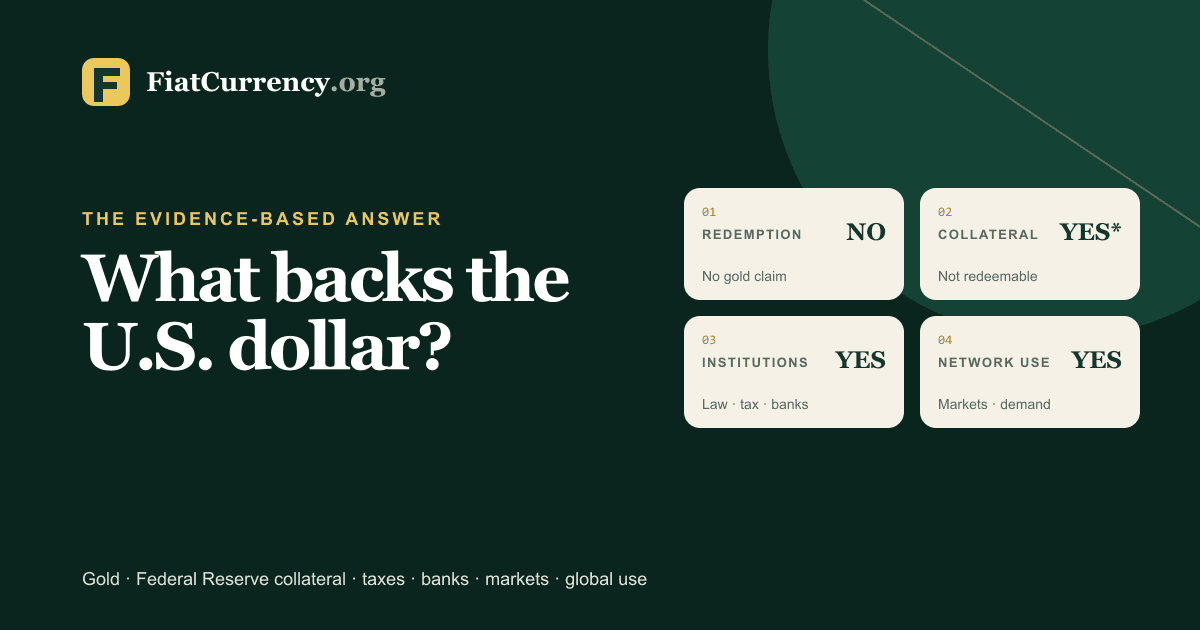
Under a commodity standard, backing usually means redemption. A qualifying holder can present money and receive a fixed quantity of gold or silver under stated rules. In central-bank accounting, backing may instead mean assets or statutory collateral held against monetary liabilities. In broader economic discussion, it can mean the institutional foundations that make a currency acceptable and reasonably stable. Evidence of one kind of backing does not prove another.
Today’s U.S. dollar has no commodity-redemption promise. The Treasury owns official gold, but dollar holders cannot redeem notes or deposits for it. The Federal Reserve does not own the Treasury’s gold; it holds nonredeemable gold certificates issued by the Treasury. Federal Reserve notes are statutorily collateralized, chiefly by Treasury and federal agency securities, but noteholders have no claim to receive those assets. (Federal Reserve, “Does the Federal Reserve own or hold gold?”; Federal Reserve H.4.1, 20 August 2026)
Nor does legal-tender law provide a complete explanation. Federal law says U.S. coins and currency are legal tender for debts, public charges, taxes, and dues. It does not impose a universal federal rule requiring every private seller to accept cash before a debt exists. Legal tender helps define valid payment of covered obligations; it does not alone determine the exchange rate or purchasing power. (31 U.S.C. § 5103; Federal Reserve cash-acceptance FAQ)
Most dollars used by households and businesses are not paper currency. Federal Reserve notes and reserve balances are central-bank liabilities. Commercial-bank deposits are liabilities of commercial banks. Cards and payment applications usually transfer claims on those deposits rather than create a separate sovereign money. Modern dollar stability therefore depends on a hierarchy in which central-bank money is the final settlement asset and private bank money is kept interchangeable with it at par through payments infrastructure, supervision, liquidity facilities, deposit insurance, and bank-resolution rules. (Federal Reserve, Money and Payments: The U.S. Dollar in the Age of Digital Transformation; BIS, Annual Economic Report 2025, chapter III)
The dollar’s global role adds another source of demand, but it is not backing in the redemption sense. Trade invoicing, foreign-exchange trading, reserve holdings, international borrowing, and offshore banking make dollars convenient to acquire and hold. In 2026Q1, the dollar accounted for 57.13 percent of disclosed official foreign-exchange reserves; in April 2025 it was on one side of 89.2 percent of global foreign-exchange trades. Those figures describe network use and market liquidity—not a commodity claim. (IMF COFER, 1 July 2026; BIS Triennial Survey 2025)
The durable conclusion is neither “gold backs the dollar” nor “nothing backs it.” The dollar is supported by a large, powerful, and fallible institutional system. Its value can weaken through inflation, fiscal or political disorder, impaired monetary credibility, financial instability, falling productive capacity, or declining demand. Those risks differ from the failure of a gold-redemption promise because no such general promise now exists.
Key findings
- “Backing” has at least four meanings: commodity redemption; balance-sheet assets or statutory collateral; sovereign, legal, and fiscal support; and market or network support.
- The modern dollar has no commodity-redemption backing. Dollar holders cannot demand a fixed amount of gold, silver, oil, or securities.
- Federal Reserve notes are collateralized, but collateralization is not redemption. The collateral structures note issuance; it does not give the public ownership of Federal Reserve assets.
- The Treasury—not the Federal Reserve—owns the U.S. government’s gold. The Fed’s gold certificates are dollar-denominated and nonredeemable.
- 1933–1934 and 1971 were different breaks. Roosevelt-era measures ended ordinary domestic gold conversion; Nixon ended the remaining official international dollar-gold conversion under Bretton Woods.
- 1968 and 1973 also matter. Congress removed the statutory gold-reserve requirement against Federal Reserve notes in 1968, while major exchange rates moved to generalized floating in 1973.
- Legal tender matters but does not create all monetary value. It identifies legally valid tender for covered obligations; it does not require every merchant to accept cash or guarantee stable prices.
- Tax obligations create recurrent demand for dollars but are not a commodity reserve. Taxation is an institutional source of demand, not a sufficient theory of purchasing power.
- Most dollar money held by the public is commercial-bank money. Bank deposits are private liabilities denominated in the sovereign unit, not physical Federal Reserve notes.
- Bank deposits are made money-like by an institutional promise of par conversion. Settlement in central-bank reserves, supervision, deposit insurance, liquidity support, and resolution arrangements help one bank dollar trade like another.
- The Federal Reserve does not directly “print all the money.” It issues central-bank liabilities; commercial-bank lending and securities purchases can create deposits; Treasury spending and taxation change deposits and reserves through the Treasury General Account.
- “Full faith and credit” is not an asset-redemption clause. It describes the federal commitment behind obligations and affects confidence in dollar claims, but a banknote is not redeemable into federal property.
- The petrodollar is a use-and-recycling story, not oil backing. Oil invoicing and investment of export proceeds can increase dollar demand without making oil redeemable against dollars.
- Geopolitical power can support the environment in which the dollar is used, but military force is not monetary collateral. No dollar holder can convert a note into defense protection.
- International dominance is self-reinforcing but not guaranteed. Invoicing, funding, safe assets, reserves, and foreign-exchange liquidity reinforce each other and can erode if institutions or alternatives change.
- A genuine return to gold would require law, parity, eligibility, and redemption procedures. Holding gold or revaluing it on a government balance sheet would not by itself restore a gold standard.
What does “backed” mean?
The phrase “backed by” is useful only after its meaning is specified. A single monetary instrument can be unbacked in one sense and supported in another.
The four meanings of monetary backing
| Meaning | Precise question | Modern U.S. dollar | What this does—and does not—show |
|---|---|---|---|
| Commodity-redemption backing | Can an entitled holder exchange money on demand for a fixed quantity of gold, silver, or another commodity? | No | This is the defining test for a conventional gold or silver standard. The dollar fails it today. |
| Balance-sheet or collateral backing | Does the issuer hold assets or pledge collateral against the monetary liability? | Yes, with important qualifications | Federal Reserve notes are liabilities and are statutorily collateralized. Holders cannot select or redeem the underlying assets. |
| Sovereign, legal, and fiscal support | Is the unit embedded in taxes, public payments, legal tender, contract enforcement, government finance, and central-bank settlement? | Yes | These institutions sustain use but are not equivalent to commodity convertibility. |
| Market and network support | Is the unit widely accepted because it is liquid, commonly priced, deeply traded, and expected to remain usable? | Yes | Network demand can be powerful yet variable; it is neither a legal guarantee nor an intrinsic commodity property. |
A warehouse receipt for a specified gold bar satisfies the first test if the gold can actually be claimed. A commercial bank deposit satisfies a different relationship: it is a claim on a bank, normally convertible at par into central-bank currency. A Federal Reserve note satisfies the statutory-liability and collateral tests but not the commodity-redemption test. A currency used in most local contracts and taxes has strong institutional support even if its central bank holds few commodity reserves.
This framework prevents two opposite errors. The first is to claim that Treasury gold or Federal Reserve assets secretly make the modern dollar a gold-backed or asset-redeemable currency. The second is to claim that the absence of commodity redemption means no institutions, assets, laws, markets, or obligations stand behind the monetary system.
Backing is not the same as value
Backing is a relationship between an instrument and something else. Value is the purchasing power or exchange rate assigned to that instrument in transactions. A gold-redeemable note can trade below par if redemption is doubtful or costly. A nonconvertible currency can retain substantial value if people expect it to be accepted, scarce enough relative to demand, and supported by credible institutions. A legal declaration can establish denomination and payment rules without fixing what goods will cost.
The value of the dollar therefore cannot be read directly from a single asset account. It emerges from supply and demand for dollar balances, expectations about future policy and prices, the safety and liquidity of dollar claims, and the economic and political system in which those claims circulate.
What exactly is “the U.S. dollar”?
The word dollar names a unit of account, not one physical object. Several legally different instruments promise or represent dollar amounts.
A modern dollar hierarchy
| Layer | Instrument | Issuer or obligor | Who normally holds it? | What makes it money-like? |
|---|---|---|---|---|
| Central-bank currency | Federal Reserve notes | Federal Reserve Banks; obligations of the United States under federal law | Public, businesses, banks, foreign holders | Legal tender, wide acceptance, convertibility into other current U.S. currency at par |
| Central-bank account money | Reserve balances | Federal Reserve Banks | Eligible depository institutions and certain official entities | Final interbank settlement, monetary-policy implementation, no private-bank credit risk |
| Commercial-bank money | Checking and savings deposits | Individual commercial bank | Households and businesses | Contractual claim on the bank, payment access, par conversion into cash or deposits at other banks, regulation and insurance |
| Treasury account balance | Treasury General Account | Federal Reserve liability to the U.S. Treasury | U.S. Treasury | Government operational account for receipts, borrowing proceeds, and disbursements |
| Nonbank payment balance | Some wallet, app, or stored-value balances | Payment company or program bank, depending on structure | Users | Contractual and custodial arrangements; not necessarily direct central-bank or bank money |
| Dollar-linked token | Stablecoin | Private token issuer | Token holders | Reserve and redemption design, market liquidity, regulation, and confidence in issuer—not sovereign legal-tender status by default |
| Dollar security | Treasury bill, note, or bond | U.S. Treasury | Investors, banks, funds, central banks | Interest-bearing federal debt denominated in dollars; highly liquid but not ordinary transaction money |
The distinction is not semantic. A $100 banknote is a central-bank liability. A $100 checking balance is a bank’s liability to its customer. A $100 Treasury bill is an interest-bearing government debt instrument. A payment app may merely display the customer’s claim on a bank or a nonbank provider. All are denominated in the same unit, yet they carry different legal claims, risks, and settlement paths. (Federal Reserve, Money and Payments; Federal Reserve, “A Lawyer’s Perspective on U.S. Payment System Evolution”)
This hierarchy explains why asking “what asset backs one dollar?” can mislead. The answer depends on whether the dollar is a note, reserve balance, bank deposit, security, or private token.
Is the U.S. dollar backed by gold?
No. The decisive test is redemption. The Federal Reserve’s current explanation states that Federal Reserve notes are not redeemable in gold, silver, or any other commodity. The Treasury’s possession of gold does not give a noteholder, depositor, bank, or foreign government a general right to obtain it at a fixed dollar price.
The domestic break came in 1933–1934
During the banking crisis of 1933, the Roosevelt administration restricted gold movements and stopped Treasury and financial institutions from converting currency and deposits into gold. The Federal Reserve History account dates the formal suspension to President Roosevelt’s proclamation of 20 April 1933.
The Gold Reserve Act, signed on 30 January 1934, transferred monetary gold to the Treasury and prohibited Treasury and financial institutions from redeeming dollars for gold. The law governing Federal Reserve notes was amended to remove the earlier gold-redemption provision. Ordinary domestic dollar holders therefore lost gold conversion decades before 1971.
The international break came in 1971
Bretton Woods later maintained a different relationship. Foreign monetary authorities could present official dollar claims for U.S. gold at the official parity, although ordinary Americans did not possess a comparable domestic right. On 15 August 1971, President Richard Nixon directed the Treasury secretary to suspend convertibility of the dollar into gold or other reserve assets. The contemporaneous address identifies the specific promise being suspended.
The decision did not create the entire modern system that evening. The Smithsonian Agreement attempted to preserve fixed exchange rates around a devalued dollar in December 1971. Generalized floating among major currencies followed in 1973, and IMF law was changed afterward.
Treasury gold is a reserve asset, not a redemption fund
The Treasury’s gold report records bullion and coins owned by the federal government at a statutory book value of $42.2222 per fine troy ounce, not the current market price. The Federal Reserve states that it does not own this gold. Treasury issued gold certificates to the Federal Reserve after the 1934 transfer, but those certificates are dollar-denominated and do not give the Federal Reserve a right to redeem them for bullion.
For Treasury gold to back the dollar in the conventional monetary sense, law would have to establish a parity, eligible claimants, a conversion mechanism, and an institution obliged to deliver gold. No such general arrangement exists.
Are Federal Reserve notes backed by assets?
The answer is yes in a statutory-collateral and balance-sheet sense, but no in a holder-redemption sense.
Notes are liabilities
The Federal Reserve’s balance-sheet guide lists Federal Reserve notes as liabilities of the Reserve Banks. Reserve balances, Treasury’s general account, and other deposits are separate liabilities. On the asset side are Treasury and agency securities, mortgage-backed securities, loans, foreign-currency assets, and other items.
A central-bank liability does not need to promise a commodity. It can be denominated and discharged in the sovereign unit itself.
Federal law requires collateral
Section 16 of the Federal Reserve Act requires collateral equal to notes issued. Eligible collateral has broadened over time and can include gold certificates, Special Drawing Right certificates, direct or guaranteed federal obligations, and other assets a Reserve Bank may lawfully hold. The Federal Reserve’s weekly H.4.1 release reports the collateral position.
The statutory structure matters, but it does not assign a slice of the portfolio to each noteholder. Someone presenting a $100 bill cannot demand $100 of Treasury bills, mortgage-backed securities, foreign currency, loans, or gold certificates. Collateral protects and structures issuance; redemption defines what the holder may claim. Those are different legal relationships.
Dated H.4.1 collateral snapshot
Live-check required: The table below uses the Federal Reserve release dated 20 August 2026, reporting conditions on 19 August 2026. Refresh it immediately before publication.
| H.4.1 Table 7 item | Millions of dollars |
|---|---|
| Federal Reserve notes outstanding | 2,831,229 |
| Less notes held by Federal Reserve Banks | 407,351 |
| Notes requiring collateral | 2,423,877 |
| Gold-certificate account pledged | 11,037 |
| Special-drawing-rights-certificate account pledged | 15,200 |
| Treasury, agency, and mortgage-backed securities pledged | 2,397,640 |
| Total collateral held against notes | 2,423,877 |
Source: Federal Reserve, H.4.1, Table 7, 20 August 2026. The release demonstrates exact statutory collateralization while also showing why collateral should not be confused with noteholder redemption.
The collateral rule is not a commodity constraint
Because broad categories of Reserve Bank assets can serve as collateral, the rule does not make the dollar’s purchasing power a daily mark-to-market share of a particular asset pool. The Federal Reserve can change the composition of its portfolio without changing the face value of cash. The value of the monetary unit depends more directly on monetary and fiscal conditions, production, markets, and expectations.
Reserve balances are another form of central-bank money
Reserve balances are electronic Federal Reserve liabilities held by eligible institutions. When a bank orders cash, the Reserve Bank debits its reserve account and supplies notes; when cash is returned, the process reverses. The Federal Reserve’s liabilities guide describes this exchange. One form of central-bank money becomes another at par—there is no commodity conversion.
“Lawful money,” legal tender, and the limits of compulsion
12 U.S.C. § 411 calls Federal Reserve notes obligations of the United States, makes them receivable for taxes, customs, and public dues, and says they are redeemable in lawful money. The statute’s amendment history records that the 1934 law removed the gold-redemption language.
The Federal Reserve’s FAQ, “What is lawful money?”, explains that courts have treated Federal Reserve notes themselves as lawful money. A holder may exchange one current form of U.S. money for another; the wording does not revive a gold or silver claim.
31 U.S.C. § 5103 says U.S. coins and currency are legal tender for debts, public charges, taxes, and dues. This establishes a legally valid way to discharge covered obligations. It does not create a universal federal command that every seller accept cash before a debt exists. The Federal Reserve’s cash FAQ notes that private businesses can generally set payment terms, subject to state and local rules.
Legal tender contributes to monetary uniformity, but it cannot alone stabilize the price level. A currency can remain legal tender while depreciating rapidly. Its practical value also depends on supply, demand, policy, settlement, production, fiscal credibility, and the availability of alternatives.
What supports the dollar’s value today?
No single institution supplies all of the dollar’s value. Several mechanisms reinforce one another.
1. A dominant unit of account
Prices, wages, leases, mortgages, taxes, financial statements, court judgments, securities, and government budgets are overwhelmingly denominated in dollars. This creates a network effect. Businesses accept dollars because suppliers, employees, lenders, customers, and public authorities also use them.
2. Recurring public obligations
Taxes, customs, fees, fines, and other public obligations create continuing demand for dollar-denominated payment. Tax acceptance is important, but it does not mechanically determine the exchange rate or what a dollar buys. The effect depends on the scale of the taxable economy, collection capacity, payment infrastructure, and confidence in continued use of the unit.
3. Contract and payment law
Courts and statutes determine what is owed, which payment discharges an obligation, when settlement is final, how collateral works, and what happens when a bank or payment provider fails. The Federal Reserve’s legal analysis of U.S. payments emphasizes that reliable rules promote interoperability and network effects.
4. Central-bank settlement
Commercial banks issue deposit liabilities, but interbank obligations settle through Federal Reserve accounts. Central-bank reserves provide the common settlement asset. The BIS describes this as the singleness of money: different forms of money exchange at par because the system anchors them to central-bank settlement.
5. Regulation, liquidity, and deposit insurance
Capital and liquidity rules, supervision, access to Federal Reserve services, bank-resolution procedures, and federal deposit insurance reduce the risk that one bank’s dollar trades at a discount to another. The FDIC currently insures eligible deposits within statutory limits. Coverage amounts and rules are live-check required before publication updates.
6. Monetary policy and expected scarcity
Congress directs the Federal Reserve to promote maximum employment, stable prices, and moderate long-term interest rates under 12 U.S.C. § 225a. The central bank influences financial conditions through administered rates, reserve supply, open-market operations, lending facilities, and communication. Expectations about future inflation influence wages, interest rates, prices, and willingness to hold dollars.
7. Fiscal capacity and sovereign credit
The federal government can levy taxes, issue debt under law, and make dollar payments. That capacity supports Treasury securities and the continuity of public institutions. It does not mean the government can spend without constraint. Appropriations, borrowing authority, politics, inflation, exchange rates, interest costs, and real resources remain binding limits.
8. Economic production
Dollars are useful because they command goods, services, labor, and assets in a large and diverse economy. National production is not pledged as redeemable collateral, but it supplies the transactions for which dollar balances are held.
9. Deep and liquid markets
Treasury securities provide widely used safe and liquid dollar assets, collateral, and pricing benchmarks. The Federal Reserve’s 2025 review links the dollar’s international role to U.S. economic scale, open and liquid markets, property rights, and the rule of law. Treasury securities support the system without becoming assets that cash holders can demand in redemption.
10. International network demand
The dollar is used for reserves, trade invoicing, foreign exchange, cross-border payments, international debt, and offshore banking. The IMF’s 2026Q1 COFER brief and the BIS 2025 foreign-exchange survey quantify different dimensions of this use. These statistics are live-check required. International use strengthens liquidity and demand but does not guarantee permanent dominance.
Confidence is shorthand, not magic
“Confidence” becomes meaningful when translated into expectations: that deposits will convert into cash at par, payments will settle, courts will enforce contracts, inflation will remain tolerable, Treasury markets will remain liquid, and the institutions governing the unit will persist. Confidence is a judgment about expected institutional performance, not faith in paper as a material.
Who creates dollars?
“The government prints money” collapses physical production, central-bank issue, fiscal payment, and commercial-bank credit into one phrase.
Physical notes and coins
The Bureau of Engraving and Printing manufactures Federal Reserve notes, and the U.S. Mint produces coins. Manufacturing notes does not by itself determine the public’s money holdings. Reserve Banks supply cash in response to bank demand, normally reducing the requesting bank’s reserve balance by the same amount.
Central-bank money
The Federal Reserve creates reserve balances when it purchases assets, makes eligible loans, or conducts other operations. It extinguishes reserves when transactions reverse or liabilities are repaid. Reserve balances are entries on the Federal Reserve’s own balance sheet and are used primarily by eligible institutions.
Commercial-bank money
Banks create deposits when they make loans or buy assets from nonbanks. The bank records a loan or security as an asset and a deposit as a liability. The Bank of England’s operational account and the Federal Reserve’s analysis of deposit growth reject the idea that banks merely lend a fixed stock of reserves.
Banks still face capital, liquidity, funding, credit-risk, profitability, supervisory, and settlement constraints. The Federal Reserve reduced reserve-requirement ratios to zero in March 2020, but that did not eliminate those other limits. The current rule is live-check required. (Federal Reserve reserve requirements)
Treasury spending and taxation
Treasury makes payments from the Treasury General Account at the Federal Reserve under congressional law. A Treasury payment generally reduces Treasury’s Federal Reserve balance, increases a commercial bank’s reserves, and increases the recipient’s deposit. Tax payments generally work in reverse. These mechanics do not erase the legal distinction between the fiscal authority and the central bank.
Quantitative easing is an asset exchange
When the Federal Reserve buys securities, it pays with reserve balances. A nonbank seller also receives a bank deposit through its bank. The operation changes portfolio composition and financial conditions; it is not identical to Congress transferring funds without receiving an asset.
Treasury debt, taxes, and “full faith and credit”
Treasury securities are central to the dollar system. They are major Federal Reserve assets, global reserve instruments, collateral, and benchmarks for interest rates. Yet a dollar holder cannot demand a Treasury bill, and a banknote does not mature or pay interest.
31 U.S.C. § 3123 pledges the faith of the United States to pay principal and interest on public-debt obligations in legal tender. That is a commitment to service government debt. Federal Reserve notes are separately designated as obligations of the United States. “Full faith and credit” is therefore meaningful sovereign-credit shorthand, but it is not a commodity clause or a guarantee of purchasing power.
Taxes support the system in two ways: they create demand for the unit used to settle public obligations, and they support the government’s fiscal capacity. Neither relationship makes a taxpayer’s future payment directly redeemable by a noteholder.
Saying that “the U.S. economy backs the dollar” is also defensible only as shorthand. A large productive economy gives people many reasons to earn and spend dollars, but no holder owns a fixed share of national output.
Why oil use is not dollar backing
Dollar oil pricing and petrodollar recycling are real. After the 1970s oil shocks, exporters accumulated dollar revenues and recycled them through imports, bank deposits, loans, and securities. The GAO’s review of the U.S.-Saudi Joint Commission discussed both economic cooperation and petrodollar recycling.
No ordinary holder acquired a right to redeem dollars for crude oil. Oil prices moved freely rather than being fixed as a monetary parity. The petrodollar is therefore an invoicing, banking, and investment network—not commodity backing.
Geopolitical and military power can influence alliances, sanctions, trade routes, and access to financial networks. That affects international currency choice. It does not make military capacity collateral or a redemption asset. A careful account treats geopolitical power as part of the dollar’s institutional environment, not as the object promised to noteholders. The dedicated petrodollar document audit reconstructs the 1974–75 agreements, recycling channels, and unsupported 2024 expiration claim.
What backs a bank deposit?
A deposit is a contractual liability of a commercial bank. The depositor does not own a named mortgage, security, or reserve balance inside the bank. The bank’s assets and income support its ability to pay; regulation, liquidity, deposit insurance, and resolution reduce the risk of loss; and Federal Reserve settlement helps deposits at different banks exchange at par.
This is why “bank-account dollars” are real money but not direct government fiat in the same legal sense as a Federal Reserve note. They are private credit money denominated in the sovereign unit.
Backing matrix
| Instrument | Issuer | Holder’s legal claim | Commodity redemption? | Relevant assets or support | Principal risk |
|---|---|---|---|---|---|
| Federal Reserve note | Federal Reserve Banks; U.S. obligation | Face amount in lawful U.S. money | No | Statutory collateral; Federal Reserve assets; sovereign monetary system | Inflation and institutional risk, not ordinary issuer default |
| Reserve balance | Federal Reserve Bank | Account claim held by eligible institution | No | Federal Reserve balance sheet and settlement law | Policy and institutional risk |
| U.S. coin | Treasury/Mint | Legal-tender currency at denomination | No | Sovereign issuance; metal value is incidental for ordinary coin | Inflation and institutional risk |
| Insured bank deposit | Commercial bank | Contractual claim on bank | No | Bank assets, liquidity, supervision, insurance within limits | Bank failure beyond protection or access delay |
| Treasury bill | U.S. Treasury | Principal payment at maturity under debt terms | No | Federal fiscal capacity and sovereign credit | Interest-rate, market, and sovereign risk |
| Payment-app balance | Varies | Contractual or custodial claim | Usually no | Provider structure and partner banks | Provider, custody, legal, and insurance risk |
| Fiat-backed stablecoin | Private issuer | Redemption right if contract and reserves perform | No commodity claim | Deposits, Treasury bills, or other disclosed reserves | Reserve, run, custody, technology, and regulatory risk |
The staged end of gold convertibility
| Date | Transition | Meaning |
|---|---|---|
| 20 April 1933 | Domestic conversion suspended | Treasury and financial institutions stopped ordinary conversion of currency and deposits into gold. |
| 30 January 1934 | Gold Reserve Act | Monetary gold moved to Treasury and dollar redemption in gold was prohibited. |
| 18 March 1968 | Gold-reserve requirement repealed | Congress removed the remaining statutory gold-certificate reserve requirement against Federal Reserve notes. |
| 15 August 1971 | Official foreign conversion suspended | Nixon ended the Bretton Woods dollar-gold conversion commitment. |
| December 1971 | Smithsonian Agreement | Fixed rates were renegotiated without restoring general gold convertibility. |
| March 1973 | Generalized floating | Major currencies ceased maintaining the Bretton Woods-style parities. |
| 1976–1978 | Jamaica and IMF reform | The post-Bretton Woods exchange-rate and gold framework received formal legal recognition. |
This staged chronology answers three different questions:
- Domestic fiat transition: 1933–1934.
- International gold-conversion transition: 1971.
- Modern floating-rate consolidation: 1973–1978.
1971 was decisive, but it was not the day fiat money was invented or the day ordinary Americans first lost gold redemption.
What can weaken the dollar?
The system’s supports are substantial but fallible. Different forms of weakness should be separated.
- Inflation reduces domestic purchasing power.
- Foreign-exchange depreciation lowers the dollar against other currencies.
- Reserve-share decline reduces one dimension of international use.
- Banking crises threaten private deposits and payment intermediation.
- Sovereign default would damage Treasury markets and institutional credibility.
- Fiscal dominance can subordinate price stability to debt-financing needs.
- Political or constitutional breakdown can weaken contract, budget, and monetary institutions.
- Currency substitution occurs when users price, save, or settle in another unit.
- Hyperinflation generally requires severe fiscal, political, productive, and monetary failure, not merely fiat status.
A fall in purchasing power, a lower exchange rate, and complete monetary collapse are not synonyms. The dollar can weaken in one dimension while remaining dominant in another.
What would a return to gold require?
A real gold standard would require much more than revaluing Treasury bullion. Policymakers would need to specify:
- a legal dollar-gold parity;
- the weight and fineness of gold;
- who may redeem;
- where and how redemption occurs;
- reserve requirements;
- the treatment of bank deposits and central-bank reserves;
- rules for reserve losses and crises;
- the treatment of existing debt and contracts; and
- whether convertibility is domestic, international, or both.
Without an enforceable redemption promise, additional gold holdings would remain reserves—not backing in the monetary-standard sense.
Myth versus evidence
Myth 1: “The dollar is backed by nothing.”
Evidence: The dollar lacks a commodity-redemption promise, which is the defensible meaning behind the phrase. But Federal Reserve notes are liabilities and statutorily collateralized; commercial-bank deposits are supported by bank assets and a public regulatory-settlement system; and dollar demand is sustained by taxes, law, production, monetary institutions, markets, and network use. “Not redeemable for a commodity” is accurate. “No institutions, assets, obligations, or economic relationships support it” is not.
Myth 2: “The dollar is secretly still backed by gold in Fort Knox.”
Evidence: The Treasury owns gold, but current dollars are not redeemable for it. The Federal Reserve does not own the Treasury’s gold, and the gold certificates on the Fed’s balance sheet are themselves nonredeemable. Official gold holdings can be reserves without constituting a gold standard. (Federal Reserve gold FAQ)
Myth 3: “Nixon removed gold backing from ordinary Americans in 1971.”
Evidence: Ordinary domestic gold redemption had already been terminated through the Roosevelt-era measures of 1933–1934. Nixon suspended the remaining official conversion offered to foreign monetary authorities under Bretton Woods. (Federal Reserve History; U.S. Department of State)
Myth 4: “Legal tender means every business must accept cash.”
Evidence: Federal law identifies U.S. currency as legal tender for debts, public charges, taxes, and dues. The Federal Reserve states that no federal statute generally forces a private business to accept cash for goods or services, although state and local rules can differ. (31 U.S.C. § 5103; Federal Reserve FAQ)
Myth 5: “Taxes are the only reason dollars have value.”
Evidence: Tax obligations create recurring demand for the unit, but they do not alone ensure stable prices, bank convertibility, market liquidity, or international acceptance. Fiscal capacity, settlement, production, law, policy credibility, and network effects all contribute.
Myth 6: “Federal Reserve collateral means a dollar is redeemable for Treasury bonds.”
Evidence: Collateral constrains note issuance and identifies pledged assets. It does not give a banknote holder a contractual right to receive those assets. The Fed’s own balance-sheet guide describes collateral against notes without offering asset redemption to the public. (Federal Reserve balance-sheet guide)
Myth 7: “The dollar is backed by U.S. government debt, so it is just an IOU redeemable for another IOU.”
Evidence: Treasury securities and central-bank money are distinct obligations. Treasury debt pays principal and interest under stated terms; notes and reserves serve monetary and settlement functions. Treasury securities are major central-bank assets and global collateral, but currency holders cannot demand them in redemption.
Myth 8: “The petrodollar agreement made oil the backing for the dollar.”
Evidence: Dollar oil invoicing and petrodollar recycling strengthened international dollar use. They did not establish a legal promise to exchange dollars for oil. The 1970s U.S.–Saudi arrangements concerned economic and strategic cooperation, not an oil-convertible dollar. (U.S. Department of State historical documents; agreement record and expiration audit)
Myth 9: “The U.S. military is what gives each dollar value.”
Evidence: Geopolitical power can influence alliances, sanctions, and the international financial order. It is not an asset into which dollars are redeemable, and it cannot by itself explain domestic contract denomination, tax payments, bank settlement, or market liquidity.
Myth 10: “Most dollars are printed paper.”
Evidence: Most money used by households and firms is held as commercial-bank deposits. Physical notes are only one form of central-bank money; reserve balances are another, and neither is the same as a customer deposit. (Federal Reserve, “Money and Payments”)
Myth 11: “Banks lend out the reserves deposited at the Federal Reserve.”
Evidence: Banks create deposits when they extend credit, while managing capital, funding, liquidity, and settlement. Reserve balances are used primarily among eligible institutions for settlement and policy operations; they are not simply passed to households as loans. (Bank of England, “Money Creation in the Modern Economy”)
Myth 12: “The Federal Reserve can create unlimited money without consequences.”
Evidence: A central bank can create its own nominal liabilities, but not real goods, labor, energy, or productive capacity. Excessive monetary accommodation can contribute to inflation, exchange-rate pressure, asset-price distortions, and loss of credibility. Legal authority, policy mandates, political constraints, financial stability, and public reaction also matter.
Myth 13: “If the dollar’s purchasing power falls over decades, the currency has failed.”
Evidence: Long-run price-level increases measure a decline in the purchasing power of a fixed nominal dollar. Evaluating the monetary system also requires examining nominal incomes, real wages, productivity, borrowing costs, employment, asset prices, and distribution. Persistent inflation can be harmful without being identical to currency collapse.
Myth 14: “A currency is strong only if its exchange rate is high.”
Evidence: Currency-unit size is arbitrary. One unit of one currency can trade for many or few units of another because of denomination history. Relevant changes are inflation, real exchange rates, trend depreciation, volatility, and what the currency buys—not the bare numerical level.
Myth 15: “A return to gold only requires the government to declare the dollar gold-backed.”
Evidence: A functioning gold standard requires a legally enforceable parity, eligible claimants, conversion procedures, reserves, and policies capable of defending the promise. Without redemption, the declaration would be symbolic.
Useful distinctions
Other questions about the dollar
These shorter answers cover practical questions that do not need another full section.
What does “redeemable in lawful money” mean today?
It does not mean redeemable in gold. Current Federal Reserve notes are themselves lawful money. In practice, redemption means exchange into other current U.S. money, such as replacement notes, coins, or a bank deposit at par, subject to ordinary institutional arrangements.
Can a store refuse cash?
Under federal law, generally yes for a new transaction, unless another rule applies. State or local law may require cash acceptance in some places. Legal tender is most directly relevant to payment of an existing debt.
Are bank-account dollars real dollars?
Yes, they function as money, but they are commercial-bank liabilities rather than direct Federal Reserve liabilities. Their exchange at par with cash and reserves is maintained through bank assets, settlement, regulation, insurance, and liquidity arrangements.
What is the difference between cash and reserves?
Cash is physical currency available to the public. Reserve balances are digital Federal Reserve liabilities normally held only by eligible institutions and used for interbank settlement and policy implementation.
Could the dollar become worthless?
No monetary unit is guaranteed forever. Severe fiscal, political, productive, banking, and monetary breakdown could destroy confidence. But gradual inflation, exchange-rate depreciation, a lower reserve share, default risk, and total currency collapse are distinct outcomes and should not be conflated.
The dedicated U.S. dollar collapse evidence review traces those distinct pathways, current indicators, warning signs, and practical consequences without assigning a false probability.
Why do foreign central banks hold dollars?
They hold liquid dollar assets for intervention, precautionary reserves, trade and debt needs, returns, and compatibility with dollar-based financial markets. Reserve managers diversify, so dollar holdings are substantial but not exclusive.
Can the dollar remain fiat while pegged to gold or another currency?
A currency could remain legally nonredeemable to the public while its issuer targets an exchange rate or commodity price. A true gold standard, however, ordinarily involves a defined conversion commitment, not only a policy target.
Can a fiat dollar be stable without permanent price constancy?
Yes. Modern price-stability objectives usually allow low positive inflation rather than a permanently fixed price index. Whether that constitutes adequate stability is a policy and distributional debate, but it differs from hyperinflation or currency collapse.
Evidence control
A claim-level source audit
The underlying audit maps 32 major claims and publication tests to statutes, Federal Reserve and Treasury material, official histories, IMF and BIS data, and central-bank research. It separates durable findings from periodic and live-check material.
Last reviewed: 25 August 2026. Dated Federal Reserve, IMF, BIS, and reserve-requirement figures were checked against the linked releases.