Start with the issuer
Four channels that should not be collapsed into “printing”
- 01Commercial banks
Create deposit money through loans and some asset purchases.
- 02Central banks
Create reserves and issue banknotes through authorized operations.
- 03Treasury and mint
Make payments, issue debt, collect taxes, and issue coins under law.
- 04Repayment and conversion
Can extinguish deposits or change their form without creating wealth.
Executive summary
The familiar image of money creation is a printing press. It is visually memorable and institutionally incomplete. Physical notes are only one form of money, and producing a note is not the same as issuing it. In a modern monetary system, most payments occur through bank deposits recorded electronically. Those deposits are liabilities of commercial banks. Reserve balances, by contrast, are liabilities of the central bank and are used mainly inside the financial system. Coins may be issued by a treasury or mint under a separate legal structure. All are denominated in the same unit of account, but they do not have the same issuer, legal character, or circulation mechanism.
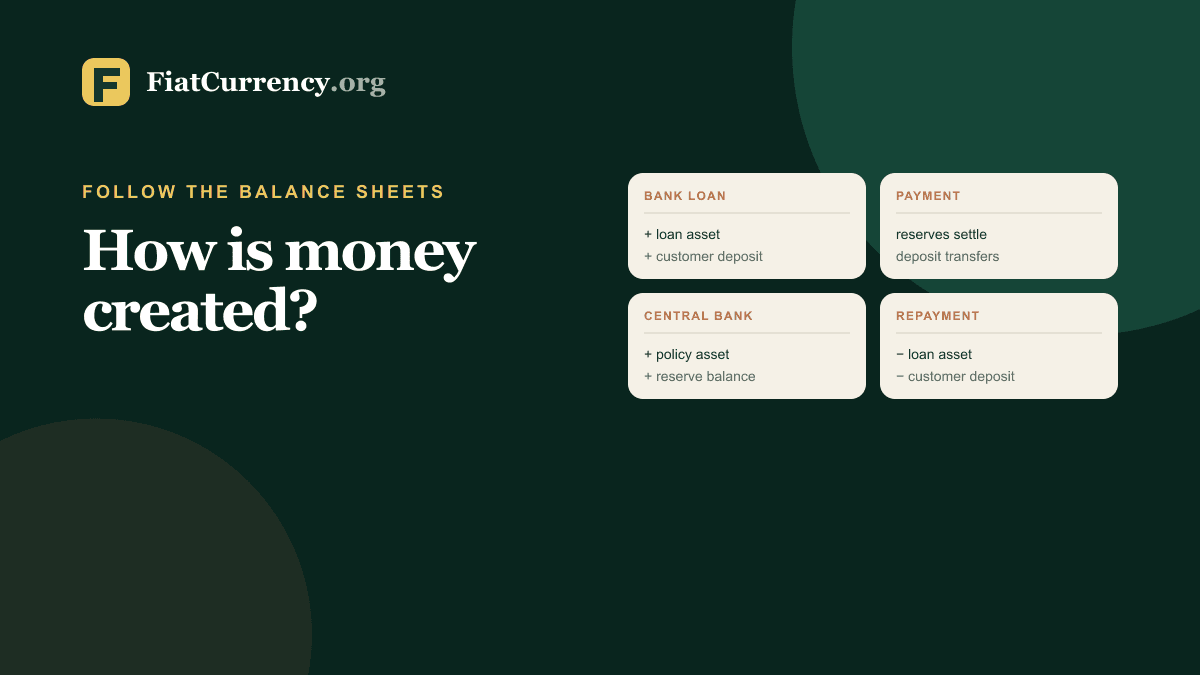
Commercial banks create deposit money through balance-sheet transactions. When a bank grants a $100,000 loan, the bank acquires a $100,000 loan asset and issues a $100,000 deposit liability to the borrower. The borrower simultaneously acquires a deposit asset and assumes a loan obligation. The transaction increases money and credit, but it does not create $100,000 of net financial wealth for the borrower: the new asset is matched by a new debt. Whether the financing later supports productive investment, consumption, asset purchases, speculation, or losses is a separate economic question.
The initial loan entry does not require a prior transfer of reserves. But this does not mean banks can create unlimited money without cost. If the borrower pays someone at another bank, the lending bank may lose deposits and must settle through reserve balances. It may replace the lost funding with other deposits, secured or unsecured borrowing, central-bank credit, asset sales, or retained earnings. Capital regulation, liquidity standards, credit losses, collateral, borrower demand, interest rates, market discipline, supervision, and expected profitability all constrain lending.
Central banks create reserve balances by lending, buying assets, conducting foreign-exchange or liquidity operations, and making other entries on their own balance sheets. A central-bank asset purchase from a commercial bank usually swaps one bank asset for reserves without directly creating a new public deposit. A purchase from a nonbank normally produces both additional reserves at the seller’s bank and a new deposit for the seller. This is why the effect of quantitative easing cannot be inferred from the rise in reserves alone.
Government finance adds another layer. In the United States, Treasury receipts and payments flow through the Treasury General Account at the Federal Reserve. A Treasury payment normally reduces the TGA, increases the reserve balance of the recipient’s bank, and increases the recipient’s deposit. A tax payment ordinarily reduces a taxpayer’s deposit and the taxpayer’s bank reserves while increasing the TGA. Debt issuance, taxation, spending, and Federal Reserve operations therefore alter different balance-sheet positions at different times. Describing every deficit as direct money printing conceals these legal and operational steps; describing the government as financially identical to a household conceals the central role of sovereign institutions and central-bank settlement.
Money is also destroyed. When a borrower repays loan principal with a bank deposit, the bank reduces both its loan asset and its deposit liability. Deposit money contracts. Interest payment is different: it becomes bank income and can return to circulation through expenses, salaries, taxes, dividends, or later lending. Default is also different from repayment. A default writes down the bank’s asset and erodes capital; it does not automatically cancel deposits previously transferred to other holders.
The most accurate general answer is therefore institutional and plural:
Money is created when central banks, commercial banks, and—in particular legal forms—treasuries or mints issue liabilities that the monetary system treats as money. The effect of any transaction depends on which institution acts, which balance sheets change, which monetary aggregate is being measured, and whether the transaction creates a new claim, transfers an existing claim, converts one form of money into another, or extinguishes a liability.
Key findings
- There is no single money-creation process. Bank lending, central-bank reserve creation, banknote issuance, coin issuance, government payments, and private token issuance create different claims.
- Most modern payments do not use physical cash. They use commercial-bank deposits recorded on bank ledgers.
- A bank loan normally creates a deposit. The bank records a new loan asset and a matching deposit liability.
- The borrower receives money and debt at the same time. Money creation is not automatically wealth creation.
- A bank does not need to transfer a pre-existing customer deposit at loan origination. The bank issues its own deposit liability.
- “Loans create deposits” does not mean banks face no limits. Capital, liquidity, settlement, funding, losses, demand, regulation, and profitability matter.
- The banking system and an individual bank must be distinguished. A deposit may remain inside the system while leaving the bank that created it.
- Reserves are not household money. They are central-bank liabilities held mainly by eligible institutions for settlement and monetary operations.
- Banks do not normally lend reserves to households. A household receives a bank deposit; reserves may move later between banks.
- A cash withdrawal mostly changes monetary form. The customer’s deposit falls as currency held by the public rises.
- Loan-principal repayment normally destroys deposit money. The bank’s loan asset and deposit liability contract together.
- Default is not the same as repayment. It reduces the value of a bank asset and may reduce capital without automatically deleting deposits already spent elsewhere.
- A central-bank purchase from a bank differs from a purchase from a nonbank. The latter normally creates a public deposit as well as reserves.
- Quantitative easing does not hand reserve balances to ordinary households. It changes asset holdings and bank reserve positions through intermediated settlement.
- Government spending and taxation move balances through the Treasury’s central-bank account. They should be traced transaction by transaction rather than reduced to slogans.
- The United States has had zero reserve-requirement ratios since 26 March 2020. This fact alone does not remove capital, liquidity, funding, or supervisory constraints. (Federal Reserve, “Reserve Requirements”)
- The textbook reserve multiplier is not a reliable literal chronology of modern U.S. lending. It can describe an ex-post ratio under simplified assumptions, but banks do not mechanically wait for reserves and multiply them into loans. (Carpenter and Demiralp, “Money, Reserves, and the Transmission of Monetary Policy”)
- Monetary aggregates are conventions, not natural objects. M1 and M2 combine selected instruments and can change definition over time.
- Money growth and inflation are related but not mechanically one-for-one at every horizon. Spending, demand for money, output, supply constraints, credit allocation, expectations, and policy responses affect the result.
- Stablecoins, tokenized deposits, and CBDCs have different issuers. A stablecoin is usually a private redemption claim; a tokenized deposit remains a bank liability; a CBDC would be a direct central-bank liability.
What does “creating money” mean?
The phrase can refer to at least seven different events:
- manufacturing a physical note or coin;
- placing currency into circulation;
- creating a central-bank reserve balance;
- creating a commercial-bank deposit;
- increasing a measured monetary aggregate such as M1 or M2;
- extending credit that finances a purchase;
- increasing the spending power available to a household, firm, bank, or government.
These events often occur together, but they are not identical. A banknote printer can manufacture billions of dollars of replacement notes without increasing the money supply if old, damaged notes are withdrawn. A customer can withdraw $500 in cash, reducing a bank deposit and increasing currency held by the public without creating $500 of new broad money. A central bank can buy a security from a commercial bank, increasing reserves while leaving public deposits unchanged. A bank can make a loan, increasing deposits before any reserves move. A government can tax and later spend the same amount, reducing and then restoring private deposits at different times.
The confusion grows because “money” itself has several meanings. Economists often describe money through its functions as a medium of exchange, unit of account, and store of value. Statistical agencies define monetary aggregates for analysis. Lawyers focus on the issuer, the liability, legal tender, payment finality, and contractual rights. Accountants focus on which institution records the asset and liability. A useful explanation has to preserve all four perspectives.
Money creation, credit creation, and wealth creation
A bank loan usually creates both money and credit. Suppose a bank lends a business $100,000 and credits the business’s transaction account.
- The bank’s loan asset rises by $100,000.
- The bank’s deposit liability rises by $100,000.
- The business’s deposit asset rises by $100,000.
- The business’s loan liability rises by $100,000.
The business has more immediately spendable money, but its net financial position has not improved by $100,000 merely because of the accounting entry. It owns a deposit and owes a matching debt. If the loan finances equipment that generates future income, real wealth may later rise. If it finances a failed project, real wealth may fall. The balance-sheet creation of money and the economic creation of value are separate processes.
A nonbank lender illustrates the distinction. If an investment fund lends $100,000 to a company, the fund’s bank deposit may fall while the company’s deposit rises. Credit is created, but aggregate bank deposits need not increase. A deposit-taking bank is unusual because it can issue the deposit used to fund the loan on its own balance sheet. (Bank of England, “New forms of digital money”)
Creation versus transfer versus conversion
Every monetary transaction should be classified as one of four basic operations:
- Creation: a new monetary liability appears without an equal monetary liability disappearing elsewhere.
- Transfer: an existing monetary claim changes holder.
- Conversion: one form of money is exchanged for another, such as a deposit for cash.
- Extinguishment: a monetary liability is cancelled, as when loan principal is repaid with a deposit.
This classification prevents a common error: treating every movement of money as creation. A card purchase usually transfers an existing deposit. A cash withdrawal converts a deposit into notes. A loan repayment extinguishes a deposit and a loan. A new bank loan creates a deposit.
What counts as money?
No single list works for every purpose. The Federal Reserve distinguishes the monetary base, M1, and M2. The monetary base consists of currency in circulation plus reserve balances held by eligible institutions at Federal Reserve Banks. M1 includes currency held by the public and very liquid transaction deposits. M2 adds selected savings and near-money instruments. Definitions have changed; in May 2020, for example, the Federal Reserve reclassified savings deposits into the liquid-deposit component of M1, creating a break in historical comparability. (Federal Reserve, “What is the money supply?”; Federal Reserve, H.6 Technical Q&A; Federal Reserve, H.6 release)
The principal forms
| Instrument | Issuer | Holder’s claim | Main users | Typical statistical treatment |
|---|---|---|---|---|
| Federal Reserve note | Federal Reserve Banks | Central-bank liability | Public and financial institutions | Currency; part of the monetary base and public money aggregates when outside banks |
| Reserve balance | Federal Reserve Bank | Central-bank liability recorded in an eligible institution’s account | Banks and other eligible account holders | Monetary base; excluded from ordinary household deposits |
| U.S. coin | U.S. Treasury through the Mint | Treasury-issued monetary instrument | Public and financial institutions | Currency in circulation |
| Checking deposit | Commercial bank or other depository institution | Private bank liability | Households, firms, governments | Core component of M1 |
| Savings deposit | Commercial bank or depository institution | Private bank liability | Households and firms | Included in current U.S. liquid-deposit measures and M2 definitions |
| Money-market fund share | Investment fund | Proportional claim on fund assets | Investors | Selected retail shares included in M2; not a bank deposit |
| Credit-card line | Bank or nonbank lender | Commitment to extend credit, not money held by customer | Cardholder | Not money until used and settled into deposits |
| Payment-app interface | Bank or payment company | Depends on underlying arrangement | Public | Often access to a bank deposit or stored-value claim; not automatically separate money |
| Payment stablecoin | Private issuer | Redemption or repurchase claim under issuer terms and law | Token users | Usually outside official money aggregates; private money-like claim |
| CBDC | Central bank | Direct digital central-bank liability | Retail or wholesale users depending on design | Would be central-bank money |
Currency is not the whole money supply
In ordinary speech, “currency” often means notes and coins. In international finance it can mean an entire national monetary unit, including deposits. In statistical work, currency is usually a narrower component. This distinction matters because a statement such as “the government prints money” may describe only the production of physical cash even though most payments use deposits.
Reserves are money, but not public spending balances
Reserve balances are electronic claims on a central bank. In the United States, eligible institutions use Federal Reserve accounts to settle obligations through services such as Fedwire. A reserve transfer from Bank A to Bank B changes which bank holds the central-bank money; it does not place reserves in the customer’s wallet. The customer receives or loses a commercial-bank deposit. (Federal Reserve, “Examining CBDC and Wholesale Payments”; Federal Reserve, “Payment Systems”)
The modern monetary hierarchy
A modern fiat system is not a flat field in which every dollar claim is identical. It is a hierarchy of issuers and convertibility promises.
Sovereign unit of account: U.S. dollar
│
├── Central-bank money
│   ├── Federal Reserve notes held by the public
│   └── Reserve balances held by eligible institutions
│
├── Treasury-issued monetary instruments
│   └── Coins
│
├── Commercial-bank money
│   ├── Checking deposits
│   ├── Savings deposits
│   └── Other deposit liabilities
│
├── Nonbank money-like claims
│   ├── Money-market fund shares
│   ├── Electronic-money or stored-value claims
│   └── Payment stablecoins
│
└── Payment interfaces and instructions
    ├── Debit and credit cards
    ├── Checks and ACH instructions
    ├── Banking applications
    └── Payment applications
The hierarchy is held together by par convertibility and settlement. A customer expects one dollar in a bank account to convert into one dollar of cash or transfer as one dollar to another bank. Deposit insurance, supervision, capital and liquidity rules, access to central-bank settlement, emergency liquidity, bank resolution, and market conventions help sustain that one-for-one relationship. These institutions do not make bank deposits identical to central-bank money; they make the two forms usable together.
A payment company may add another layer. A balance displayed in an app may be a bank deposit held for the customer, a claim on a pooled custodial account, prepaid value, or an unsecured claim on the company. The interface does not determine the legal nature of the money. The issuer and redemption structure do.
How a commercial-bank loan creates a deposit
The clearest way to understand bank money creation is to follow balance sheets rather than metaphors.
Step 1: the bank approves the loan
Assume a bank approves a $100,000 business loan. At origination, the simplified entries are:
| Bank balance sheet | Assets | Liabilities |
|---|---|---|
| New loan to customer | +$100,000 | — |
| New customer deposit | — | +$100,000 |
| Customer balance sheet | Assets | Liabilities |
|---|---|---|
| New bank deposit | +$100,000 | — |
| New loan obligation | — | +$100,000 |
The bank has expanded both sides of its balance sheet. It has not taken $100,000 from another depositor’s account. It has issued a new liability—its promise to honor the customer’s deposit—and acquired a new asset—the borrower’s promise to repay.
This is the central fact behind the phrase “loans create deposits.” The Bank of England, Bundesbank, and Norges Bank all describe the process in these terms. Banks can also create deposits when they purchase an asset from a nonbank and pay by crediting the seller’s account. (Bank of England, “Money creation in the modern economy”; Deutsche Bundesbank, April 2017 Monthly Report; Norges Bank, Norway’s Financial System 2026)
Step 2: the borrower has a deposit, not reserves
The new balance in the borrower’s account is a claim on the commercial bank. It is not a reserve balance at the central bank. The bank promises to transfer, convert, or pay the amount according to the account contract and payment rules.
If the borrower keeps the money in the account, no interbank settlement is needed. If the borrower pays another customer at the same bank, the bank can debit one deposit and credit another. Total deposits at that bank are unchanged by the payment itself.
Step 3: the borrower pays someone at another bank
Suppose the borrower buys equipment from a seller who banks at Bank B.
- Bank A debits the borrower’s deposit by $100,000.
- Bank A sends a payment instruction through the relevant system.
- Bank A’s reserve balance falls by $100,000.
- Bank B’s reserve balance rises by $100,000.
- Bank B credits the seller’s deposit by $100,000.
| Entity | Asset change | Liability change |
|---|---|---|
| Borrower | Deposit −$100,000; equipment +$100,000 | Loan remains +$100,000 |
| Bank A | Reserves −$100,000 | Borrower deposit −$100,000 |
| Bank B | Reserves +$100,000 | Seller deposit +$100,000 |
| Seller | Deposit +$100,000 | — |
| Federal Reserve | — | Bank A reserve liability −$100,000; Bank B reserve liability +$100,000; total reserves unchanged |
The deposit created by Bank A has moved into Bank B as a new liability of Bank B. For the banking system as a whole, the deposit remains. For Bank A individually, the deposit and reserves have left.
This distinction resolves an apparent contradiction. A bank can create a deposit at origination, yet still need funding and reserves after the borrower spends. The bank’s ability to initiate the loan does not guarantee that it can retain the deposit or settle every outflow cheaply.
Same-bank payment versus different-bank payment
| Question | Same bank | Different banks |
|---|---|---|
| Does the payer’s deposit fall? | Yes | Yes |
| Does the recipient’s deposit rise? | Yes | Yes |
| Do aggregate deposits change because of the payment? | No | No |
| Do reserves move between banks? | No | Usually yes |
| Does the lending bank lose funding? | No, the deposit remains at the bank | Yes, unless offset by inflows or replacement funding |
A bank can create deposits by buying assets
Suppose a bank buys a $50,000 bond from a household and credits the household’s account. The bank’s securities assets rise by $50,000 and its deposit liabilities rise by $50,000. New deposit money has been created even though no loan was made.
If a nonbank buys a bank-issued bond or newly issued bank equity, the reverse can occur: the buyer’s deposit may be exchanged for a longer-term bank liability or ownership claim, reducing transaction deposits while strengthening the bank’s funding or capital. Money creation is therefore connected to the composition of bank assets and liabilities, not lending alone.
Does a bank need deposits before it can lend?
The most accurate answer is no at the instant of loan origination, but deposits and other funding matter immediately afterward and over the life of the loan.
A bank does not normally identify a particular saver’s $100,000 and transfer it to the borrower. It records a loan and a deposit. But the new deposit is itself a funding liability. If the borrower transfers it to another bank, the originating bank loses that funding and reserves. The bank must manage the resulting position.
Possible responses include:
- attracting deposits by offering competitive rates or services;
- borrowing from another bank or the wholesale market;
- issuing certificates of deposit, bonds, or other liabilities;
- using secured funding such as repurchase agreements;
- selling assets;
- drawing on central-bank facilities against eligible collateral;
- retaining earnings or issuing equity;
- reducing other lending or changing loan prices.
The Bundesbank emphasizes that banks which create deposits may later face payment outflows and need refinancing. The Bank of England similarly distinguishes the accounting act of creation from the economic and regulatory constraints on bank lending. (Deutsche Bundesbank, “How money is created”; Bank of England, “Money creation in the modern economy”)
System-wide truth versus individual-bank constraint
For the banking system as a whole, a new loan generally creates a deposit somewhere in the system. For an individual bank, the deposit may leave. This is why both of these statements can be true:
- loans create deposits;
- banks compete for deposits and other funding.
The first describes aggregate balance-sheet creation. The second describes distribution, liquidity, funding cost, and institutional survival.
What limits bank money creation?
No single constraint is sufficient. A bank’s ability and willingness to expand credit depend on interacting limits.
1. Borrower demand
Banks cannot force solvent borrowers to take every offered loan. Demand changes with investment opportunities, household confidence, interest rates, property prices, expected income, and economic conditions.
2. Creditworthiness and expected losses
A loan is valuable to a bank only if expected repayments, collateral recovery, and fees compensate for funding costs, operating expenses, capital use, and default risk. Weak underwriting can expand deposits temporarily while producing future losses and bank distress.
3. Capital
A bank’s capital absorbs losses and supports risk-taking. Regulatory capital ratios compare eligible capital with risk-weighted or leverage exposures. A new loan can increase required capital or reduce the bank’s buffer. Raising equity is often more costly and slower than creating a deposit entry.
4. Liquidity and settlement
The bank must meet outgoing payments, cash withdrawals, margin calls, and other obligations. Liquidity requirements and internal stress tests affect the amount and composition of liquid assets and stable funding it maintains. The Basel framework includes a Liquidity Coverage Ratio for short-term stress and a Net Stable Funding Ratio for longer-horizon funding resilience. (Basel Committee, “Basel III”; BIS, consolidated liquidity standards)
5. Funding cost and composition
A bank may create a low-cost deposit at origination, but lose it to another institution. Replacing it with wholesale borrowing can be expensive or unstable. Deposit competition, market rates, collateral availability, credit ratings, and confidence all matter.
6. Monetary policy
Central banks influence the price and availability of reserve balances and short-term funding, which affect deposit rates, loan rates, asset values, borrower demand, and bank profitability. Monetary policy is an important system-wide limit, but it does not operate as a simple daily quota of reserves allocated to each loan.
7. Regulation and supervision
Capital, liquidity, large-exposure, underwriting, consumer-protection, anti-money-laundering, stress-testing, and concentration rules can constrain or redirect credit. Supervisory judgment can require stronger risk management even when formal ratios are met.
8. Market discipline and confidence
Depositors, counterparties, bondholders, shareholders, rating agencies, and clearing organizations react to risk. A bank that expands too aggressively can face higher funding costs or a run.
9. Profitability and strategy
A bank may possess legal and accounting capacity to lend but decide that expected return is too low. Lending competes with securities, fee businesses, liquidity holdings, and other uses of the balance sheet.
10. Real resources and economic conditions
Credit can finance claims on labor, land, equipment, commodities, and existing assets. If nominal financing expands faster than the economy’s capacity to supply what borrowers seek, prices, imports, leverage, or asset valuations may adjust.
The correct conclusion is neither “banks can lend only what has already been saved” nor “banks can create infinite money.” Banks issue money-like liabilities within a network of balance-sheet, regulatory, market, policy, and real-economy constraints.
Reserves, reserve requirements, and the money multiplier
What are reserve balances?
Reserve balances are deposits that eligible institutions hold at a central bank. They are used to settle interbank payments, meet central-bank obligations, and implement monetary policy. A bank may obtain reserves from incoming payments, other banks, asset sales to the central bank, central-bank loans, or other balance-sheet operations.
Are reserves lent to households?
Normally no. When a bank makes a mortgage, the borrower receives a bank deposit. The bank may later transfer reserves to another bank when the borrower pays the seller. Reserves remain on the central bank’s ledger among eligible account holders.
Do reserve requirements limit U.S. bank lending?
As of 26 August 2026, the Federal Reserve’s reserve-requirement ratios remain zero percent, a policy effective since 26 March 2020. This eliminates a statutory reserve ratio as a binding constraint on transaction deposits, but not the need for settlement balances or the many other constraints described above. (Federal Reserve, “Reserve Requirements”)
What happened to the textbook money multiplier?
A simplified textbook model begins with a quantity of reserves, applies a required-reserve ratio, and derives a maximum deposit expansion. This can illustrate how a binding reserve requirement might constrain a stylized banking system. It is not a reliable chronological description of how modern banks decide to lend.
In practice:
- banks respond to profitable lending opportunities and credit demand;
- lending creates deposits;
- payment flows determine reserve needs;
- banks obtain reserves and funding through markets or the central bank;
- the central bank supplies reserves consistent with its operating framework and interest-rate objective;
- capital, liquidity, risk, and supervision constrain expansion.
Federal Reserve research found that U.S. data and institutional arrangements did not support the standard reserves-to-loans multiplier mechanism as a useful description. The multiplier may still be calculated as an ex-post ratio of a money aggregate to the monetary base, but that ratio should not be mistaken for a mechanical policy lever. (Carpenter and Demiralp, “Money, Reserves, and the Transmission of Monetary Policy”)
What happens when a loan is repaid?
Loan origination and principal repayment are approximately symmetrical.
Suppose the borrower has a $10,000 deposit and owes $10,000 of principal to the same bank. When the bank debits the deposit and reduces the loan:
| Bank | Asset change | Liability change |
|---|---|---|
| Loan principal | −$10,000 | — |
| Customer deposit | — | −$10,000 |
The bank’s balance sheet contracts by $10,000. Deposit money is extinguished. Norges Bank states this directly: deposits created by lending are deleted when customers use deposits to repay loan principal. (Norges Bank, “How is money created?”)
Principal and interest are different
A loan payment often contains both principal and interest.
- Principal reduces the bank’s loan asset and the payer’s deposit; it ordinarily destroys deposit money.
- Interest becomes income of the bank. The payer’s deposit falls, but the bank’s equity or income position rises. When the bank pays salaries, vendors, taxes, interest to depositors, or dividends, deposits can return to nonbank holders.
Saying “all interest can never be repaid because banks create only principal” is therefore incorrect. Interest payments circulate through bank expenses, income, lending, and asset transactions. The ability to service debt depends on income, cash flow, refinancing, defaults, and distribution—not on a requirement that each loan independently create its own interest in advance.
What if the payment comes from another bank?
If the borrower pays from Bank B to repay a loan at Bank A:
- Bank B reduces the borrower’s deposit.
- Bank B transfers reserves to Bank A.
- Bank A receives reserves.
- Bank A reduces its loan asset.
Aggregate deposits fall because Bank B’s deposit liability contracts and no new deposit is credited at Bank A; Bank A receives reserves instead.
Default is not repayment
If a borrower defaults after spending the original deposit, the deposit may still exist in someone else’s account. The bank writes down the loan asset and records a loss, reducing capital. The monetary effect depends on later actions: resolution, recapitalization, asset sales, deposit withdrawals, new lending, and policy responses. Default can cause money contraction indirectly by damaging bank capacity and confidence, but it does not mechanically erase the deposit originally created.
How central banks create money
Central banks issue two principal forms of money:
- banknotes, which the public can hold;
- reserve balances, which are electronic liabilities used mainly by eligible institutions.
A central bank creates reserves by crediting an account on its own ledger. The offsetting asset might be a government security, a loan to a bank, foreign currency, or another eligible asset. Like a commercial bank, the central bank expands both sides of its balance sheet.
Example: central-bank loan to a bank
| Central bank | Assets | Liabilities |
|---|---|---|
| Loan to commercial bank | +$1 million | — |
| Reserve balance of commercial bank | — | +$1 million |
| Commercial bank | Assets | Liabilities |
|---|---|---|
| Reserve balance | +$1 million | — |
| Borrowing from central bank | — | +$1 million |
The commercial bank has more settlement liquidity but also owes the central bank. No household deposit necessarily changes.
Example: central bank purchases a security from a bank
| Central bank | Assets | Liabilities |
|---|---|---|
| Security | +$1 million | — |
| Bank reserve balance | — | +$1 million |
| Commercial bank | Assets | Liabilities |
|---|---|---|
| Security | −$1 million | — |
| Reserve balance | +$1 million | — |
The bank swaps one asset for another. Reserves rise, but public deposits need not change.
Central-bank money is not automatically broad money
An increase in reserves expands the monetary base. Whether M1 or M2 rises depends on the transaction and the counterpart. This is why statements such as “the central bank printed $1 trillion” can be misleading. They may refer to asset purchases that created reserve balances, not to $1 trillion of physical notes or $1 trillion of deposits handed directly to households.
Does the Federal Reserve print money?
The phrase combines at least four institutions and operations.
- The Bureau of Engraving and Printing manufactures Federal Reserve notes.
- The Federal Reserve Board places an annual print order based on expected demand, replacement needs, and inventories.
- Federal Reserve Banks issue notes to depository institutions and debit the institutions’ reserve accounts or otherwise settle the transaction.
- The U.S. Mint produces and issues coins through the Treasury structure; Reserve Banks distribute them to institutions.
Manufacturing a note does not by itself increase money held by the public. Notes can be printed to replace worn currency. When a bank orders cash, its reserve balance is generally reduced as its vault cash rises. When a customer withdraws cash, the customer’s deposit falls and currency held by the public rises. (Federal Reserve, “Federal Reserve Notes”; Federal Reserve, “Currency Print Orders”; U.S. Mint, “Bringing Coins into Circulation”)
Cash withdrawal as conversion
Assume a customer withdraws $1,000.
| Customer | Asset change |
|---|---|
| Bank deposit | −$1,000 |
| Cash | +$1,000 |
| Bank | Asset change | Liability change |
|---|---|---|
| Vault cash | −$1,000 | — |
| Customer deposit | — | −$1,000 |
Broad money may change little depending on the aggregate definition because one included form falls while another rises. The transaction changes composition, not necessarily total spending power.
Cash deposit reverses the process
When a customer deposits $1,000 in notes, the bank’s vault cash rises and its deposit liability rises. Currency held by the public falls while deposits rise. Again, this is chiefly conversion.
How quantitative easing creates money
Quantitative easing is a large-scale asset-purchase policy. Its immediate balance-sheet effect depends on who sells the asset.
Case 1: the central bank buys from a commercial bank
The bank gives up a security and receives reserves. The central bank gains the security and issues reserves. Public deposits do not necessarily change.
| Sector | Securities | Reserves | Public deposits |
|---|---|---|---|
| Central bank | + | — | — |
| Selling bank | − | + | No direct change |
Case 2: the central bank buys from a nonbank
A pension fund sells a security. Because the pension fund does not hold a reserve account, settlement occurs through its bank.
- The central bank credits the bank’s reserve account.
- The bank credits the pension fund’s deposit.
- The pension fund exchanges a security for a bank deposit.
| Sector | Securities | Reserves | Deposits |
|---|---|---|---|
| Central bank | + | — | — |
| Pension fund | − | — | + |
| Pension fund’s bank | — | + | + liability |
Both reserves and bank deposits rise. Federal Reserve research on deposit growth during the pandemic explicitly distinguishes purchases from banks and nonbanks in this way. (Federal Reserve, “Understanding Bank Deposit Growth during the COVID-19 Pandemic”)
QE is not simply bank lending
Reserves do not compel banks to create loans in a fixed multiple. QE can affect the economy through asset prices, yields, portfolio rebalancing, liquidity, expectations, exchange rates, and financial conditions. Banks still assess credit, capital, profitability, and funding. A large reserve balance can coexist with weak loan demand or cautious lending.
Quantitative tightening
When the central bank sells assets or allows securities to mature without full replacement, reserve balances can decline. The precise effect depends on the holder, Treasury cash flows, central-bank liabilities, and market settlement. Quantitative tightening changes the size or composition of the central-bank balance sheet; it is not a simple reversal of every prior loan or deposit.
Government spending, taxation, and money creation
This is the most politically contested part of the subject. The answer changes if one discusses legal authorization, Treasury cash management, consolidated public-sector accounting, central-bank independence, or macroeconomic capacity. Those perspectives should not be collapsed.
The U.S. Treasury General Account
The U.S. Treasury maintains its principal operating cash account—the Treasury General Account—at the Federal Reserve Bank of New York. Treasury receipts, debt proceeds, and payments alter the TGA. The Daily Treasury Statement reports deposits, withdrawals, operating cash, and public-debt transactions. (U.S. Treasury, “Cash and Debt Forecasting”; Bureau of the Fiscal Service, “Daily Treasury Statement”)
A Treasury payment to a private contractor
Suppose Treasury pays a contractor $1 million. The table is a stylized direct-TGA settlement view; actual payment chains can include fiscal agents and other intermediaries.
- Treasury’s TGA balance falls by $1 million.
- The contractor’s bank reserve balance rises by $1 million.
- The bank credits the contractor’s deposit by $1 million.
| Entity | Asset change | Liability change |
|---|---|---|
| Treasury | Cash balance at Fed −$1 million | Payment obligation settled |
| Federal Reserve | — | TGA liability −$1 million; bank reserve liability +$1 million |
| Contractor’s bank | Reserves +$1 million | Contractor deposit +$1 million |
| Contractor | Deposit +$1 million | Receivable or service claim settled |
Private deposits and bank reserves rise at the moment of payment, while the TGA falls. The payment is not a commercial-bank loan and creates no private loan debt for the contractor.
A tax payment
Suppose a taxpayer pays $100,000 from a bank account. The table is a stylized direct-TGA settlement view; actual collection channels can include intermediary accounts and timing differences.
- The taxpayer’s deposit falls.
- The taxpayer’s bank reserve balance falls.
- The TGA rises.
| Entity | Asset change | Liability change |
|---|---|---|
| Taxpayer | Deposit −$100,000 | Tax obligation settled |
| Taxpayer’s bank | Reserves −$100,000 | Customer deposit −$100,000 |
| Federal Reserve | — | Bank reserve liability −$100,000; TGA liability +$100,000 |
Private deposits and reserves contract while Treasury cash rises. Later spending can reverse that movement.
Debt issuance
When Treasury issues a security to a nonbank investor, the buyer exchanges a bank deposit for a Treasury claim. Settlement moves reserve balances toward the TGA. When Treasury later spends, deposits and reserves return to private holders. Over the full sequence, the nonbank sector may hold more Treasury securities rather than more deposits, depending on the financing mix, timing, and central-bank operations.
Debt issuance therefore differs from bank lending:
- a Treasury security is a government liability and investor asset;
- it is not normally counted as transaction money;
- it can be highly liquid and serve as collateral;
- it can be purchased by banks, nonbanks, foreign institutions, or the central bank in secondary markets;
- its monetary effect depends on the purchaser and subsequent transactions.
Does spending have to be “funded” first?
Under current U.S. law and operating practice, federal spending requires congressional authority, Treasury payment procedures, and sufficient capacity to operate within debt and cash-management rules. Treasury issues debt and collects taxes; it maintains cash at the Federal Reserve; the Federal Reserve and Treasury are legally distinct institutions.
At the same time, the dollars used to settle Treasury payments are entries within a sovereign monetary system, not a stock of commodity coins physically gathered before every payment. The government is not financially identical to a household. The best description preserves both facts:
- operationally, public payments settle by changing TGA, reserve, and deposit balances;
- legally, authority to spend, tax, borrow, and issue money is distributed among institutions;
- economically, spending is constrained by inflation, productive capacity, labor, technology, imports, exchange rates, interest costs, confidence, and political legitimacy.
Deficits are not automatically direct central-bank money creation
A fiscal deficit means government outlays exceed receipts over a period. It can be financed through debt issuance and cash balances. If the central bank later purchases Treasury securities in the secondary market, that is a separate monetary-policy transaction. Consolidating Treasury and central-bank balance sheets can illuminate the public sector’s aggregate position, but it can also hide legal restrictions, interest payments, maturity structure, market exposure, and central-bank independence.
The phrase “the government printed the deficit” should be reserved for a clearly specified arrangement in which monetary liabilities are directly issued to finance expenditure. It should not be used as a generic synonym for every deficit in a country with fiat currency.
M0, the monetary base, M1, and M2
Monetary aggregates answer different analytical questions. They are not ranked measures of “realness.”
| U.S. measure | Core components as of the August 2026 H.6 framework | Principal use | Important qualification |
|---|---|---|---|
| Monetary base | Currency in circulation plus reserve balances | Central-bank liabilities and settlement base | Reserves are not public transaction deposits |
| M1 | Currency held by the public plus demand deposits and other liquid deposits | Highly liquid money available for transactions | Definition changed materially in May 2020 |
| M2 | M1 plus small-denomination time deposits and retail money-market fund shares, with technical adjustments | Broader liquid money and near-money | Not all components have identical risk or payment function |
The Federal Reserve’s H.6 release is the controlling source for current U.S. definitions and data. Because definitions can change, publishers should date any table and avoid comparing pre- and post-reclassification series without adjustment. (Federal Reserve, H.6, 25 August 2026)
Is “M0” an official U.S. label?
“Monetary base” is the safer current Federal Reserve term. Writers often use M0 for currency or base money, but usage varies across countries and sources. Do not assume M0 means the same components everywhere.
Why aggregates can move differently
A household can move money from a checking account to a retail money-market fund, changing the composition of M1 and M2. A cash withdrawal shifts deposits into currency. QE can raise reserves without a proportional rise in M2. Loan repayment can reduce deposits while reserves remain unchanged in aggregate. The choice of measure determines whether a transaction counts as creation, destruction, or reclassification.
Money creation and inflation
Creating money can support additional spending, but the path from balance sheets to prices is not mechanical.
Inflation depends on interactions among:
- the quantity and composition of money and credit;
- the public’s demand to hold money;
- lending standards and borrower behavior;
- government spending and taxation;
- interest rates and asset prices;
- wages, productivity, and supply capacity;
- imports, exchange rates, and commodity prices;
- expectations and price-setting behavior;
- financial instability and policy responses.
An increase in reserves may remain inside the banking system. A new mortgage may raise the price of an existing house more directly than the price of consumer goods. A government transfer may raise deposits and spending quickly. A supply shock can raise prices even if money growth is modest. Conversely, rapid money growth can coexist temporarily with weak inflation if money demand rises sharply or spending collapses.
The long-run relationship between nominal spending, money, output, and prices remains important. But it does not justify assuming that every one-percent increase in the monetary base produces an immediate one-percent increase in the consumer price index. The Federal Reserve describes monetary aggregates as one set of information among many because their relationship with economic variables changes over time. (Federal Reserve, “What is the money supply?”; ECB, “Money and inflation”)
Stablecoins, tokenized deposits, and CBDCs
Digital representation does not determine the issuer.
Payment stablecoins
A payment stablecoin is generally a private token designed to maintain a fixed value against a currency. Its holder has a claim defined by the issuer’s redemption terms and governing law. Reserve assets may include bank deposits, Treasury securities, or other eligible instruments. The token does not become central-bank money merely because reserves are denominated in dollars.
In the United States, Public Law 119-27—the GENIUS Act—was approved on 18 July 2025 and created a federal framework for payment stablecoins. On 17 August 2026, the Treasury announced a proposed rule on payment-stablecoin issuance, offering, and sale and described 18 January 2027 as the law’s expected effective date. Implementation therefore remains live-check required. (GovInfo, Public Law 119-27; full statutory text; U.S. Treasury, proposed rule announcement)
Tokenized bank deposits
A tokenized deposit is still a liability of a commercial bank, represented on a programmable platform. It may add transfer and settlement functionality, but the underlying issuer remains the bank. Whether it can be exchanged at par with ordinary deposits and central-bank money depends on legal and technical design.
Central bank digital currency
A CBDC would be a direct digital liability of a central bank, denominated in the sovereign unit of account. A retail CBDC would be available to the public; a wholesale CBDC would serve eligible financial institutions or market infrastructures. The public already uses digital private money through bank accounts and apps, so CBDC is not synonymous with “digital payment.” (BIS, “Central bank digital currencies—Executive Summary”; Federal Reserve, “Money and Payments: The U.S. Dollar in the Age of Digital Transformation”)
Comparison
| Instrument | Issuer | Direct claim on | Typical creation mechanism | Central-bank money? |
|---|---|---|---|---|
| Bank deposit | Commercial bank | Bank | Lending, asset purchase, receipt of transfers | No |
| Tokenized deposit | Commercial bank | Bank | Same underlying bank-balance-sheet process, represented as token | No |
| Payment stablecoin | Private permitted or other issuer | Issuer and reserve/redemption structure | Token issuance against received assets or claims | No |
| Retail CBDC | Central bank | Central bank | Central-bank issuance | Yes |
| Wholesale CBDC or tokenized reserves | Central bank | Central bank | Central-bank issuance to eligible users | Yes |
The BIS stresses that tokenized central-bank reserves can anchor settlement, while tokenized deposits remain private money and stablecoins have a distinct redemption structure. (BIS, Annual Economic Report 2026, Chapter III; BIS, Tokenisation in the context of money and other assets)
One credit cycle, five balance sheets
This original walkthrough combines loan creation, spending, interbank settlement, production, and repayment.
Stage A: Bank A creates a $50,000 loan
| Entity | Asset change | Liability change |
|---|---|---|
| Bank A | Loan +$50,000 | Borrower deposit +$50,000 |
| Borrower | Deposit +$50,000 | Loan +$50,000 |
Money effect: commercial-bank deposits rise by $50,000.
Reserve effect: none immediately.
Net wealth effect: no automatic increase; borrower has matching asset and debt.
Stage B: borrower buys equipment from a seller at Bank B
| Entity | Asset change | Liability change |
|---|---|---|
| Borrower | Deposit −$50,000; equipment +$50,000 | Loan unchanged |
| Bank A | Reserves −$50,000 | Borrower deposit −$50,000 |
| Federal Reserve | — | Bank A reserve liability −$50,000; Bank B reserve liability +$50,000; total reserves unchanged |
| Bank B | Reserves +$50,000 | Seller deposit +$50,000 |
| Seller | Deposit +$50,000; inventory/equipment claim transferred | — |
Money effect: aggregate deposits remain $50,000 higher than before the loan.
Reserve effect: reserves move from Bank A to Bank B.
Funding effect: Bank A has lost the created deposit and reserves; Bank B has gained both.
Stage C: borrower earns revenue and repays $10,000 of principal from Bank B
| Entity | Asset change | Liability change |
|---|---|---|
| Borrower | Deposit −$10,000 | Loan −$10,000 |
| Bank B | Reserves −$10,000 | Borrower deposit −$10,000 |
| Federal Reserve | — | Bank B reserve liability −$10,000; Bank A reserve liability +$10,000; total reserves unchanged |
| Bank A | Reserves +$10,000; loan −$10,000 | — |
Money effect: aggregate deposits fall by $10,000.
Credit effect: bank credit falls by $10,000.
Reserve effect: reserves move back to Bank A but total reserves remain unchanged.
This sequence demonstrates why the statements “banks create money,” “banks need funding,” “payments use reserves,” and “repayment destroys money” are compatible.
Money-creation transaction matrix
| Transaction | Public deposits | Bank reserves | Currency held by public | Bank credit | Typical broad-money effect |
|---|---|---|---|---|---|
| Bank grants a loan and credits borrower | Increase | No immediate aggregate change | No change | Increase | Increases |
| Bank buys an asset from a nonbank | Increase | Depends on seller’s bank | No change | Bank assets increase | Increases |
| Borrower pays customer at same bank | Holder changes | No change | No change | No change | No change |
| Borrower pays customer at another bank | Holder and issuing bank change | Transfer between banks | No change | No change | No change |
| Loan principal repaid from deposit | Decrease | Transfer may occur | No change | Decrease | Decreases |
| Loan defaults after funds were spent | No automatic immediate change | No automatic change | No change | Loan asset written down | Capital loss; later effects vary |
| Customer withdraws cash | Decrease | No immediate reserve change; reserves may fall later if the bank replenishes vault cash | Increase | No change | Mainly composition change |
| Customer deposits cash | Increase | No immediate reserve change; bank vault cash rises | Decrease | No change | Mainly composition change |
| Central bank lends to bank | No direct change | Increase | No change | No direct private credit change | Base increases |
| Central bank buys security from bank | Usually no direct change | Increase | No change | No direct loan change | Base increases; broad money little changed initially |
| Central bank buys security from nonbank | Increase | Increase | No change | No direct loan change | Usually increases |
| Treasury taxes a bank customer | Decrease | Decrease as TGA rises | No change | No change | Private money decreases at payment |
| Treasury pays a private recipient | Increase | Increase as TGA falls | No change | No private loan created | Private money increases at payment |
| Nonbank buys newly issued bank bond | Deposit may decrease | Depends on settlement | No change | Bank long-term funding rises | Can reduce transaction deposits |
| Stablecoin issuer receives bank deposits and issues tokens | Deposits shift to issuer/custodian | Depends on banks | No change | No bank loan required | Official aggregates may change composition; token claim rises |
The matrix is intentionally qualitative. Exact effects depend on jurisdiction, counterparties, aggregate definitions, clearing arrangements, and whether transactions occur within the same institution.
Common myths about money creation
Myth 1: Banks lend out money deposited by savers
Evidence: A bank normally creates a new deposit when it grants a loan. Existing deposits remain in their owners’ accounts. Savings and deposits still matter because they are funding liabilities, influence liquidity, and can leave the bank after the loan is spent.
Myth 2: Banks lend reserves to households
Evidence: Households receive bank deposits. Reserves are central-bank liabilities used mainly by eligible institutions. They may move between banks when the household spends.
Myth 3: Every loan begins with a reserve transfer
Evidence: The loan and deposit can be recorded before any interbank payment. Reserve needs arise from settlement, withdrawals, and central-bank obligations.
Myth 4: A fixed reserve multiplier determines lending
Evidence: Modern lending is not a mechanical multiple of reserves. The United States has had zero reserve-requirement ratios since March 2020, while capital, liquidity, demand, risk, funding, and policy continue to constrain banks.
Myth 5: Banks can create unlimited money at no cost
Evidence: Deposit creation is easy as an accounting entry and costly as a sustainable business. Loans consume capital, produce risk, can cause funding outflows, require operations and compliance, and may default.
Myth 6: The Federal Reserve creates every dollar
Evidence: The Fed issues notes and reserves. Commercial banks issue most deposit money used by households and firms. The Treasury issues coins.
Myth 7: Printing banknotes is the main source of modern money
Evidence: Most transactions use deposits. Notes are produced partly to replace worn currency and enter circulation through banks.
Myth 8: Quantitative easing gives cash directly to households
Evidence: QE purchases assets. A purchase from a nonbank creates a bank deposit for the seller and reserves for the seller’s bank; a purchase from a bank may only swap securities for reserves.
Myth 9: More reserves automatically produce more loans
Evidence: Banks lend when risk-adjusted returns, borrower demand, capital, funding, and strategy support lending. Reserves facilitate settlement; abundant reserves do not force credit creation.
Myth 10: Loan repayment puts money back into a vault
Evidence: Principal repayment reduces a deposit liability and a loan asset. The deposit is extinguished as an accounting claim.
Myth 11: Default destroys money in the same way as repayment
Evidence: Default impairs the bank’s loan asset and capital. Deposits previously transferred to sellers can remain outstanding.
Myth 12: Interest is mathematically unpayable because banks create only principal
Evidence: Interest becomes bank income and recirculates through wages, expenses, taxes, dividends, and other transactions. Debt service depends on income and distribution, not a closed one-loan accounting identity.
Myth 13: Credit cards contain money
Evidence: A card is a payment and credit instrument. Using it creates a receivable and triggers settlement into deposits; the unused credit line is not money held by the cardholder.
Myth 14: A payment app creates money whenever it displays a balance
Evidence: The balance may represent a bank deposit, pooled custodial claim, stored value, or company liability. The app interface alone does not establish new money creation.
Myth 15: Treasury prints every deficit
Evidence: Treasury taxes, borrows, manages the TGA, and makes authorized payments. Federal Reserve asset purchases are separate operations. Deficits and money creation can interact, but they are not synonymous.
Myth 16: Taxes fund spending by physically recycling the same dollars
Evidence: Tax payments reduce private deposits and reserves while raising the TGA; spending reverses the flow. The system operates through ledger entries, legal authority, and debt/cash management rather than tagged physical dollars.
Myth 17: Government spending is unconstrained under fiat currency
Evidence: Operational ability to settle authorized payments does not remove legal, political, inflation, exchange-rate, interest-cost, productive-capacity, or resource constraints.
Myth 18: Every increase in M2 causes immediate consumer-price inflation
Evidence: The effect depends on money demand, spending, credit allocation, output, supply, expectations, and policy. Monetary aggregates remain informative but are not a one-variable short-run price formula.
Myth 19: Stablecoins are central-bank digital money
Evidence: Stablecoins are private claims. Their safety depends on reserves, redemption, custody, liquidity, law, and issuer performance. A CBDC is a direct central-bank liability.
Myth 20: All electronic money is a CBDC
Evidence: Bank deposits and payment-app balances have been electronic for decades. CBDC refers to a particular issuer relationship: a direct digital claim on a central bank.
Quick reference
Frequently asked questions
Concise answers about bank lending, reserves, the Federal Reserve, cash, QE, taxes, repayment, M1 and M2, stablecoins, and CBDCs.
Who creates money?
Commercial banks create deposit money; central banks create notes and reserve balances; treasuries or mints may issue coins. Private issuers can also create money-like claims such as stored value or stablecoins.
How do banks create money?
A bank records a loan as an asset and credits the borrower’s account with a deposit liability. It can also create deposits when it buys assets from nonbanks.
Do banks create money out of nothing?
They create a new monetary liability through accounting, but not without a matching asset, risk, capital use, operating cost, funding exposure, and legal obligation. “Out of nothing” obscures the loan contract and constraints.
Does a bank need deposits before making a loan?
Not as a pre-existing pool transferred at origination. But deposits and other funding are essential because the created deposit can leave, and the bank must settle payments and maintain a sustainable balance sheet.
Do banks lend out reserves?
Not to ordinary customers. Banks give customers deposits. Reserves are transferred among eligible institutions to settle payments.
What happens when a bank loan is spent?
The borrower’s deposit is transferred to a seller. If the seller uses another bank, reserves move from the borrower’s bank to the seller’s bank.
Does loan repayment destroy money?
Repayment of principal normally reduces both the customer’s deposit and the bank’s loan asset, contracting deposit money.
What happens to interest payments?
Interest becomes bank income rather than reducing principal. The payer’s deposit contracts when the payment is made; deposits can re-enter circulation when the bank pays expenses, salaries, taxes, dividends, or makes other payments.
Does loan default destroy money?
Not mechanically. Default writes down the bank’s asset and can reduce capital. The deposit originally created may still be held elsewhere.
What are central-bank reserves?
They are electronic liabilities of the central bank held by eligible institutions. Banks use them for settlement and monetary operations.
Can ordinary people hold Federal Reserve reserves?
Generally no. Ordinary people hold Federal Reserve notes or claims on commercial banks and payment providers. Access to reserve accounts is institutionally restricted.
How does the Federal Reserve create money?
It can create reserve balances by lending or buying assets and issues banknotes through the Federal Reserve Banks. The offsetting side of its balance sheet contains assets such as securities or loans.
Does the Federal Reserve physically print dollars?
The Bureau of Engraving and Printing manufactures notes. The Federal Reserve orders and issues them. The U.S. Mint produces coins.
Does withdrawing cash create money?
Usually it converts a bank deposit into currency. The form changes more than the total amount.
How does cash enter circulation?
Depository institutions obtain notes and coins through Federal Reserve cash services. Banks distribute them to customers through withdrawals and business cash operations.
Does quantitative easing create money?
Yes, it creates reserve balances. If the central bank buys from a nonbank, it also normally creates a bank deposit for the seller. A purchase from a bank may only exchange securities for reserves.
Is QE the same as printing money?
No. It is an asset-purchase operation conducted through electronic balance sheets. The phrase can be shorthand, but it hides the assets purchased, counterparties, reserves, and deposit effects.
Does government spending create money?
A Treasury payment to a private recipient normally raises the recipient’s bank deposit and the bank’s reserves while reducing the TGA. The net monetary effect over time depends on taxes, debt issuance, cash management, and central-bank operations.
Do taxes destroy money?
At payment, taxes reduce private bank deposits and bank reserves while increasing the Treasury’s central-bank balance. Later government spending can restore private deposits and reserves.
Does borrowing by the government create money?
Issuing a Treasury security creates a government debt instrument, not automatically transaction money. The deposit and reserve effects depend on who buys the security and what happens afterward.
What is the monetary base?
In the United States it is currency in circulation plus reserve balances held at Federal Reserve Banks.
What is M1?
Under the current Federal Reserve definition, M1 includes currency held by the public, demand deposits, and other liquid deposits. The definition changed in 2020.
What is M2?
M2 includes M1 plus small time deposits and retail money-market fund shares, subject to technical adjustments in the H.6 release.
Is the money multiplier real?
It can be calculated as a ratio and can illustrate a simplified reserve-constrained model. It is not a reliable literal sequence in which the central bank supplies reserves and banks automatically multiply them into loans.
What limits bank lending if reserve requirements are zero?
Capital, liquidity, settlement, funding, credit risk, supervision, borrower demand, interest rates, collateral, strategy, and profitability.
Is all money debt?
Most modern money is somebody’s liability: notes and reserves are central-bank liabilities; deposits are bank liabilities. Commodity money can be an asset without a corresponding issuer liability. Not every financial debt is money.
Is money creation the same as creating wealth?
No. A loan creates a deposit asset and a debt liability. Real wealth depends on production, resources, skills, technology, and the value generated by what the financing supports.
Can banks create money by buying houses or securities?
A bank can create deposits when it purchases an asset from a nonbank and credits the seller’s account, subject to law, risk, capital, and policy constraints.
Do nonbank lenders create money?
They create credit but usually transfer existing bank deposits rather than issue deposits accepted as bank money. Some regulated nonbanks issue stored-value or money-like claims under separate frameworks.
Are stablecoins new money?
They are new private token claims, but their issuance often transfers existing deposits or securities into an issuer’s reserve structure. Whether they count as money depends on use and definition; they are not sovereign central-bank money.
Is a CBDC new money?
A CBDC would be a new form or interface of central-bank money. Its issuance could replace cash, reserves, deposits, or other assets depending on design and user behavior.
Why does money creation matter?
It determines who can issue purchasing power, how credit reaches the economy, how payments settle, how policy operates, where risk accumulates, and how inflation or financial crises can develop.
Sources and methodology
This article uses a balance-sheet method. Every major claim is tested by asking:
- Who is the issuer?
- What asset and liability are created, transferred, converted, or extinguished?
- Which institution holds the claim?
- Does central-bank settlement occur?
- Which monetary aggregate changes?
- Is the transaction a loan, asset purchase, fiscal payment, tax, currency conversion, or token issuance?
- What legal, capital, liquidity, funding, and policy constraints apply?
Primary emphasis is placed on central banks, the U.S. Treasury, the Bureau of the Fiscal Service, the U.S. Mint, BIS/Basel publications, statutes, and official statistical releases. Official explainers are not treated as ideological authority; they are used for institutional mechanics and compared across jurisdictions. Academic work is used where simplified public explanations conceal dispute, especially around the money multiplier, bank constraints, and monetary transmission.
The examples are deliberately stylized. Real banks use multiple accounts, clearing systems, collateral arrangements, accounting standards, and intraday credit. Taxes, Treasury payments, asset purchases, and securities settlement can pass through intermediaries. Stylization is useful only when it preserves the direction of the balance-sheet changes.
Evidence control
Balance sheets before slogans
The editorial audit maps 40 major claims across 45 official, legal, statistical, standards, and analytical sources. It separately flags current reserve rules, monetary aggregates, stablecoin implementation, and annual cash data for future rechecking.
Last reviewed: 26 August 2026.