Open research artifacts
Inspect the case corpus and audits
Scope warning: preserve the record type, outcome code, confidence, and source fields in any analysis. No public reuse license has been specified, so these downloads are provided for inspection rather than as an implied license grant.
Executive summary
Popular claims about fiat-currency failure usually begin with an impressive-looking number. One widely shared infographic says 152 fiat currencies failed through hyperinflation, with an average life of 24.6 years and a median of seven. Another article says a study examined 775 fiat currencies and found an average life of 27 years. Neither public claim is accompanied by a transparent currency-level database that defines fiat status, specifies start and end dates, includes surviving currencies, distinguishes episodes from currencies, and explains why a peaceful changeover should count as failure. (152-currency claim artifact; 775-currency claim artifact)
The best-known scholarly hyperinflation table answers a narrower question. Hanke and Krus originally documented 56 hyperinflation episodes using a specified threshold, dates, peak monthly rates, currencies in circulation, and measurement methods. Their table was not a list of 56 dead fiat currencies. Multiple episodes involved the same country or currency; some currencies survived; some entries concerned occupation money, post-imperial ruble circulation, or hybrid arrangements; and some currencies ended for political reasons. Later research added cases, and an open 2026 abstract reports a total of 71 episodes. That evolving count illustrates the value of replicable episode research, but it still does not provide a universal fiat-currency failure rate. (Original table; 2026 update abstract)
This project therefore uses an outcome taxonomy instead of a slogan. It distinguishes hyperinflationary destruction, public rejection and currency substitution, severe crises in currencies that survive, stabilization reforms, administrative redenominations, political succession, independence transitions, monetary-union replacement, and continuing currencies. The accompanying 146-record case corpus deliberately includes successful or continuing currencies and non-failure endings so readers can inspect why a denominator matters. It is not represented as a complete census of all money ever issued.
The evidence from genuine failures is nevertheless sobering. Hyperinflation can destroy tax collection in real terms, cripple banking, shorten contracts, push prices and savings into foreign currency, and make domestic money unusable as an accounting system. Modern cases are usually preceded by chronic instability rather than appearing overnight. Successful stabilization generally requires more than a new banknote: fiscal adjustment, an end to uncontrolled central-bank or quasi-fiscal financing, credible institutional reform, functioning payments and banks, and a nominal anchor that the public believes will persist. (IMF, “The Realities of Modern Hyperinflation”)
The comparative evidence also undermines inevitability. Modern fiat systems have suffered inflation, devaluations, banking crises, defaults, wars, and policy errors without all ceasing to function. The United States dollar, pound sterling, Swiss franc, Japanese yen, Scandinavian currencies, and many others remain active—although continuity of a currency name should never be confused with an unchanged monetary regime. Active observations are “right-censored”: their eventual end is unknown. Excluding them and averaging only ended currencies guarantees a misleadingly short lifespan.
The central finding is that currency failure is an institutional outcome, not a natural expiration date embedded in fiat money. Fiat arrangements give states and banking systems greater monetary flexibility than commodity redemption systems, but that flexibility creates risks when fiscal, political, monetary, and financial institutions cease to constrain one another. Durability depends less on the paper or digital form of money than on the capacity to tax, settle payments, regulate banks, preserve a usable unit of account, maintain production, manage public liabilities, and sustain expectations that tomorrow’s money will still be accepted.
Key findings
- There is no verified universal count of every fiat currency ever created. Currency names, denominations, territories, issuers, and regimes do not map neatly into one observation each.
- The “775 currencies, 27 years” claim is not reproducible from the public page that popularized it. No row-level dataset, inclusion rule, failure definition, or treatment of survivors is supplied.
- The “152 failures, 24.6 years” infographic is not a scholarly hyperinflation census. It has been criticized for counting peaceful replacements and misclassifying monetary units.
- The Hanke–Krus table originally contained 56 hyperinflation episodes, not 56 failed currencies. Later additions bring the authors’ reported count to 71 as of 2026.
- Hyperinflation is a threshold event, not automatically currency death. Some currencies survive the episode; others are renamed, redenominated, dollarized, or abandoned.
- Currency crisis is broader than hyperinflation and narrower than monetary death. A speculative attack or sharp depreciation can occur while the currency remains in normal use.
- Redenomination is not automatically failure. Removing zeros can be an administrative simplification after stabilization or a desperate reform during continuing collapse.
- Monetary-union replacement is not failure. Legacy euro currencies were converted at legally fixed rates through a treaty-based institutional merger.
- Political succession is not automatically failure. The East German mark, Czechoslovak koruna, Soviet ruble, and Yugoslav dinar ended under very different political and monetary conditions.
- A denominator is indispensable. Counting failed currencies without active, replaced, and excluded currencies cannot produce a failure rate.
- Lifespan requires explicit start and end rules. The first coin, first banknote, central-bank founding, fiat transition, redenomination, or current legal unit all yield different ages.
- Surviving currencies are right-censored observations. Averaging only currencies that have already ended produces survivor-selection bias.
- Genuine collapses are usually multi-system crises. Fiscal failure, war, productive collapse, banking distress, foreign-currency debt, and expectations often reinforce monetary financing.
- Hyperinflation damages more than purchasing power. It degrades taxation, accounting, credit, intermediation, contracts, price discovery, and public administration.
- Currency substitution can precede formal abolition. Households and firms may move prices, savings, and transactions into foreign currency while the domestic unit remains legal tender.
- A new note cannot restore credibility by itself. Stabilization requires a credible change in fiscal and monetary institutions.
- Commodity convertibility does not eliminate monetary failure. Convertible systems can suspend redemption, devalue, default, and transmit banking crises.
- Long-lived currency rankings are definition-sensitive. A familiar name may span several metallic standards, issuers, redenominations, and fiat transitions.
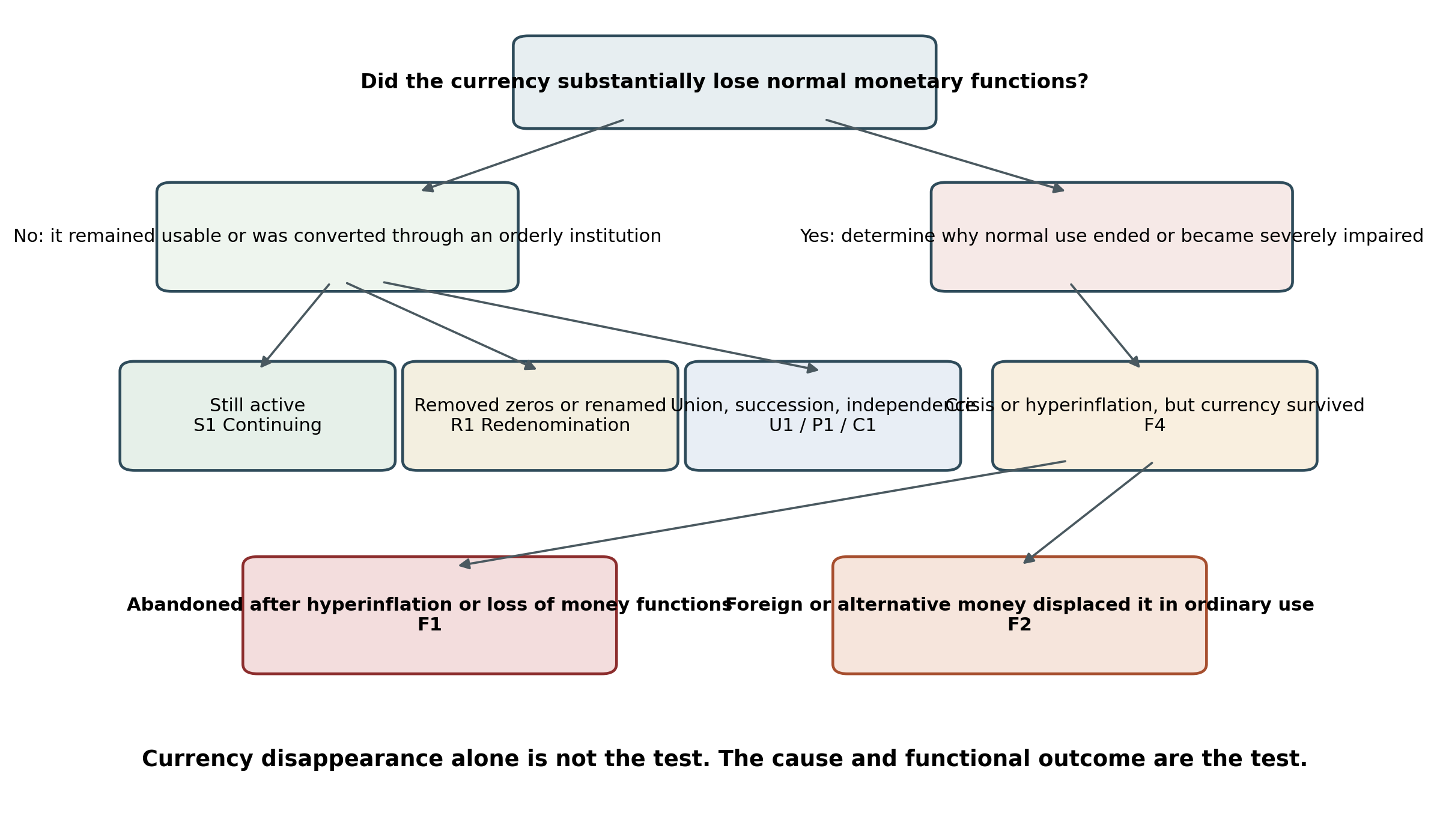
- The appropriate question is not whether a currency name ended, but why normal monetary use ended.
- The strongest public resource is a transparent case database, not a universal slogan. Every included observation should expose its classification, evidence, uncertainty, and alternative interpretation.
What is a currency failure?
The phrase sounds self-explanatory until one tries to count cases. A banknote can cease circulating because it became nearly worthless, because a state joined a monetary union, because a country removed three zeros, because an empire dissolved, because a government introduced a new design, or because a central bank converted old notes into an equivalent new unit. Treating all of these events as one category destroys the information needed to understand them.
A functional definition
This research uses the following working definition:
A currency failure occurs when a monetary unit substantially loses one or more core functions—unit of account, generally accepted means of payment, settlement instrument, or usable store of nominal value—and is abandoned, forcibly replaced, or displaced because the supporting monetary institutions can no longer sustain ordinary use.
This definition does not require every price to be quoted in another currency before failure can be recognized. Nor does it define every inflationary loss as failure. It asks whether the monetary system has stopped performing its coordinating functions and whether replacement is a consequence of that breakdown.
Four distinctions are essential.
Currency failure versus inflation
Inflation is a rise in the general price level. A currency can experience moderate or even high inflation and continue to serve as the unit in which wages, taxes, contracts, loans, and accounts are written. Whether that performance is acceptable is a separate economic and political question. Calling every cumulative decline in purchasing power “failure” makes gradual inflation indistinguishable from a currency that cannot price tomorrow’s lunch.
Currency failure versus currency crisis
The IMF literature usually identifies a currency crisis through a speculative attack, sharp depreciation, reserve loss, or policy defense involving interest rates or exchange controls. Such a crisis may be devastating, but the national unit can survive it. The Mexican peso, Thai baht, Indonesian rupiah, Russian ruble, and Argentine peso have each suffered severe crises without every episode ending the currency itself. (IMF currency-crisis study; IMF 2025 crisis catalogue)
Currency failure versus redenomination
A redenomination changes the unit in which prices are expressed. Ten thousand old units might become one new unit. The conversion can follow successful disinflation, continuing instability, or administrative modernization. It does not, without additional evidence, show that the currency was rejected. Turkey’s 2005 removal of six zeros followed disinflation; Venezuela’s repeated redenominations occurred amid continuing collapse. The identical arithmetic operation can therefore represent different institutional realities. (IMF WEO change notes)
Currency failure versus institutional replacement
The Deutsche Mark, French franc, Italian lira, Dutch guilder, and other euro predecessors did not vanish because stores refused them or their tax systems collapsed. Their exchange rates against the euro were irrevocably fixed, financial systems converted, and cash was withdrawn through an organized legal changeover. The euro project can be criticized or defended on many grounds, but calling each legacy currency a hyperinflationary failure falsifies what happened. (ECB conversion rates; ECB changeover history)
The fiat currency outcome taxonomy
The following taxonomy is designed for counting, comparison, and editorial consistency.
| Code | Outcome | Definition | Count as monetary failure? |
|---|---|---|---|
| F1 | Hyperinflationary destruction | Extreme price instability renders the unit unusable and it is abandoned or replaced because normal monetary functions collapse | Yes |
| F2 | Public rejection and currency substitution | Domestic money is displaced in pricing, saving, and payment by foreign or alternative money | Usually, if functional displacement is durable |
| F3 | Fiscal-state collapse | The issuer loses effective tax, administrative, territorial, or political capacity and the currency collapses with it | Yes, while preserving the political cause |
| F4 | Severe currency crisis; currency survives | Hyperinflation, crash, or banking crisis occurs, but the currency continues or recovers | Crisis, not currency death |
| R1 | Redenomination without automatic failure | Unit is rescaled or renamed without demonstrated loss of normal monetary use | No |
| R2 | Stabilization reform after crisis | Successor unit is introduced as part of ending high inflation or institutional breakdown | Case-specific; prior unit may have failed |
| P1 | Political succession or reunification | Currency ends because the state, federation, or constitutional issuer changes | Not automatically |
| U1 | Monetary-union replacement | National currency converts into a common currency at a legal rate | No, absent independent collapse |
| C1 | Independence or sovereignty transition | New state establishes a currency or adopts another after decolonization or independence | Not automatically |
| S1 | Continuing currency | Unit remains in normal monetary use at the review date | No; observation is right-censored |
| H1 | Hybrid or disputed | Evidence supports several classifications or the transition is incomplete | Preserve uncertainty |
The taxonomy does not resolve every case mechanically. Yugoslavia combined hyperinflation, war, sanctions, federation breakup, and repeated dinar reforms. The Soviet ruble area involved state dissolution, price liberalization, shared monetary institutions, and later national currencies. A useful database must be able to say hybrid rather than forcing a clean answer.
Research method and database scope
The accompanying file is an audited case corpus, not a claim to have identified every currency ever issued. That limitation is deliberate.
What the corpus contains
The first version includes 146 records covering:
- the original 56 Hanke–Krus hyperinflation episodes;
- later hyperinflation additions identifiable from open abstracts;
- national currencies converted into the euro;
- prominent redenominations and stabilization reforms;
- political-succession, reunification, and independence transitions;
- dollarization and public-rejection cases;
- a set of continuing modern currencies included to expose the denominator problem.
What one row represents
A row can represent a hyperinflation episode, a currency transition, or a continuing currency. It is therefore not valid to total all rows and call the result “the number of currencies.” The record_type field tells users what the observation represents.
Why the corpus does not publish a universal failure rate
A valid failure rate would require a complete population of eligible currencies, a fixed definition of fiat money, consistent start dates, a uniform end event, and treatment of still-active units. No such universally accepted global register exists. ISO 4217 provides authoritative current and historical currency codes, but a code is a data standard—not a theory of monetary identity or failure. (SIX, ISO 4217 maintenance)
Confidence labels
High confidence means the core transition and classification are directly supported by official or scholarly sources. Medium confidence means the event is documented but the best outcome category is contestable or monetary conditions were hybrid. Low confidence would be used where primary evidence is missing; no record should be presented as precise merely to fill a table.
Important limitation in the updated hyperinflation count
The open Hanke–Krus working paper provides a complete 56-row table. Later open abstracts identify several additions and report 71 total episodes as of 2026, but this research did not locate one freely accessible consolidated table exposing all 71 rows and source notes. The corpus therefore includes the original 56 and only later additions identifiable by name from accessible sources. It does not invent the missing intermediate records. (2026 abstract)
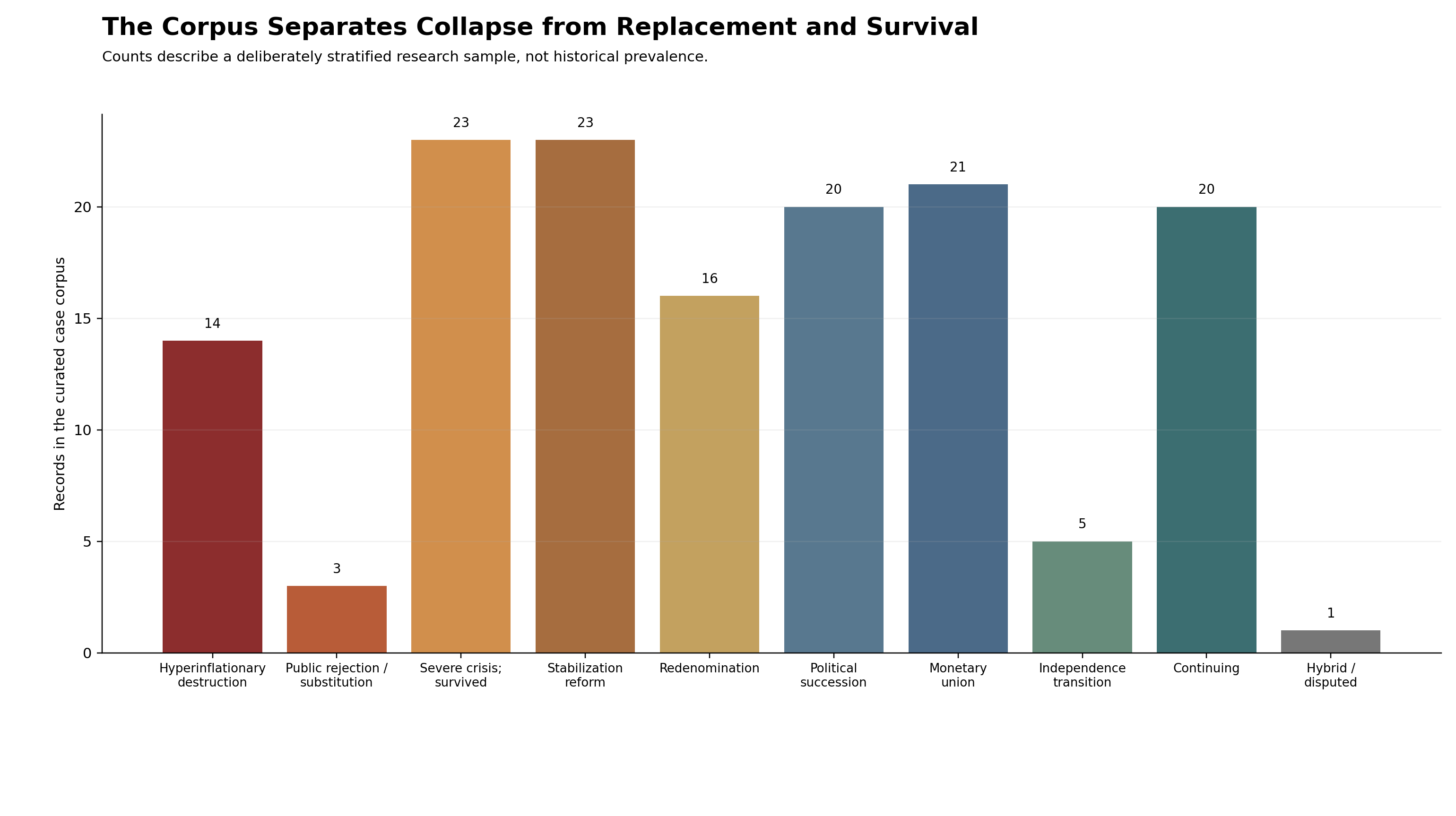
Figure 2. Outcome counts in the 146-record research corpus. These counts describe the editorial sample, not the historical prevalence of each outcome.
Auditing the “152 failed fiat currencies” claim
The 152-currency statistic spread because it offers a memorable picture: many dead currencies, short lifespans, and a single lesson. Its weaknesses become apparent when the entries are treated as historical observations rather than decorative proof.
It confuses currencies with outcomes
The infographic’s basic category is “failed fiat currency,” but many ended units were replaced for reasons unrelated to hyperinflation. Euro adoption, political unification, state succession, or a routine redenomination can all make a currency code historical. Counting them as identical failures guarantees a large number before any economic analysis begins.
It treats peaceful euro conversion as collapse
A national currency that was exchanged into euros at a legally fixed rate did not “go to zero.” Holders did not wake to find that a French franc or Deutsche Mark had no conversion value. The unit stopped being the accounting and cash standard because governments had agreed to use a common currency. The conversion may have had distributional and political effects, but it was not hyperinflationary destruction.
It mistakes denominations for independent currencies
Currency histories frequently reuse names such as peso, dinar, mark, franc, ruble, and dollar. Removing zeros may generate a new ISO code. A list can inflate its currency count by treating each denomination as an unrelated monetary experiment while simultaneously describing a long-lived currency name as one continuous object when convenient.
It has no transparent denominator
Even a perfectly classified list of 152 failed currencies would not establish that every fiat currency fails. How many qualifying currencies survived? How many were active when the list was compiled? How many commodity, representative, occupation, private-bank, or hybrid instruments were excluded? Without a denominator, the list is a collection of cases rather than a probability.
It counts episodes as if they were lives
A country can cross a hyperinflation threshold more than once. Taiwan appears three times in the original Hanke–Krus episode table; Germany appears in 1920 and again in 1922–1923; Congo/Zaire, Georgia, Peru, Bulgaria, Turkmenistan, and Yugoslavia also have multiple episodes. Adding episodes does not tell us how many unique currencies were born and died.
Verdict
The claim is not reliable enough to publish as a global statistic. The infographic is useful as a claim artifact—evidence that the number circulates—not as evidence that 152 properly defined fiat currencies died from hyperinflation.
Auditing the “775 currencies and 27-year average” claim
The 775-currency statistic has been repeated in gold, cryptocurrency, and investment commentary for years. The publicly visible article usually cited for it says that a study of 775 fiat currencies found an average lifespan of 27 years and divides outcomes into hyperinflation, war, independence, monetary reform, and continuing legal tender. It does not provide the underlying 775-row data, the identity of the study, a codebook, or a survival-analysis method. (Visible claim page)
The source cannot be reproduced
A responsible lifespan statistic should allow a reader to inspect every observation. At minimum, it needs currency name, issuer, start date, end date, monetary regime, reason for ending, and treatment of active currencies. None of that is available in a downloadable dataset on the claim page.
“Independence” and “monetary reform” are not failures by definition
If a colony becomes independent and introduces a national currency, the colonial unit’s disappearance may say nothing about inflation or monetary credibility. If a country removes zeros after stabilizing prices, the reform can be evidence of previous instability but not proof that the new system began from complete monetary death.
The mean is sensitive to how currencies are split
Suppose one country uses a “peso” for 100 years but redenominates it four times. Treating that history as five currencies produces five short lives. Treating it as one currency lineage produces one long life. Neither is neutral; the research question must determine the unit of observation.
Active currencies cannot be handled as deaths
The dollar, pound, franc, yen, krona, rupee, and other active units have no observed end date. They are right-censored in survival-analysis terms. Omitting them makes the sample look shorter-lived. Assigning the compilation date as their death falsely treats continued use as failure.
Verdict
The 27-year figure should not be published as a fact unless the complete data and methodology become available and survive audit. The correct editorial wording is:
A widely repeated commercial claim says 775 fiat currencies averaged 27 years, but the public source does not expose the currency-level dataset or a reproducible method. It is therefore unverified.
What the Hanke–Krus table does—and does not—show
The Hanke–Krus table is a much stronger research product because it asks a narrower question and defines the threshold. It begins from Philip Cagan’s convention: a price-level increase of at least 50 percent per month. Under the table’s method, an episode ends when monthly inflation falls below the threshold and remains there for at least a year. The authors identify dates, peak rates, currencies, and price measures. (Hanke and Krus, pp. 10–14)
An episode is not a currency
The table’s location column can repeat. Its currency column may identify the Russian ruble circulating in a newly independent state, an occupation note, a wartime unit, or more than one currency in circulation. The authors themselves emphasize that the listed currency may not have been the only one used in that location.
A threshold is not an outcome classification
Crossing 50 percent monthly inflation establishes an episode under the chosen definition. It does not tell us whether the unit survived, whether a central bank continued, whether the currency was redenominated, whether a state dissolved, or whether the public permanently adopted foreign money.
Some currencies survived hyperinflation
The Bulgarian lev crossed the threshold in 1991 and 1997, then stabilized under a currency-board system and remained Bulgaria’s currency until euro adoption in 2026. The Armenian dram, Kazakh tenge, and Congolese franc also illustrate that a currency name or unit can continue after a threshold episode. Hyperinflation is a monetary catastrophe; it is not a synonym for legal extinction.
Later additions improve the episode count, not the universal failure claim
Later research added Venezuela, another Zimbabwe episode, occupied-Poland cases, Lebanon, Suriname, Łódź Ghetto cases, and, in a 2026 abstract, episodes in Zambia, the CFA franc zone, and Belarus. This expansion shows how difficult historical discovery and measurement can be. It does not convert the table into a census of “all fiat currency lives.”
The denominator problem
Every claim that “X percent of fiat currencies fail” requires a population of currencies at risk. That population is hard to define.
What is one currency?
Consider five possible rules:
- Name rule: every uninterrupted name is one currency.
- Unit rule: every redenomination is a new currency.
- ISO-code rule: every alphabetic code is one currency.
- Issuer rule: every change of state or central bank begins a new currency.
- regime rule: every commodity, convertible, suspended, currency-board, or fiat phase is a new observation.
The same monetary history yields radically different counts under each rule. Sterling looks ancient under the name rule, much younger under a modern-fiat-regime rule, and divisible into several institutional systems under an issuer-and-convertibility rule.
Which instruments qualify as fiat?
A nineteenth-century convertible banknote is not modern fiat money. A debased coin can be fiduciary or token money without full separation from a metallic standard. A colonial currency board issues local notes against a foreign anchor. A private bank deposit is credit money denominated in a fiat unit. A complete census must decide which of these are included and when their fiat phase begins.
Which endings qualify as failure?
If every legal replacement is a failure, euro adoption and reunification dominate the count. If only hyperinflationary abandonment qualifies, banking and dollarization crises may be missed. If any large devaluation qualifies, the same surviving currency can “fail” repeatedly.
Survivors and right-censoring
An active currency has a known start under the chosen definition but no observed end. Survival analysis can incorporate that information. A simple arithmetic mean of dead currencies cannot. The absence of right-censoring is one of the clearest signs that a purported lifespan statistic is not measuring what readers think it measures.
Cohort effects
Many currencies began after empires dissolved, colonies gained independence, or socialist federations broke apart. A sample dominated by twentieth-century state creation will naturally contain many young currencies even when none has failed. Age structure is not failure probability.
Original survival-analysis framework
A defensible future global study should use event-history methods rather than a dead-currency average.
Step 1: Freeze the unit of observation
Choose one of three publishable units:
- Legal unit: a defined monetary unit under a particular statute and issuer.
- Institutional regime: a unit under one convertibility and central-bank framework.
- Currency lineage: a family of linked units that preserves legal or public continuity across redenominations.
Publish results under more than one rule rather than pretending one is natural.
Step 2: Define entry
Possible entry dates include first legal issue, first general circulation, establishment of the issuer, end of commodity convertibility, or last major redenomination. The study should report sensitivity to alternative entry dates.
Step 3: Define terminal events
Use competing risks rather than one death code:
- functional failure;
- monetary union;
- political succession;
- independence transition;
- administrative redenomination;
- continuing observation.
Step 4: Include active currencies
Active units are right-censored at the review date, not labeled immortal and not discarded.
Step 5: Publish the data
Each row needs a source trail, classification confidence, and notes explaining edge cases. Code should reproduce every summary table and survival curve.
Step 6: Report sensitivity
A robust result should survive reasonable changes in start rules, failure rules, territorial grouping, and treatment of hybrid currencies. If the headline changes from 20 years to 100 years when euro conversions are reclassified, the classification—not monetary physics—is driving the result.
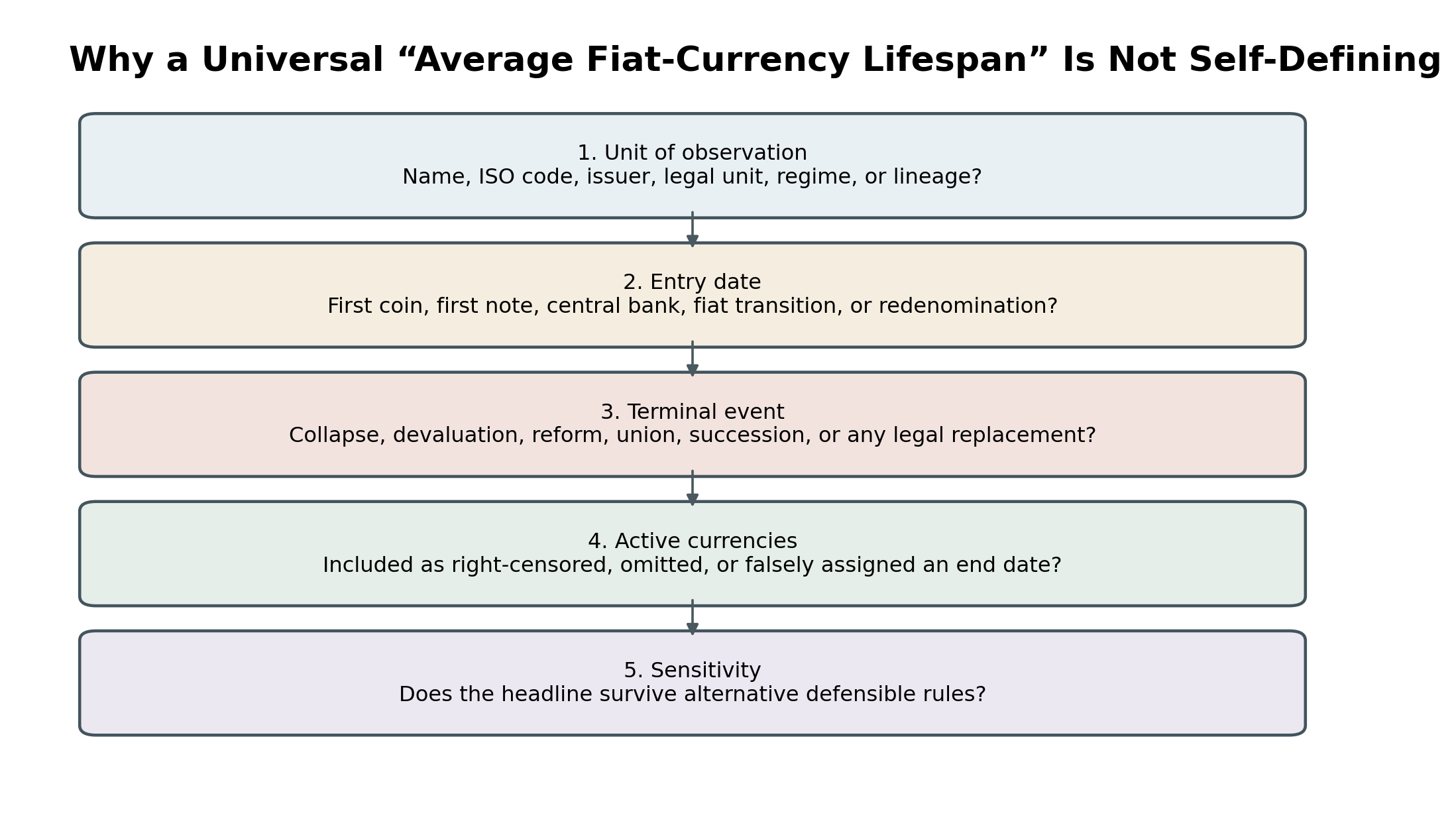
Figure 3. A universal “average lifespan” cannot be interpreted without four prior decisions: what counts as one currency, when it begins, what counts as failure, and how active currencies are handled.
Genuine fiat-currency failure mechanisms
The rejection of bad statistics should not minimize real disasters. Monetary collapse can destroy savings, contracts, fiscal administration, and the information system on which an economy depends. The evidence points to interacting mechanisms.
1. Fiscal failure
A government that cannot collect sufficient real revenue, borrow on sustainable terms, or reduce expenditure may turn increasingly to central-bank financing or quasi-fiscal operations. Inflation then erodes the real value of taxes collected with a delay, weakening the fiscal position further. This feedback loop is sometimes called the Olivera–Tanzi effect. In Zimbabwe, the IMF reported that government revenue and expenditure collapsed in real dollar terms in 2008 while quasi-fiscal operations were monetized. (IMF Zimbabwe consultation)
Fiscal failure does not mean every deficit causes hyperinflation. Governments issue debt, tax, borrow in domestic currency, and operate central banks under many regimes. The danger becomes acute when liabilities cannot be funded through ordinary channels, the tax base contracts, maturity shortens, confidence falls, and money creation is used to cover a widening real resource gap.
2. Political and state failure
War, revolution, occupation, civil conflict, and state dissolution dominate the historical table. Hungary’s 1946 catastrophe followed war and destruction. The wartime Greek drachma, Japanese occupation notes in the Philippines, Chinese wartime and civil-war currencies, Yugoslav dinars, Republika Srpska dinar, and coercive ghetto currency all operated under extreme political conditions.
Political authority matters because money is embedded in taxation, courts, public payrolls, banking supervision, and territorial control. When the state cannot enforce contracts or collect taxes across its territory, monetary policy cannot be isolated from the broader collapse.
3. Productive collapse
Money buys claims on goods and services. If agricultural output, industry, transport, electricity, or imports collapse while nominal spending continues, the price system faces a real shortage. Zimbabwe’s crisis included profound falls in production and public services. Wartime hyperinflations combine monetary financing with destroyed supply, rationing, occupation, and trade disruption.
“Too much money chasing too few goods” is directionally useful but incomplete. Research must ask why money expanded, why goods contracted, why people refused to hold the currency, and which institutions prevented correction.
4. External-balance failure
Foreign-currency debt, import dependence, falling export receipts, reserve exhaustion, and an overvalued peg can produce a currency crisis. Depreciation raises the domestic-currency burden of dollar or euro debt, damaging banks, firms, and government finances. The resulting balance-sheet contraction can feed fiscal support, capital controls, and further depreciation.
This mechanism explains why a currency can experience a severe crisis without hyperinflation or extinction. It also explains why public money demand may shift toward foreign currency long before domestic notes formally disappear.
5. Banking and financial failure
Banks connect deposit money, payments, government debt, foreign currency, and central-bank settlement. Hyperinflation erodes deposits and shortens balance sheets. Currency depreciation can bankrupt borrowers with unhedged foreign liabilities. Government attempts to freeze or convert deposits can accelerate flight from the banking system.
Reinhart and Savastano found banking crises across the modern hyperinflation cases they examined and emphasized the long-lived damage to financial intermediation. Dollarization often persists even after inflation falls because confidence in domestic financial claims recovers slowly. (IMF Finance & Development)
6. Monetary and expectations failure
As inflation accelerates, people reduce domestic cash balances, spend faster, demand foreign currency, index contracts, and shorten the interval between payment and repricing. That decline in money demand raises velocity and makes a given amount of monetary financing more inflationary. Businesses stop trusting posted prices, employees demand more frequent payment, and taxes arrive after their real value has eroded.
“Confidence” is often used as a vague explanation. Here it means concrete behavior: refusing long maturities, converting deposits, pricing in another unit, demanding cash in advance, or no longer accepting domestic money without immediate repricing.
Case study: Weimar Germany
Germany’s 1922–1923 hyperinflation is the most famous example, but not the largest. The Hanke–Krus table places its peak monthly inflation at 29,500 percent in October 1923, with prices doubling in roughly 3.7 days. Hungary in 1946 and Zimbabwe in 2008 were more extreme by the table’s peak-rate measure. (Hanke–Krus table)
The crisis cannot be reduced to a government randomly deciding to print. Germany emerged from war with fiscal weakness, political conflict, reparations obligations, and a contested distribution of losses. The Ruhr occupation and passive-resistance policy intensified expenditure and output disruption. The Reichsbank accommodated government and private credit while money demand collapsed.
Stabilization involved the Rentenmark, limits on its issue, fiscal measures, an end to passive resistance, and a broader change in expectations about the policy regime. Sargent’s classic comparison of interwar stabilizations emphasizes that durable disinflation depended on credible changes to fiscal and monetary arrangements, not merely the cosmetic replacement of paper. (Sargent, “The Ends of Four Big Inflations”)
Classification: the Papiermark’s 1922–1923 episode is a strong F1/R2 case—functional destruction followed by stabilization reform. Germany’s one-month 1920 threshold episode, however, did not kill the currency; it belongs in F4, illustrating why episode and death cannot be equated.
Case study: Hungary, 1945–1946
Hungary experienced the highest peak rate in the original table. In July 1946, the monthly rate is reported as 4.19 × 10^16 percent, with prices doubling in about 15 hours. The postwar economy faced destroyed production, fiscal collapse, reparations, occupation costs, and a monetary system unable to anchor prices.
The pengő ceased to be a usable unit. Hungary introduced the forint in August 1946 within a broader stabilization. This is the clearest kind of case for a failure database: the old unit’s monetary functions collapsed, the public could not use it as a stable accounting standard, and a successor currency replaced it after institutional reform.
Classification: F1 — hyperinflationary destruction. The case does not establish that all fiat currencies have a similar lifespan. It establishes that a state emerging from war can destroy a monetary unit when fiscal, productive, and institutional collapse reinforce monetary financing.
Case study: Yugoslavia, 1992–1994
Yugoslavia’s hyperinflation combined federation breakup, war, sanctions, fiscal fragmentation, production loss, and monetary financing. The table records a peak monthly rate of 313 million percent in January 1994. Republika Srpska experienced a parallel episode with its own dinar.
The word “dinar” continued across reforms, which creates a counting trap. A name-based database might treat the entire lineage as one currency. A code-based database might count every reform as a new currency. A functional database should identify the 1992–1994 unit as destroyed while preserving the political succession that produced multiple issuers and successor systems. (Petrović, Bogetić, and Vujošević)
Classification: the hyperinflating federal dinar is F1, while some successor changes are also P1. The case is both monetary failure and state disintegration.
Case study: Zimbabwe, 2007–2009
Zimbabwe offers unusually direct evidence of public rejection. The original official consumer-price series stopped before the final explosion; Hanke and Kwok used an implied exchange rate derived from a cross-listed share to estimate later inflation. The Hanke–Krus table reports a peak monthly rate of 7.96 × 10^10 percent in mid-November 2008 and a price-doubling time of about 24.7 hours.
The IMF described much more than rising banknote denominations. Quasi-fiscal operations, weak central-bank governance, collapsing revenue, falling production, shrinking public services, frozen foreign-currency deposits, and exchange restrictions formed one crisis. By late 2008, local-currency deposits had nearly disappeared and foreign currencies dominated transactions. In early 2009, official multicurrency use recognized a process already occurring in practice. (IMF, 2009 consultation; IMF, “Challenges and Policy Options”)
Repeated redenominations failed because removing zeros did not change the fiscal and institutional regime. Dollarization stopped the domestic hyperinflation but did not automatically restore production, governance, credit, or public finances.
Classification: F2, with a strong F1 component—functional destruction followed by public rejection and foreign-currency substitution.
Case study: Venezuela
Venezuela crossed the Hanke–Krus threshold in late 2016. The country later removed five zeros in 2018 and six more in 2021. IMF data documentation records the unit changes, but a redenomination is not itself the explanation. The crisis involved fiscal dependence on oil, production decline, exchange controls, monetary financing, political conflict, emigration, shortages, and collapsing confidence in the bolívar. (Venezuela hyperinflation paper; IMF WEO unit changes)
The bolívar name survived multiple reforms while its units changed. This is exactly why “currency name” and “currency life” are unstable categories. A holder’s purchasing power could be devastated even though the government continued to issue a bolívar.
Classification: the bolívar fuerte is F1/R2; the continuing lineage is a sequence of reforms under persistent crisis rather than one clean death date.
Case study: Argentina
Argentina demonstrates the difference among hyperinflation, currency reform, a currency board, sovereign default, and later peso crises. The austral crossed the hyperinflation threshold in 1989–1990 and was replaced by the peso at 10,000 australes per peso. The Convertibility Plan then tied the peso to the U.S. dollar under a currency-board-like legal framework.
The 2001–2002 collapse involved public debt, recession, banking restrictions, balance-sheet mismatches, political instability, and the abandonment of the parity. Yet the peso continued. Calling every later depreciation a new currency death would make the same unit fail repeatedly without ever disappearing. (IMF Independent Evaluation Office, Argentina)
Classification: the austral’s end is F1/R2. The 2001–2002 peso event is a severe F4 currency and banking crisis, not the legal death of the peso.
Case study: Ecuador and official dollarization
Ecuador announced dollarization in January 2000 after a banking and exchange-rate crisis. The sucre was converted at 25,000 per U.S. dollar. Official dollarization removed the domestic unit and its independent monetary policy, but it did not make every fiscal or banking problem disappear. (IMF speech; IMF conversion record)
Was the sucre a failed currency? The answer is stronger than for euro conversion because public confidence, depreciation, and banking distress motivated the switch. Yet the conversion was a legal policy choice at a fixed rate, not a Zimbabwe-style disappearance into barter and foreign notes before any formal decision.
Classification: F2/R2 — public rejection and official currency substitution following systemic crisis.
Case study: Lebanon
Lebanon’s crisis intertwined sovereign default, a banking system heavily exposed to the state and central bank, multiple exchange rates, deposit restrictions, fiscal weakness, political paralysis, and a sharp fall in the Lebanese pound. Hanke identified a 2020 hyperinflation episode under a parallel-market PPP method. Whether one accepts every high-frequency estimate or not, the broader functional deterioration is clear: extensive dollar pricing, restrictions on access to deposits, and fragmented exchange rates weakened the pound’s monetary roles.
The pound nevertheless remains legal and continues to circulate. That makes Lebanon an important boundary case. A currency can be functionally impaired, heavily substituted, and subjected to enormous depreciation without a single legal abolition date.
Classification: F2/H1 — substantial currency substitution and institutional impairment, with continuing legal use.
Hyperinflation is not the only path to failure
A currency can be rejected before reaching 50 percent monthly inflation. A fixed exchange-rate and banking crisis can produce dollarization. A state can lose territory and tax capacity. A government can force conversion into another unit. The Hanke–Krus threshold is useful because it is precise, but a failure database should not use it as the sole gate.
Conversely, crossing the threshold does not guarantee permanent abandonment. Bulgaria stabilized the lev; Armenia retained the dram; Kazakhstan retained the tenge; and Poland retained the złoty after stabilization and later redenomination. A global failure taxonomy must therefore record both the crisis and what happened after it.
Cases that should not be called failures
Euro legacy currencies
Twenty-one national currencies in the present 21-member euro area ended through staged adoption. The dates differ, and Bulgaria’s entry on January 1, 2026 is a live-check item at publication. The common characteristic is legal conversion into a monetary union, not hyperinflationary repudiation. (EU countries using the euro)
| Legacy outcome | Currency ended? | Public monetary collapse? | Political/institutional cause | Failure classification |
|---|---|---|---|---|
| French franc converted to euro | Yes | No | Monetary union | U1, not failure |
| Deutsche Mark converted to euro | Yes | No | Monetary union | U1, not failure |
| Italian lira converted to euro | Yes | No | Monetary union | U1, not failure |
| Croatian kuna converted to euro | Yes | No | Monetary union | U1, not failure |
| Bulgarian lev converted to euro in 2026 | Yes | No independent collapse at conversion | Monetary union | U1, not failure |
East German mark
The Deutsche Mark became legal tender in the German Democratic Republic on July 1, 1990 under the monetary, economic, and social union treaty. The GDR mark did not end because a monthly price index crossed a universal threshold. It ended as part of reunification. (Bundesbank)
Czechoslovak koruna
After Czechoslovakia dissolved, a brief common-currency arrangement ended and separate Czech and Slovak currencies began on February 8, 1993. The Czech National Bank describes the separation as successful. This is a political-succession event, not evidence that fiat currency expires after a short life. (Czech National Bank)
Administrative redenominations
A country can remove zeros while preserving contracts at a fixed legal ratio. The accounting unit changes; the value of every properly converted balance does not. Redenomination may reveal a history of inflation, but its occurrence cannot be the definition of failure. Ghana, Romania, Turkey, Zambia, Mauritania, São Tomé and Príncipe, and others have changed units without each experiencing a contemporaneous currency death.
Why some fiat currencies remain comparatively durable
Durability is not permanent price constancy. A currency can lose purchasing power gradually, experience recessions, float against other currencies, and survive major policy errors while continuing to perform its monetary functions.
Tax and fiscal capacity
A durable currency is embedded in a state able to levy and collect taxes, make payments, enforce obligations, and refinance debt. Fiscal capacity supports demand for the unit and limits reliance on inflationary finance. It is not equivalent to commodity redemption.
A credible settlement system
Banks and payment institutions need a final settlement asset and operational infrastructure. Currency durability depends on the ability to transfer claims at par, clear payments, provide liquidity in crises, and maintain confidence that bank money can convert into central-bank money.
Monetary-policy credibility
Credibility does not mean a central bank never misses an inflation target. It means the public expects the institution and political system to respond when inflation threatens the unit’s usefulness. Legal mandates, operational tools, transparency, and a record of correction all matter.
Banking regulation and lender-of-last-resort capacity
Commodity systems do not remove bank runs. Modern fiat systems can provide emergency liquidity, but support becomes dangerous if it preserves insolvent institutions, finances fiscal deficits without limit, or socializes foreign-currency losses. Durable systems separate liquidity support, solvency resolution, and fiscal responsibility as far as institutional realities allow.
Productive and political capacity
Money ultimately provides access to goods, labor, assets, and public obligations. An economy with productive capacity, political legitimacy, and deep markets can sustain demand for its currency even after shocks. A state losing territorial control, production, and tax administration cannot solve those problems through note design.
Network effects and international use
Widespread use lowers transaction costs and creates demand because others are expected to accept the same unit. Reserve-currency status can strengthen liquidity and foreign demand, but it is not immunity. International use can also create external liabilities and political constraints.
What happens when a currency genuinely collapses?
The consequences appear in a sequence, though not every case follows the same order.
Prices become short-lived information
Businesses reprice frequently or quote in a foreign currency. Posted prices cease to coordinate production and consumption because the unit changes too quickly.
Payment intervals shrink
Workers seek daily or indexed wages. Suppliers demand prepayment. Credit periods disappear. Taxpayers delay remittance while governments accelerate collection.
Saving leaves the domestic unit
Households move toward foreign cash, durable goods, gold, property, inventories, or offshore accounts. This is not irrational hoarding; it is an attempt to avoid a nominal claim that is rapidly deteriorating.
Banks shrink and fragment
Deposits lose real value, maturities shorten, and foreign-currency liabilities create insolvency risk. Payments may continue, but intermediation and long-term credit contract.
Accounting breaks down
Financial statements, tax assessments, budgets, and contracts become difficult to interpret. Historical-cost accounts can show fictitious profits. Courts struggle with nominal obligations written before the collapse.
Currency substitution becomes self-reinforcing
Once wages, rents, imports, savings, and wholesale prices move into another unit, domestic money demand may not recover immediately after stabilization. The foreign currency has acquired a network of its own.
Distributional effects are severe and uneven
Fixed nominal claims and cash savings are destroyed fastest. Debtors may benefit in nominal terms but lose jobs, collateral, and access to credit. People with foreign assets, real property, or political access to official exchange rates can be protected or enriched. A single inflation number hides these transfers.
How hyperinflations and currency failures end
Fiscal stabilization
The government must close the financing gap through revenue, expenditure reform, debt restructuring, external support, or some combination. If central-bank financing continues because the fiscal problem is unresolved, a new note inherits the old problem.
Monetary regime change
Options include money-growth limits, an exchange-rate anchor, a currency board, dollarization, central-bank reform, or a credible interest-rate framework. No anchor is self-enforcing; each requires fiscal and political support.
Banking repair
Insolvent banks, frozen deposits, and foreign-currency mismatches must be resolved. Otherwise the payment system remains impaired and confidence shifts to cash or foreign banks.
Exchange-market unification
Multiple rates create rents, corruption, concealed taxes, and false accounting. Successful stabilizations often narrow or eliminate the gap between official and market rates.
Restoring money demand
People must believe the new regime will persist. That belief is built through observable policy, not slogans. Even after inflation falls, deposits and domestic-currency credit can remain depressed for years. (Reinhart and Savastano)
A new currency is neither necessary nor sufficient
Some stabilizations retain the old name. Others create a successor unit. The decisive question is whether the fiscal, monetary, banking, and political regime changed. Reprinting the same policy under a new design produces another failed reform.
Longest-lived fiat currencies: why a ranking is harder than it looks
Searchers often ask for the oldest fiat currency. The answer depends on what continuity means.
Name continuity
Sterling has a very long name lineage. But medieval silver accounting, gold convertibility, Bank Restriction, the classical gold standard, wartime suspensions, Bretton Woods, and modern floating fiat money are not one unchanged system.
Legal-unit continuity
The U.S. dollar dates to the Coinage Act of 1792 as a legal unit, but its metallic definition, bimetallic operation, greenbacks, gold convertibility, domestic gold restrictions, Bretton Woods role, and post-1973 regime changed. Dating “the fiat dollar” to 1792 would import pre-fiat history into a fiat-lifespan statistic.
Issuer continuity
A central bank may be founded after a currency name. Governments can change while the issuer remains. Monetary unions can preserve conversion continuity while ending national issuance.
Denomination continuity
Mexico’s “new peso” became simply the peso; Poland’s złoty retained its name after redenomination; Belarusian rubles have several unit generations. A code change does not answer whether the public understands the unit as continuous.
Defensible editorial answer
Do not publish a ranked list without declaring the continuity test. A safer conclusion is:
Several modern currency names and legal units have long histories, but no universal “oldest fiat currency” ranking is neutral because commodity standards, convertibility, issuers, redenominations, and political regimes changed at different dates.
Does every fiat currency eventually fail?
As a literal statement about an infinite future, the claim cannot be tested. Every political institution may eventually change, and a currency can end even in a peaceful monetary union. That philosophical possibility is not evidence of an economically determined expiration date.
As an empirical statement—“fiat currencies have a predictable short life and all end through collapse”—the claim is false or unsupported. Long-running units remain active. Many ended units were converted or replaced without functional failure. Genuine collapses share institutional pathologies rather than a common age.
The proper test is not whether a currency will exist forever. It is whether fiat status predicts collapse after controlling for war, state formation, fiscal capacity, banking systems, exchange regimes, political institutions, and economic development. The viral lifespan claims do not perform that test.
How the U.S. dollar fits the failure framework
The United States is not exempt from the failure taxonomy, but inflation, depreciation, reserve diversification, and federal default do not by themselves meet its functional-collapse test. The dedicated U.S. dollar collapse evidence review applies the framework to current fiscal, banking, settlement, international-use, and domestic currency-substitution indicators; What Backs the U.S. Dollar Today? explains the institutional supports that exist now.
Could the euro fail?
The euro is unusual because monetary authority is centralized in the Eurosystem while fiscal authority remains largely national. The sovereign-debt crisis demonstrated stresses created by that structure, but the currency continued. A euro failure could mean withdrawal of one member, fragmentation of the monetary union, conversion into successor currencies, inflationary loss of function, or technical payment-system breakdown. These are different events.
A member’s exit would not automatically prove that the euro itself had failed globally. A negotiated redesign could preserve the currency for remaining states. Once again, the outcome code matters.
Fiat currency, gold, and false comparisons
Currency-failure arguments often compare a list of paper units with gold. The comparison contains several category errors.
Gold is an asset and commodity that has persisted physically; a currency is a legal and institutional unit used for accounting and settlement. A gold standard can fail through suspended redemption, devaluation, banking panic, capital controls, or political abandonment even though the metal still exists. Conversely, a fiat currency can continue while losing purchasing power gradually.
The useful comparison is between monetary regimes, not between the physical survival of gold and the legal survival of a currency name. Relevant questions include adjustment mechanisms, banking stability, fiscal constraints, deflation risk, lender-of-last-resort capacity, international balance, and credibility.
Fiat currency, cryptocurrency, and collapse narratives
Bitcoin and other cryptocurrencies revived public interest in fixed supply, state authority, custody, and monetary rules. A cryptocurrency can continue to exist as software while losing liquidity, users, security, exchange access, or unit-of-account relevance. That is analogous to the distinction between legal existence and functional monetary use.
Stablecoins provide another instructive case. A dollar stablecoin is generally a private claim or token whose value depends on reserves, redemption, custody, banking access, and legal priority. Its failure would not necessarily be a failure of the dollar. The underlying unit and the private issuer must be classified separately.
Failure framework summary
| System | Failure mechanism | Observable warning signs | Why it is not sufficient alone |
|---|---|---|---|
| Fiscal | Revenue collapse, debt-market loss, monetary financing | Short maturities, arrears, central-bank claims, falling real tax receipts | Some high-debt states retain credible financing and taxation |
| Political | War, revolution, loss of territory or legitimacy | Competing issuers, capital flight, contract breakdown | Political change can also produce orderly succession |
| Productive | Output, exports, energy, or food supply collapse | Shortages, import compression, falling real wages | Supply shocks need not become monetary collapse if policy adjusts |
| External | Reserve loss, foreign debt, overvalued peg | Parallel-rate premium, sudden stop, depreciation | A currency can float and survive a crisis |
| Banking | Runs, insolvency, currency mismatch | Deposit flight, controls, nonperforming loans | Banking rescue can preserve the currency if fiscal costs are managed |
| Monetary/expectations | Accelerating financing and falling money demand | Indexation, rapid repricing, foreign-unit contracts | Expectations respond to the other institutional systems |
The framework’s purpose is diagnostic. It prevents “money printing” from becoming an all-purpose explanation while still recognizing that uncontrolled monetary financing is central in many hyperinflations.
Myth versus evidence
| Claim | Evidence-based assessment |
|---|---|
| Every fiat currency goes to zero | No complete dataset or coherent failure-rate analysis establishes this. |
| There have been exactly 775 fiat currencies | Widely repeated but unverified from a published row-level dataset. |
| Fiat currencies average 27 years | Unsupported without definitions, survivors, and censoring. |
| 152 currencies failed through hyperinflation | The viral infographic is not a reliable scholarly census. |
| Euro adoption proves national currencies failed | False; it was treaty-based conversion into monetary union. |
| Redenomination proves worthlessness | False; it can be administrative or part of successful stabilization. |
| Hyperinflation equals devaluation | False; one concerns prices, the other an exchange rate. |
| Currency crisis equals currency death | False; many currencies survive severe attacks and depreciation. |
| Printing alone explains every collapse | Incomplete; fiscal, political, banking, external, productive, and expectations channels interact. |
| Gold-backed money cannot fail | False; redemption can be suspended and banking or fiscal crises can occur. |
| A new note stops hyperinflation | False unless the policy regime changes. |
| Dollarization solves every problem | False; it removes one monetary channel but not fiscal, banking, debt, or productivity constraints. |
| The same currency name means one continuous system | False; names persist across standards, issuers, and redenominations. |
| Long-run inflation is identical to sudden collapse | False; speed, function, and institutional effects differ. |
| Hanke–Krus lists dead currencies | False; it lists threshold episodes. |
The full 40-claim audit is available in CSV format.
Quick reference
Frequently asked questions
Concise answers on currency collapse, hyperinflation, lifespan claims, redenomination, dollarization, gold, and active currencies.
What is fiat currency failure?
It is the substantial loss of a currency’s core monetary functions followed by abandonment, forced replacement, or durable displacement because the supporting institutions can no longer sustain normal use.
Do all fiat currencies eventually fail?
No historical dataset proves that all fiat currencies collapse, and many ended currencies were peacefully replaced. A claim about an infinite future is not an empirical failure-rate statistic.
How many fiat currencies have failed?
There is no authoritative universal count because “fiat,” “one currency,” and “failure” are defined inconsistently. A defensible count must publish every row and outcome category.
Is the 775-currency statistic real?
The number is widely repeated, but the public page usually cited for it does not provide a 775-row dataset or reproducible methodology. It should be treated as unverified.
Is the average fiat-currency lifespan 27 years?
That figure is not defensible without a complete population, consistent start and end dates, and treatment of active currencies. Averaging only ended units creates bias.
Did 152 fiat currencies fail through hyperinflation?
The viral infographic making that claim is not equivalent to the scholarly Hanke–Krus table and appears to mix peaceful replacements with genuine failures.
How many hyperinflations have occurred?
Hanke and Krus originally documented 56 episodes. A 2026 open abstract by Hanke and Saade reports that later additions bring their table to 71. Counts depend on the threshold, data quality, and episode-separation rule.
What is the standard definition of hyperinflation?
A common convention, associated with Philip Cagan, is at least 50 percent inflation per month. Later Hanke work specifies exceeding that rate for at least 30 consecutive days.
Is hyperinflation the same as currency collapse?
No. It is a severe inflation episode. Some currencies are abandoned; others survive, stabilize, or retain their names after reform.
Is devaluation the same as hyperinflation?
No. Devaluation or depreciation concerns the currency’s exchange rate. Hyperinflation concerns the domestic price level.
Does a currency crisis mean the currency failed?
Not necessarily. A currency can lose substantial exchange value, face a speculative attack, or require emergency policy and still continue functioning.
Does redenomination mean failure?
No. Redenomination changes the unit, such as converting 10,000 old units into one new unit. The monetary system may be stable, recovering, or still collapsing.
Did the French franc fail?
Not in the hyperinflationary sense when it was replaced by the euro. It was converted at a fixed legal rate during monetary union.
Did the Deutsche Mark fail?
No. It was converted into the euro after being a highly credible currency. The East German mark ended earlier through reunification, also not a standard monetary-collapse case.
Did the Czechoslovak koruna fail?
Its 1993 end followed peaceful state dissolution and an organized currency separation. That is political succession, not automatic monetary failure.
What was the worst hyperinflation?
By the peak monthly rate in the original Hanke–Krus table, Hungary in July 1946 was the most extreme, followed by Zimbabwe in November 2008.
Why do currencies collapse?
Common interacting causes include fiscal breakdown, monetary financing, war, political disintegration, production loss, banking crises, foreign-currency debt, capital flight, and collapsing demand for domestic money.
Is money printing always involved?
Rapid monetary financing is central in many hyperinflations, but explaining why it occurs and why money demand collapses requires fiscal, political, banking, external, and productive analysis.
Can gold-backed money fail?
Yes. Redemption can be suspended, parity can change, banks can fail, and governments can default or impose controls. Gold’s physical survival is not the same as a monetary regime’s survival.
What happens to savings during currency collapse?
Domestic cash and fixed nominal claims lose purchasing power rapidly. Outcomes differ for indexed claims, foreign currency, real assets, bank deposits, and debts.
What happens to debt during hyperinflation?
Unindexed domestic nominal debt can be eroded, but borrowers may lose income and collateral. Foreign-currency or indexed debt can become more burdensome. Legal interventions can alter contracts.
Why do people use dollars during crises?
They seek a more stable unit for prices, savings, and contracts. Once foreign-currency networks develop, substitution can persist after inflation falls.
What is dollarization?
It is use of a foreign currency, often the U.S. dollar, as a significant or official domestic monetary unit. It can be informal, partial, or official.
Does dollarization guarantee stability?
It removes independent domestic money issuance and currency risk against the adopted unit, but does not eliminate fiscal default, banking crises, political risk, or recession.
Can a failed currency recover?
The old unit may stabilize, be redenominated, or be replaced. Recovery requires credible fiscal, monetary, banking, and political change, not only new notes.
What is the oldest surviving fiat currency?
There is no neutral ranking without defining continuity. Currency names can long predate their modern fiat regimes and survive multiple standards or redenominations.
Where is the U.S. dollar risk analysis?
The U.S. dollar collapse evidence review separates inflation, depreciation, default, reserve-status loss, and true domestic monetary failure, then tests the relevant warning signs against dated official indicators.
Can the euro fail?
The union can face fragmentation or member-exit risk, but one member’s withdrawal, a sovereign crisis, and total loss of euro monetary function are different events.
Is cryptocurrency immune to currency failure?
No. A token can lose users, liquidity, security, exchange access, or monetary function even if its code continues to exist.
Why are fiat-lifespan charts unreliable?
They often omit survivors, confuse currencies with episodes, count peaceful replacements as failures, and fail to publish the underlying data.
Data publication and reproducibility
The following files accompany this article:
fiat-currency-outcomes-case-corpus.csv— 146 case records with outcome codes, evidence, sources, and notes.fiat-currency-outcomes-case-corpus.json— machine-readable version plus scope warning.fiat-currency-failures-claim-audit.csv— 40 recurring claims, verdicts, and evidence summaries.fiat-currency-failures-source-ledger.csv— 50 primary, official, scholarly, and claim-corpus sources.reproduce-fiat-currency-failures.py— validates files, regenerates summary tables and charts, and records corpus counts.
The corpus should be versioned. New rows must state whether they add a currency, an episode, or a transition. Corrections should never silently change a headline count.
Comparative outcome matrix: twenty cases that should not be collapsed into one statistic
The following table applies the taxonomy to a deliberately varied set of cases. Its purpose is not to rank suffering. It shows how identical treatment in a “dead currencies” list conceals the historical mechanism.
| Case | Monetary event | Did ordinary monetary use collapse? | Why the unit ended or changed | Classification |
|---|---|---|---|---|
| Hungarian pengő, 1946 | Record hyperinflation and replacement by forint | Yes | War destruction, fiscal breakdown, monetary financing | F1 |
| German Papiermark, 1923 | Hyperinflation and Rentenmark stabilization | Yes | Postwar fiscal-political crisis and regime change | F1/R2 |
| Zimbabwe dollar, 2008–2009 | Hyperinflation, public rejection, multicurrency use | Yes | Quasi-fiscal financing, output and revenue collapse | F2/F1 |
| Yugoslav dinar, 1992–1994 | Hyperinflation during war and state breakup | Yes | War, sanctions, fiscal fragmentation, financing | F1/P1 |
| Argentine austral, 1989–1992 | Hyperinflation and replacement by peso | Yes | Fiscal-debt crisis and stabilization reform | F1/R2 |
| Argentine peso, 2001–2002 | Convertibility collapse and banking crisis | Severely impaired, but continued | Debt, recession, bank controls, parity failure | F4 |
| Ecuadorian sucre, 2000 | Official dollarization | Substantially | Banking and exchange-rate crisis, public distrust | F2/R2 |
| Lebanese pound, 2020s | Multiple rates, banking restrictions, dollarization | Partly and unevenly | Sovereign, banking, fiscal, political crisis | F2/H1 |
| Bulgarian lev, 1997 | Hyperinflation followed by currency board | Temporarily impaired; survived | Banking-fiscal crisis and stabilization | F4 |
| Armenian dram, 1993–1994 | Hyperinflation in transition | Impaired; survived | Post-Soviet transition and conflict | F4 |
| Kazakh tenge, 1993 | Threshold episode around introduction | Impaired; survived | Ruble-area breakup and transition | F4 |
| Polish złoty, 1989–1990 | Hyperinflation and stabilization | Impaired; survived name lineage | Transition and fiscal-monetary reform | F4/R1 |
| French franc, 1999–2002 | Irrevocable conversion into euro | No | Monetary union | U1 |
| Deutsche Mark, 1999–2002 | Irrevocable conversion into euro | No | Monetary union | U1 |
| Croatian kuna, 2023 | Conversion into euro | No | Monetary union | U1 |
| East German mark, 1990 | Replaced by Deutsche Mark | No general hyperinflation at changeover | Reunification | P1 |
| Czechoslovak koruna, 1993 | Split into Czech and Slovak currencies | No | Peaceful state dissolution | P1 |
| Turkish lira, 2005 | Six zeros removed | No contemporary collapse | Administrative redenomination after disinflation | R1 |
| Ghanaian cedi, 2007 | Four zeros removed | No contemporary collapse | Administrative redenomination | R1 |
| U.S. dollar, active | Continuing fiat currency | No | Observation has no end date | S1/right-censored |
Three lessons follow from the matrix.
First, the end of a unit and the failure of a monetary system are separate variables. The French franc ended; the Argentine peso survived. Yet the Argentine crisis was plainly more destructive than the franc-to-euro conversion. A database based only on whether a code moved to an historical list would reverse the economic meaning.
Second, continuity can coexist with enormous loss. The name “peso,” “ruble,” “dinar,” or “złoty” can survive devaluation, default, redenomination, banking restrictions, and political transition. A dataset that counts only formal disappearance understates crises in continuing currencies. A dataset that calls every crisis a death overstates the number of currencies.
Third, currency reform has to be evaluated as a sequence. A redenomination introduced after fiscal stabilization differs from repeated zero removal while monetary financing continues. Both may create a new code, but only the institutional sequence tells readers whether the reform restored money demand.
What this database can support—and what it cannot
The corpus is suitable for claim auditing, teaching, comparative case selection, and building a larger source-frozen census. It can answer questions such as:
- Which famous “failed currency” examples were actually euro conversions or political successions?
- Which hyperinflation episodes occurred in currencies that remained in use?
- Which reforms involved dollarization, redenomination, or a successor unit?
- Which source supports each classification?
- Where is classification confidence only medium?
It cannot responsibly answer:
- What percentage of all fiat currencies fail?
- What is the universal mean or median lifespan?
- Which current currency will fail next?
- Whether one monetary regime causes collapse independent of war, fiscal capacity, institutions, and development?
Those questions require a complete and explicitly bounded population. Version 1.0 is structured to make that future work possible without pretending it has already been completed.
Data-governance rules for future additions
Every future record should satisfy six rules.
- Name the observation. State whether it is a currency, episode, transition, or continuing unit.
- Use a direct source. A commercial infographic may identify a claim but cannot be the sole authority for a historical event.
- Separate facts from classification. The conversion date may be certain even when the outcome code is disputed.
- Preserve compound causes. War plus hyperinflation should not be reduced to a monetary-only label.
- Never infer failure from an ISO-code deletion alone. The standard records data history, not economic pathology.
- Publish revisions. If an outcome code changes, retain the reason, old value, source, and date.
These rules make the database less dramatic than viral graphics. They also make it useful.
Sources and methodology
Core hyperinflation research
- Steve H. Hanke and Nicholas Krus. “World Hyperinflations.” 2012 working paper; later Routledge chapter. https://ciaotest.cc.columbia.edu/wps/cato/0026280/f_0026280_21522.pdf
- Cato Institute. “World Inflation and Hyperinflation Table.” https://www.cato.org/research/world-inflation-and-hyperinflation-table
- Steve H. Hanke and Nicole Saade. “On Hyperinflation: New Evidence from Zambia, the Central African Franc Zone, and Belarus.” Open abstract reports 71 episodes. https://www.world-economics-journal.com/Papers/Monetary-Facts-and-Inflation.aspx?ID=901
- Carmen M. Reinhart and Miguel A. Savastano. “The Realities of Modern Hyperinflation.” Finance & Development 40, no. 2 (2003). https://www.elibrary.imf.org/view/journals/022/0040/002/article-A007-en.xml
- Stanley Fischer, Ratna Sahay, and Carlos Végh. “Modern Hyper- and High Inflations.” IMF Working Paper 02/197. https://www.elibrary.imf.org/view/journals/001/2002/197/article-A001-en.xml
- Thomas J. Sargent. “The Ends of Four Big Inflations.” https://www.nber.org/system/files/chapters/c11452/c11452.pdf
Crisis and currency-substitution research
- Carmen M. Reinhart and Kenneth S. Rogoff. “This Time Is Different: A Panoramic View of Eight Centuries of Financial Crises.” NBER Working Paper 13882. https://www.nber.org/papers/w13882
- Thomson Fontaine. “Currency Crises in Developed and Emerging Market Economies.” IMF Working Paper 05/13. https://www.imf.org/-/media/websites/imf/imported-full-text-pdf/external/pubs/ft/wp/2005/_wp0513.pdf
- IMF. “Currency Crises in the Post-Bretton Woods Era: A Catalogue.” 2025. https://www.imf.org/en/Publications/WP/Issues/2025/06/13/Currency-Crises-in-the-Post-Bretton-Woods-Era-A-Catalogue-567993
- IMF. “Currency Substitution in Developing Countries.” https://www.elibrary.imf.org/view/journals/001/1992/040/article-A001-en.xml
- Luis I. Jácome and Åke Lönnberg. “Implementing Official Dollarization.” IMF Working Paper 10/106. https://www.imf.org/-/media/websites/imf/imported-full-text-pdf/external/pubs/ft/wp/2010/_wp10106.pdf
Currency standards and peaceful transitions
- SIX Group, ISO 4217 Maintenance Agency. https://www.six-group.com/en/products-services/financial-information/market-reference-data/data-standards.html
- European Central Bank. “Determination of the Euro Conversion Rates.” https://www.ecb.europa.eu/press/pr/date/1998/html/pr981231_2.en.html
- European Union. “Countries Using the Euro.” https://european-union.europa.eu/institutions-law-budget/euro/countries-using-euro_en
- Deutsche Bundesbank. “German Monetary Union: Historical Background.” https://www.bundesbank.de/en/tasks/topics/german-monetary-union-historical-background-666890
- Czech National Bank. “Separation of the Czechoslovak Currency Was a Success.” https://www.cnb.cz/en/cnb-news/press-releases/4f948865-3a7c-11e8-a804-5254004e4603
Case-specific official research
- IMF. Zimbabwe 2009 Article IV conclusion. https://www.imf.org/en/news/articles/2015/09/28/04/53/pn0953
- IMF. “Zimbabwe: Challenges and Policy Options after Hyperinflation.” https://www.elibrary.imf.org/view/journals/087/2010/006/article-A001-en.xml
- IMF. “Zaïre’s Hyperinflation, 1990–96.” https://www.elibrary.imf.org/view/journals/001/1997/050/article-A001-en.xml
- IMF. “The Georgian Hyperinflation and Stabilization.” https://www.elibrary.imf.org/view/journals/001/1999/065/article-A001-en.xml
- IMF. “The Late 1990s Financial Crisis in Ecuador.” https://www.elibrary.imf.org/view/journals/001/2004/012/article-A001-en.xml
- IMF. World Economic Outlook database change notes. https://www.imf.org/en/Publications/WEO/weo-database/changes
Claim artifacts audited
- “152 Fiat Currencies That Failed Due to Hyperinflation.” Reddit infographic thread. https://www.reddit.com/r/Bitcoin/comments/8nwpo9/i_made_an_infographic_there_are_152_fiat/
- “The Failure of Money.” Business Insider republication of the 775/27-year claim. https://www.businessinsider.com/the-failure-of-money-2012-9
A full source ledger with evidentiary purpose and source tier is provided separately.
Evidence control
A case corpus, not a headline failure rate
The publication exposes 146 classified records, 40 recurring-claim verdicts, and a 50-source ledger. It distinguishes episodes, currencies, reforms, political transitions, monetary-union conversions, and continuing units.
Research reviewed: 26 August 2026. Active currencies are right-censored, and current crisis classifications require periodic review.